Naraka Chaturdashi 2026: Choti Diwali & Ritual
_Reviewed by Shri Ankit Bansal, Vedic Astrology Consultant with 15+ years of experience. As of 2026._
_Reviewed by Shri Ankit Bansal, Vedic Astrology Consultant with 15+ years of experience. As of 2026._
---
Naraka Chaturdashi 2026 falls on Thursday, October 29 — the 14th lunar day (Chaturdashi) of the dark fortnight (Krishna Paksha) in the month of Kartik. This is Choti Diwali (the small Diwali), observed one day before the main Diwali (October 30). Naraka Chaturdashi commemorates Lord Krishna's victory over the demon Narakasura and marks the liberation of 16,000 women held captive by the demon — one of the most celebrated victory events in Puranic mythology.
As of 2026, Naraka Chaturdashi is the 2nd day of the 5-day Diwali festival cluster: Dhanteras (October 28) → Naraka Chaturdashi (October 29) → Diwali (October 30) → Govardhan Puja (October 31) → Bhai Dooj (November 1). The ritual day centers on two practices: the Abhyanga Snan (ritualistic oil bath taken at a specific astronomical time) and the lighting of 14 earthen lamps at dusk, a practice specifically associated with protection from Yama (the god of death).
In South India — particularly in Andhra Pradesh, Telangana, Tamil Nadu, Karnataka, and Kerala — Naraka Chaturdashi is the primary Diwali equivalent. While North India celebrates Diwali on Amavasya night (October 30) as the main festival, South India considers Naraka Chaturdashi the climax. The celebration of Krishna's victory over Narakasura holds particular resonance in South India, as Narakasura is described in the Bhagavata Purana as the king of Pragjyotishapura — identified as the Assam-Bengal-Bihar region — whose southward conquests were defeated by Krishna.
Astrologically, Kartik Krishna Chaturdashi is one of the most potent days in the Vedic calendar for protective rituals. The 14th lunar day in the dark fortnight (Amavasya approaching) represents the moment of maximum darkness before the new moon. Lighting lamps at this moment — in honor of the goddess and as protection against Yama — carries the maximum symbolic power of light overcoming darkness. For your personal Panchang and auspicious timings on October 29, 2026, use the birth chart calculator.
What Is the Full Story of Krishna, Satyabhama, and Narakasura?
The Naraka Chaturdashi story is told in the Bhagavata Purana, Book 10, Chapter 59. It involves 3 primary figures: Krishna, his wife Satyabhama, and the demon Narakasura.
Narakasura (also called Bhaumasura — the son of Bhumi/Earth goddess) was the king of Pragjyotishapura. Despite being the son of the Earth goddess (a divine lineage), Narakasura descended into demonic behavior through the intoxication of power. He conquered the heavens (Indraloka) and stole the earrings of Indra's mother Aditi (Aditi's prized ear ornaments, a symbol of the theft of divine authority). He also abducted and imprisoned 16,000 women from noble families in his palace, holding them against their will.
Indra and Aditi appealed to Lord Krishna (at his court in Dwarka) for intervention. Krishna agreed to fight Narakasura. He flew to battle on his eagle vehicle Garuda, accompanied by his wife Satyabhama — who specifically requested to accompany him and participate in the battle. This was unusual because Krishna typically fought his battles alone or with his brother Balarama. Satyabhama's participation is the theologically significant element of this story.
The battle was fierce. Narakasura's army was formidable, and he fought with divine weapons. At one point in the battle, a weapon struck Krishna and he momentarily appeared to faint — at which point Satyabhama took up Krishna's bow and fought in his place, continuing the battle. Krishna then "awakened" and praised Satyabhama's valor. The moment when Satyabhama participated in the battle is why Naraka Chaturdashi is considered a day of female strength and the power of the devoted wife.
Krishna ultimately killed Narakasura. Before dying, Narakasura requested a boon: that his death day be celebrated with light, joy, and oil baths (Abhyanga Snan) — that his death not be remembered as a tragedy but as a liberation. Krishna granted the boon. The 16,000 imprisoned women were freed and, having no home to return to due to societal stigma, accepted Krishna's offer of protection and became part of his extended household — a social reform act by Krishna addressing the treatment of victims of abduction.
What Is the Abhyanga Snan and When Should It Be Performed?
Abhyanga Snan is the ritualistic oil bath that is the central physical practice of Naraka Chaturdashi. "Abhyanga" means oil application/massage, and "Snan" means bath. The practice involves applying sesame oil (or coconut oil) to the entire body before bathing — a practice that connects to both Ayurvedic health tradition and the Naraka Chaturdashi mythology.
The mythological basis: Narakasura's victory was celebrated by the gods and the freed women with an oil bath — washing away the pollution of the demon's era and beginning fresh. The Abhyanga Snan on Naraka Chaturdashi is a ritual reenactment of this cleansing.
The prescribed timing for Abhyanga Snan is one of the most specific in the Vedic calendar: it must be performed during the Chandrodaya (moonrise time) period on the morning of Naraka Chaturdashi — or before sunrise at the Brahma Muhurta (approximately 4 to 6 AM). The Bhagavata Purana specifies that the oil bath should be taken while the moon is still visible (i.e., before sunrise).
For October 29, 2026, moonrise in most of India will occur around 2:30 to 3:30 AM (as it is the Krishna Paksha Chaturdashi, the moon rises late at night/early morning). The ideal Abhyanga Snan time is therefore approximately 3 AM to 5:30 AM on October 29. The bath must be complete before the first rays of the Sun on that day.
Sesame oil is specifically prescribed for Abhyanga Snan (not coconut oil). Sesame oil's warming, deeply penetrating properties make it the Ayurvedic oil of transformation — aligned with Saturn's energy of removing the old to make way for the new. Some families add kumkum, turmeric, and sandalwood powder to the warm water.
Why Are 14 Lamps Lit on Naraka Chaturdashi?
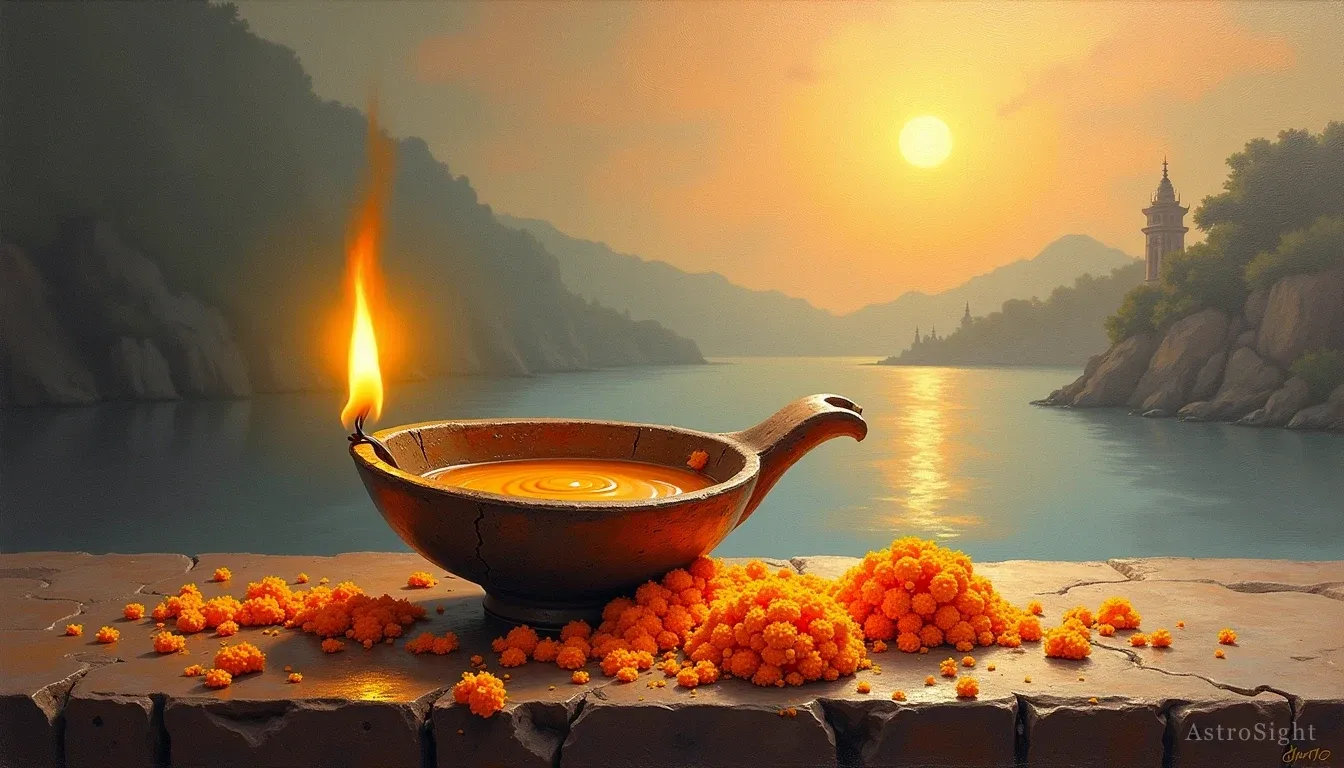
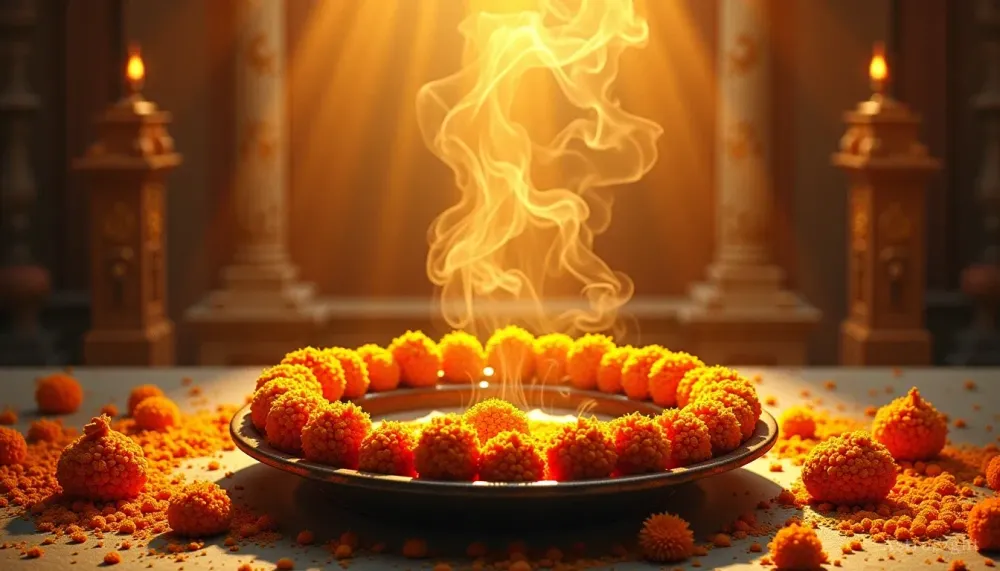
The lighting of 14 earthen lamps (Diyas) at dusk on Naraka Chaturdashi is the second key ritual of the day, distinct from the Abhyanga Snan (which is a morning practice). The 14 lamps are called Yama Deepam — lamps offered to Yama (the god of death) — and their purpose is protection from premature death and from the suffering of Naraka (the underworld) for the household members.
The number 14 corresponds to the Chaturdashi tithi (14th lunar day) on which this festival falls. There is a specific Vedic tradition: the diya lit on the 14th lunar day of the dark fortnight in Kartik month has the power to light the path of deceased ancestors in the afterlife and simultaneously protect the living from Yama's premature summons.
The 14 lamps are placed: 1 at the main door (facing south — toward Yama's direction), 1 at each corner of the house (4 corners), 1 at the kitchen, 1 at the bathroom, 1 at the threshold, 1 near the water source, 1 near the vehicle or stable, and the remaining lamps distributed at sacred spots within the house. In some traditions, all 14 are placed in a row facing south outside the main door.
The lamps are lit at dusk (approximately 30 minutes after sunset) and allowed to burn for at least 1 hour. They face south — Yama's direction — as an offering to death itself, requesting its benevolence toward the household.
What Is Yamadeepdaan and How Is It Different from Yama Deepam?
Yamadeepdaan is a separate practice observed on both Dhanteras (October 28) and Naraka Chaturdashi (October 29) in which a single large lamp is offered specifically for Yama at the main door — a dedicated act of honoring the god of death to ensure a peaceful death (when the time comes) and protection from untimely death for all household members.
Yamadeepdaan is a larger, more intentional lamp than the 14 Yama Deepam lamps. It is typically a large earthen diya filled with mustard oil (specifically mustard oil — not ghee — for Saturn and Yama-related purposes), with 4 wicks. It is placed at the south-facing main door after sunset, with a prayer to Yama recited.
The prayer is: "Mrityuna Pasha Danda Bhayam Panchatvamapi Chantakam / Nirakarayatu Devo Nirantaram Yama Deepam / Namo Yamaya Dharmarajaya Mrutyave Chantakaya / Vaivasvataya Kaalaya Sarvabhuta-Kshayaya / Audumbaraya Dadnaya Neelaya Parameshtine / Vrikodaraya Chitraya Chitragupta Namas' Tubhyam."
The Yamadeepdaan lamp is lit on both Dhanteras (Yama Deepan on Dhanteras is prescribed by many Dharmashastra texts) and on Naraka Chaturdashi — reinforcing the protective offering on both days of approaching Amavasya.
How Is the 5-Day Diwali Festival Structured?
The complete Diwali festival structure in 2026 is a 5-day arc from October 28 to November 1. Each day addresses a different dimension of human welfare.
| Day | Date (2026) | Festival | Primary Purpose |
|---|---|---|---|
| Day 1 | October 28 (Wed) | Dhanteras | Health, wealth, Yama Deepan; Dhanvantari worship |
| Day 2 | October 29 (Thu) | Naraka Chaturdashi | Victory over evil; Abhyanga Snan; 14 lamps |
| Day 3 | October 30 (Fri) | Diwali (Lakshmi Puja) | Wealth invitation; Amavasya night Lakshmi worship |
| Day 4 | October 31 (Sat) | Govardhan Puja | Nature gratitude; cow worship; Annakut |
| Day 5 | November 1 (Sun) | Bhai Dooj | Sibling bond; brother's longevity; Yama Dwitiya |
The 5-day structure moves from health and wealth (Dhanteras) → victory over inner demons (Naraka Chaturdashi) → abundance (Diwali) → gratitude to nature (Govardhan) → family protection (Bhai Dooj). This is a complete moral and practical framework for a flourishing household, not merely a cluster of arbitrary celebrations.
What Is the Significance of Narakasura's Death Request?
The most philosophically significant element of the Naraka Chaturdashi story is Narakasura's final boon: he asked that his death day be celebrated with light, joy, and oil baths — not mourned as a defeat but celebrated as a liberation.
This request reflects a profound Puranic worldview: even the demon, in his final moment of grace before dying, participates in the transformation. By requesting celebration rather than mourning, Narakasura acknowledges that his death removes an obstruction from the world and chooses to make that removal beautiful.
In Vedic theology, this is the moment of "dying into grace" — the Tamoguna (quality of darkness and obstruction) transforming into Sattvaguna (quality of purity and light) at the final moment. The Abhyanga Snan that devotees perform on this day is therefore not just a commemoration of external victory — it is a participation in this internal transformation: washing away one's own Narakasura-like tendencies (ego, hoarding, exploitation of others) and stepping into the light.
I have seen clients approach Naraka Chaturdashi as merely a social day of lights and sweets — but when they engage with the mythological layer and perform the Abhyanga Snan at the prescribed early morning time with genuine reflection on their own tendencies to hold others captive (through control, expectation, or emotional domination), they report a qualitative shift in their household dynamics in the months that follow.
How Do South Indian Communities Celebrate Naraka Chaturdashi?
In South India, Naraka Chaturdashi is the primary Diwali — the climax celebration — rather than the day before Diwali. This is because South India has a stronger cultural connection to the Bhagavata Purana's Krishna stories, and Narakasura's kingdom was in the eastern region (today's Assam/Bengal border), making Krishna's victory particularly significant as an act of liberation for the eastern/southern peoples.
The Abhyanga Snan in South India is performed with sesame oil mixed with ground kokum (a souring agent that symbolizes the removal of bitterness from life). In Tamil Nadu, the practice includes applying a small amount of oil to the head first, then having the oil worked into the scalp by the grandmother or mother of the household — a multi-generational bonding act.
Firecrackers in South India are set off primarily on Naraka Chaturdashi morning (after the Abhyanga Snan), not on Diwali night. The crackers celebrate Krishna's victory in the early morning hours — when the demon was killed (the mythological time is given as the Brahma Muhurta).
The Naraka Chaturdashi feast in Andhra Pradesh and Telangana includes Bobbatlu (the Telugu version of Puran Poli), Paramannam (sweet rice pudding), and Ariselu (sesame and jaggery sweet) — all items that appear in Krishna's festival traditions.
What Remedies Does Naraka Chaturdashi Offer for Astrological Difficulties?
Naraka Chaturdashi is specifically potent for remedies connected to the 8th house (longevity, obstacles, transformation) and to Saturn and Mars afflictions.
For Saturn-related challenges (Sade Sati, Saturn Mahadasha, or Saturn in difficult house positions): the Abhyanga Snan with sesame oil is a direct Saturn remedy — sesame is Saturn's sacred seed, and the oil bath on this day combines Saturn's remedy with the cleansing mythology of the festival.
For Rahu-Ketu challenges: lighting 14 earthen lamps facing south at dusk is a classical remedy for the Rahu-Ketu axis disturbance. The south direction and the Yama energy of this ritual specifically address Ketu's south-node, past-karma energy.
For Mars affliction (Mangala Dosha or Mars in malefic positions): the battle energy of Naraka Chaturdashi (Krishna's warrior manifestation in combat) is associated with Mars's positive protective quality. Lighting a ghee lamp to Hanuman on this morning — before the Abhyanga Snan — channels Mars energy into protection rather than conflict.
The companion article on Govardhan Puja 2026 covers the following day's celebration and its own astrological remedies, completing the full Diwali cluster's ritual framework.
Align Your Spiritual Path with Your Purpose
Your birth chart reveals your dharma — the path aligned with your soul purpose. Get expert analysis connecting spiritual direction with practical life choices.
Get Your Career Report
Shri Ankit Bansal
Vedic Astrologer · Numerology and Vastu Expert, 15+ Years
Shri Ankit Bansal is a renowned numerology and Vastu expert with over 15 years of specialized experience in these ancient Indian sciences. His extensive practice encompasses thousands of consultations in numerological analysis, name corrections, business numerology, and comprehensive Vastu assessments for residential and commercial properties. As a contributing writer for AstroSight, Shri Bansal combines his deep understanding of numerical vibrations with practical Vastu principles to provide holistic solutions that harmonize living and working spaces with cosmic energies. His expertise spans personal numerology charts, business name analysis, property Vastu audits, and remedial measures that blend traditional wisdom with modern lifestyle requirements. Through his methodical approach and proven track record, Shri Bansal has established himself as a trusted authority in helping clients optimize their environment and numerical influences for enhanced prosperity, health, and overall well-being.