

Govardhan Puja 2026: Date, Story & Annakut
_Reviewed by Shri Ankit Bansal, Vedic Astrology Consultant with 15+ years of experience. As of 2026._
_Reviewed by Shri Ankit Bansal, Vedic Astrology Consultant with 15+ years of experience. As of 2026._
---
Govardhan Puja 2026 falls on Tuesday, November 10 — the first day (Pratipada) of the bright fortnight (Shukla Paksha) in the month of Kartik. This is two days after Diwali (November 8) and the 4th day of the 5-day Diwali festival cluster. Govardhan Puja, also called Annakut Puja, celebrates Krishna's victory over Indra's ego and the beginning of the tradition of offering the Chappan Bhog — 56 food items — to Govardhan Hill as a substitute for Indra worship.
As of 2026, Govardhan Puja is observed across North India, particularly in Uttar Pradesh, Rajasthan, Delhi, and the Braj region around Mathura and Vrindavan. In Maharashtra, the same day is celebrated as Bali Pratipada (marking King Bali's annual return to the earth, granted by Lord Vamana/Vishnu) and in some regions as Padwa (the Marathi New Year — though the primary Marathi New Year is Gudi Padwa in Chaitra).
The significance of Govardhan Puja connects to agricultural and ecological themes: the festival honors Govardhan Hill, which provided shelter, water, and grass for the cows and people of Vrindavan. The worship of nature (the hill, the cows, and the ecosystem) over institutional power (Indra as the god of rain who demanded annual tribute) is the central message Krishna established through this act.
Astrologically, Kartik Shukla Pratipada follows the darkest night of the year (Diwali Amavasya). The Moon just begins to wax — the first sliver of the new cycle. Beginning an act of gratitude to nature on the very first day of the Moon's growth encodes the message that prosperity (the growing Moon, Shukla Paksha) flows from right relationship with the natural world, not from seeking institutional favor.
You can check your current planetary positions and auspicious times for Govardhan Puja 2026 at the birth chart calculator.
What Is the Full Story of Krishna Lifting Govardhan Hill?
The Govardhan story is told in full in the Bhagavata Purana, Book 10 (Dasham Skandha), Chapters 24 and 25. It is one of the most beloved narratives of Krishna's childhood in Vrindavan.
Each year, the people of Vrindavan performed a large yajna (fire ritual) and feast for Indra, the king of the gods, to ensure timely rains and good harvests. Young Krishna — approximately 7 years old at the time, though his divine age is not linear — asked his father Nanda Maharaj why this ritual was performed for Indra rather than for the hill Govardhan, which directly provided their daily needs.
Krishna argued: "Govardhan Hill gives us grass for our cows, wood for our homes, water from its streams, and shelter from storms. The cows give us milk, which gives us butter and ghee for our ceremonies. Our prosperity comes directly from Govardhan. Indra merely sends rain, which Govardhan catches and distributes. Let us honor the source we know and see — the hill, the cows, and the earth."
Nanda and the other elders were persuaded by the young Krishna's reasoning. They directed the offerings to Govardhan Hill instead. Indra, furious at the loss of his tribute, sent a 7-day storm over Vrindavan — torrential rains, wind, and flooding designed to destroy the village and punish its people.
Krishna responded by lifting Govardhan Hill with the little finger of his left hand — holding it aloft like an umbrella for 7 days and 7 nights while all the people of Vrindavan and their animals sheltered beneath it. Not a single drop of the storm reached them.
At the end of 7 days, Indra's storm spent itself and he descended to earth in his elephant Airavata to acknowledge Krishna as the Supreme Being (Purushottama) he had not recognized. Indra apologized, and Krishna restored the cosmic order — but the tradition of worshipping Govardhan Hill was established forever.
What Is Annakut and the Chappan Bhog Offering?
Annakut means "mountain of food" (Anna = food, Kut = mountain). The Chappan Bhog (56 food items offered to the deity) is the centerpiece of Govardhan Puja's Annakut tradition. The number 56 connects to Krishna's feeding schedule: as the lifter of Govardhan for 7 days, Krishna was said to have gone without eating for 7 days. To compensate, the cowherd women prepared 8 types of food for each of the 7 days (8 × 7 = 56), creating the Chappan Bhog.
The 56 food items in the traditional Chappan Bhog include: 12 types of sweets (Mithai), 8 types of savouries, 6 types of pickles (Achar), 5 types of chutneys, 5 types of fried items, 4 types of bread (Roti and Puri varieties), 4 types of dal, 4 types of rice preparations, 4 types of vegetables, and 4 types of drinks (milk-based preparations).
In temple practice — particularly at the Nathdwara temple in Rajasthan (the primary Govardhan Puja temple) and at ISKCON temples globally — the Annakut is presented as a mountain-shaped arrangement of food items before the deity, and all devotees receive prasad from this mountain.
In household practice, the Annakut puja is scaled to what the family can prepare — even 5 or 11 items presented as a symbolic Annakut is considered complete when offered with devotion.
How Do You Perform Govardhan Puja Vidhi at Home?
The Govardhan Puja vidhi at home centers on making a Govardhan Hill from cow dung (gobar) and performing the puja of that hill form.
Step 1: Early in the morning (before sunrise is ideal, but Pratah Kala — sunrise to 9 AM — is the prescribed window), prepare the Govardhan Hill. The hill is made by shaping fresh cow dung into a mound approximately 12 to 18 inches long and 6 to 8 inches high in the courtyard or outside the main door. The hill is decorated with flowers, grass, and small twig trees. A small Krishna idol (Bal Gopal) is placed at the center of the hill.
Step 2: Surround the hill with small cows, milkmaids (Gopi figures), and peacock feathers — representing the world of Vrindavan that the hill sheltered.
Step 3: Perform the puja of the Govardhan Hill with Shodashopachara (16 offerings) — flowers, incense, lamp, Naivedya (the Annakut food offerings), and water.
Step 4: Perform 7 Parikrama (circumambulations) of the Govardhan Hill in the clockwise direction while chanting "Govardhan Dharidhare Krishna Govinda Gopala."
Step 5: Perform the Aarti with ghee lamp.
Step 6: The Annakut food mountain is then presented to the hill-form of Govardhan. All family members receive prasad.
In cow-keeping households (particularly in villages), the cows are given a special bath, decorated with flowers and turmeric, and worshipped as part of the Govardhan Puja — reflecting the original story's connection to the protection of cattle.
What Is the Astrological Connection to Krishna's Birth Chart?
Krishna's birth chart is one of the most analyzed charts in Vedic astrology. According to classical sources and the Bhagavata Purana, Krishna was born at midnight on Ashtami (the 8th lunar day) of the dark fortnight (Krishna Paksha) in the month of Bhadrapada, under the Rohini Nakshatra with the Moon in Taurus.
The Moon in Rohini Nakshatra (Taurus) at birth gives Krishna his signature characteristics: beauty, creative abundance, love of cows and nature, and the ability to give material and emotional nourishment (Rohini's primary deity is Brahma the creator, and its symbol is a chariot — suggesting both creative power and the vehicle of divine purpose).
The Govardhan Puja connection: Rohini Nakshatra's lord is the Moon, and Taurus is the Moon's exaltation sign. A Moon in exalted Rohini represents the peak of nurturing power — the capacity to shelter and provide for many. Krishna's act of lifting Govardhan to shelter everyone is a perfect expression of this natal Moon energy in its most elevated form.
Vedic astrologers including B.V. Raman, in his analysis of divine charts in _Notable Horoscopes_, note that Krishna's Lagna (rising sign) is debated between Cancer (Moon sign rising) and Taurus — but in either case, the Moon in Rohini Taurus in the chart reflects the Govardhan story's essential symbolism.
What Are the Regional Celebrations of Govardhan Puja?
Govardhan Puja carries different names and emphases across India's regions.
| Region | Name | Key Celebration |
|---|---|---|
| Uttar Pradesh (Braj) | Govardhan Puja / Annakut | Primary celebration; cow dung hill, Chappan Bhog, parikrama |
| Rajasthan | Annakut at Nathdwara | Nathdwara's Srinathji temple famous for its large Annakut display |
| Maharashtra | Bali Pratipada / Padwa | Celebrates King Bali's annual return; husband honors wife with gifts |
| Gujarat | Bali Pratipada | Business new year; merchants close old accounts and open new ones |
| Punjab | Govardhan Puja | Celebrated similarly to North India; emphasis on cow worship |
| South India | Vishnu's Victory Day | Some communities celebrate it as Vamana's victory over Bali |
The Maharashtra celebration as Padwa (husband gifting wife) is particularly meaningful — the same day that marks Krishna's victory over Indra's ego (protecting the collective through love) is also marked in Maharashtra as the husband's act of acknowledging and honoring his wife.
What Is the Significance of 7 Days in the Govardhan Story?
The 7-day duration of the Govardhan lift carries numerical significance in Vedic tradition. The 7 days correspond to the 7 planets (Sapta Graha) of classical Vedic astrology: Sun, Moon, Mars, Mercury, Jupiter, Venus, and Saturn — the same 7 that give their names to the 7 days of the week.
Indra's 7-day storm represents the full force of all 7 planetary difficulties bearing down simultaneously. Krishna's ability to hold the hill for all 7 days symbolizes the divine power that transcends the entire planetary system.
The 7 Parikrama (circumambulations) of the Govardhan Hill performed during the puja ritually mirrors Krishna's 7-day protection. Each circumambulation corresponds to one planet's sphere being honored and brought into alignment with the worship.
Govardhan Hill in Braj (the actual hill in Uttar Pradesh, near Mathura) is circumambulated by pilgrims over 21 kilometers — a parikrama that takes 1 full day on foot. This physical parikrama is considered one of the most meritorious acts in the Vaishnava tradition.
What Is the Connection Between Govardhan Puja and Cows?
Cows are central to Govardhan Puja in both the mythological and ritual dimensions. The original story is explicitly about protecting the cows (Go-Raksham) — the life and economy of Vrindavan depended entirely on its cattle, and Indra's storm threatened to destroy them.
In the Vedic tradition, the cow is considered equal in sanctity to the mother — "Gau Mata" (mother cow). The 5 products of the cow (Pancha Gavya) — milk, curd, ghee, urine (gaumutra), and dung — are used in all major puja rituals as purifying agents. During Govardhan Puja, fresh cow dung is used to form the hill itself — the earth's most sacred substance shapes the representation of the most sacred hill.
Dairy farmers, cow-keepers, and agricultural communities across India treat Govardhan Puja as one of their most important annual festivals. The cows are bathed, decorated with flower garlands and coloured powder, fed their favorite food, and worshipped on this day.
For urban households, the connection is maintained symbolically — by using fresh cow dung for the hill form, by offering milk and ghee in the puja, and by donating to cow shelters (Gaushala) on this day.
How Does Govardhan Puja Connect to the Guru Purnima Calendar?
To understand the complete Vaishnava spiritual calendar that frames Govardhan Puja, see the companion article on Guru Purnima 2026 date significance and rituals, which covers the other major Vaishnava celebration of the year.
Both Guru Purnima and Govardhan Puja carry the same theological message: the direct relationship between the devotee and the divine (whether through the Guru or through nature as represented by Govardhan Hill) is more real and powerful than institutional religious hierarchy. Indra's claim to tribute and the traditional Guru hierarchy's claim to uncritical obedience are both gently subverted in these two festivals — replaced by direct, personal devotion.
Align Your Spiritual Path with Your Purpose
Your birth chart reveals your dharma — the path aligned with your soul purpose. Get expert analysis connecting spiritual direction with practical life choices.
Explore Our Reports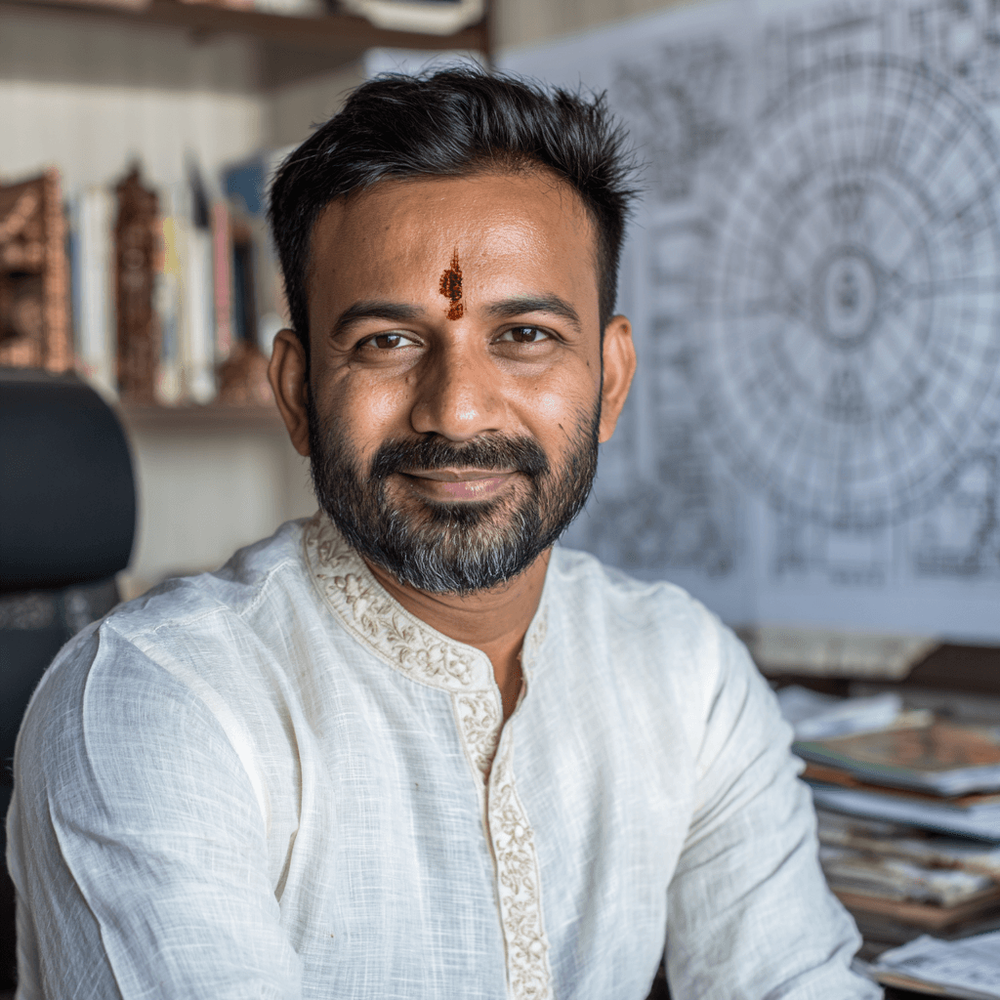
Shri Ankit Bansal
Vedic Astrologer · Numerology and Vastu Expert, 15+ Years
Shri Ankit Bansal is a renowned numerology and Vastu expert with over 15 years of specialized experience in these ancient Indian sciences. His extensive practice encompasses thousands of consultations in numerological analysis, name corrections, business numerology, and comprehensive Vastu assessments for residential and commercial properties. As a contributing writer for AstroSight, Shri Bansal combines his deep understanding of numerical vibrations with practical Vastu principles to provide holistic solutions that harmonize living and working spaces with cosmic energies. His expertise spans personal numerology charts, business name analysis, property Vastu audits, and remedial measures that blend traditional wisdom with modern lifestyle requirements. Through his methodical approach and proven track record, Shri Bansal has established himself as a trusted authority in helping clients optimize their environment and numerical influences for enhanced prosperity, health, and overall well-being.


