
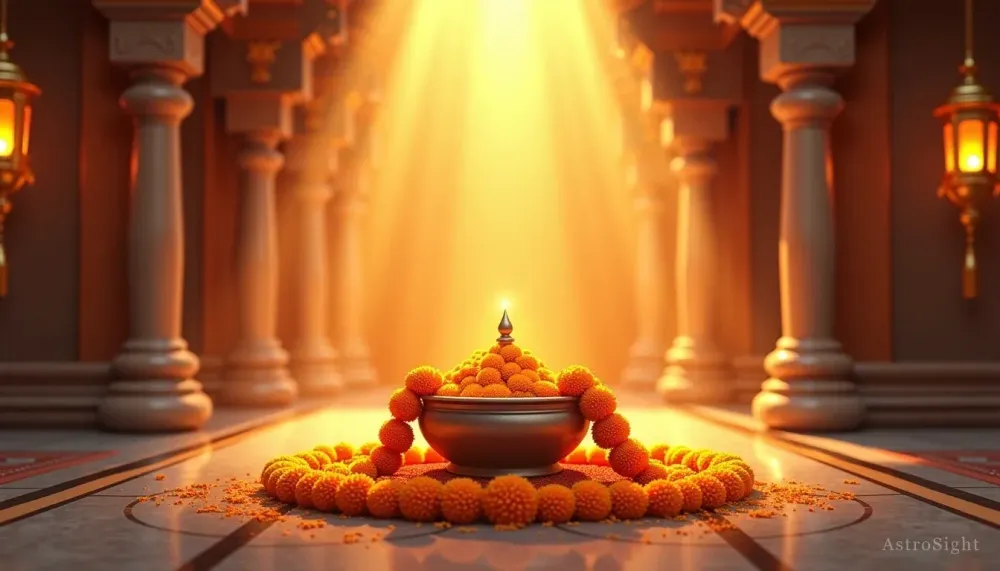
Gudi Padwa 2026: Marathi New Year Date & Tradition
_Reviewed by Shri Ankit Bansal, Vedic Astrology Consultant with 15+ years of experience. As of 2026._
_Reviewed by Shri Ankit Bansal, Vedic Astrology Consultant with 15+ years of experience. As of 2026._
---
Gudi Padwa 2026 falls on Thursday, March 19 — the first day (Pratipada) of the bright fortnight (Shukla Paksha) in the month of Chaitra, which is the first month of the Hindu lunisolar calendar. Gudi Padwa is the Marathi and Konkani New Year, celebrated with the raising of the Gudi (a decorated bamboo pole) outside the main entrance of every home. As of 2026, this festival aligns with the astronomical event of the Sun entering Aries from Pisces — marking the beginning of the solar new year as well.
Gudi Padwa is not just a regional Marathi festival — it is the beginning of the universal Hindu New Year as per the lunisolar Panchang. The same day is celebrated as Ugadi in Andhra Pradesh, Telangana, and Karnataka (Ugadi = "Yuga + Adi" = beginning of a new era), as Cheti Chand (Sindhi New Year), as Sajibu Nongma Panba (Meitei/Manipuri New Year), and as the first day of Chaitra Navratri across North India.
The significance of this date in Vedic tradition is that Brahma (the creator god) began the act of creation on Chaitra Shukla Pratipada. The first sunrise of the first day of the first month of the year is therefore the "original" sunrise — the prototype of all creation. Setting up the Gudi (which represents victory and auspiciousness) on this day invites the blessings of that original creative moment into the household.
The second traditional significance: according to the Ramayana, Lord Rama returned victorious from Lanka on this day (though other traditions place this differently), and the people of Ayodhya raised victory flags (Gudis) in celebration. In Shaka Samvat history (the Marathi calendar era), the Shalivahana king raised his Gudi of victory after defeating the Sakas — establishing the Shalivahana Shaka era that begins 78 CE.
For astrological muhurat calculations for March 19, 2026, use the birth chart calculator to generate the Panchang for your city.
What Is a Gudi and How Do You Set It Up?
A Gudi is the central symbol of Gudi Padwa — a bamboo pole decorated with specific auspicious items, erected vertically outside the main door of the home, facing east toward the rising sun.
The components of a properly constructed Gudi:
The bamboo pole: A fresh green bamboo stalk, at least 5 to 6 feet long, is used. Bamboo represents strength, flexibility, and rapid growth — it grows 30 times faster than most trees and recovers from cutting with renewed vigor. This makes bamboo the ideal symbol for the new year's aspirations.
Cloth (Vastra): A bright silk or cotton cloth — traditionally yellow, green, or red — is tied at the top of the bamboo. This cloth is called the Gudi Vastra and represents the warrior's banner raised in victory. Some families use a new saree piece purchased specifically for the occasion each year.
Neem leaves (Kadu Limb): A bunch of fresh neem leaves is attached just below the cloth. Neem is bitter — its presence at the top of the Gudi is a symbolic reminder that life contains both sweet and bitter, and the new year is welcomed with full acceptance of both.
Mango leaves (Aam Patra): Fresh mango leaves tied with the neem leaves represent prosperity, fertility, and auspiciousness. The combination of neem (bitter) and mango (sweet) is philosophically significant — no New Year's resolution can be complete without accepting the full spectrum of experience.
Marigold garland: Orange or yellow marigold flowers strung in a garland are wrapped around the upper portion of the pole. Marigold is the sacred flower of all Hindu festivals, and its golden color connects to the Sun's energy — appropriate for a New Year that begins with the Sun in Aries (his exaltation sign neighbor).
Sugar crystals (Gathi): A string of small sugar crystals (Sakhar Gathi) is hung on the Gudi. Sugar crystals represent sweetness, celebration, and the desire for a life filled with joy in the new year.
Copper or silver pot (Kalash): An upturned copper or silver pot is placed at the very top of the Gudi, above the cloth. The upturned pot represents fullness (the pot is so full it has turned over) and also the "crowned victory" symbolism — a pot on a pole was a traditional Indian symbol of a victorious army's standard.
The Gudi is set up facing east, outside the main door of the house, at sunrise. It is taken down before sunset (before the day's auspicious period ends).
What Is the Auspicious Muhurat for Gudi Padwa 2026?
The most auspicious time for setting up the Gudi on March 19, 2026 is the Pratah Kala — the morning window, ideally within the first 2 hours after sunrise.
March 19 sunrise time varies by city: approximately 6:25 AM in Mumbai, 6:17 AM in Pune, 6:30 AM in Nagpur, and 6:35 AM in Aurangabad. The Gudi should be raised in the first 30 minutes after sunrise — this is the most auspicious window for New Year activities as the first light of the New Year strikes the Gudi at the moment of its maximum potency.
If sunrise timing is not feasible, the morning Abhijit Muhurta (approximately 11:45 AM to 12:30 PM on March 19) is the secondary most auspicious window.
The Gudi should not be set up after sunset or during Rahu Kalam (check the daily Panchang for your city's specific Rahu Kalam timing, which varies by day and location).
What Is the Puja Vidhi for Gudi Padwa?
The Gudi Padwa puja follows a concise format that is complete within 30 to 45 minutes.
Step 1: Wake before sunrise. Take a ritual bath and wear new clothes — yellow (Sun's color), green (Chaitra month's spring color), or any bright auspicious color. Avoid white or black clothing on this day.
Step 2: Apply a rangoli (colored powder design) at the entrance of the home. The traditional Gudi Padwa rangoli features the Swastika, lotus, and peacock motifs.
Step 3: Construct and erect the Gudi as described above, facing east.
Step 4: Perform the puja of the Gudi: offer flowers (marigold), kumkum, turmeric, rice grains (akshat), and light a ghee lamp before the Gudi.
Step 5: Apply kumkum tilak to the base of the bamboo pole and to the copper pot at the top (by touching the pot with the tilak).
Step 6: Recite the Gudi Padwa prayer — "Savitri Brahmi Nikhila-Deva-Pratika / Brahmasampradaya Sarvashrestha Pratipadatithi / Asmin Varshe Sharira Aarogyam Dhan Sampada / Sarva Soubhagya Prapnoti Ity Asheervadaha" — or simply offer personal prayers for the new year.
Step 7: Eat the traditional Gudi Padwa Naivedya — neem leaves mixed with jaggery, tamarind, raw mango, and coconut (called Ugadi Pachadi in South India). This bitter-sweet mixture is eaten as the first food of the new year, symbolizing the acceptance of all of life's flavors.
What Are the Traditional Foods of Gudi Padwa?
The traditional Maharashtrian foods for Gudi Padwa reflect the abundance of early spring harvest.
Puran Poli: The most iconic Gudi Padwa sweet — a flatbread stuffed with a sweetened chana dal and jaggery filling, flavored with cardamom and nutmeg. Puran Poli is the centerpiece of the Gudi Padwa feast. It is served with ghee, milk or Katachi Amti (spiced dal made from the water strained from the Puran dal).
Shrikhand: Hung curd sweetened with sugar and flavored with saffron and cardamom, served with Puri. Shrikhand is considered auspicious for new beginnings as it is made from milk that has been transformed (curd → strained curd → shrikhand) — a metaphor for transformation and upliftment.
Neem-Jaggery Chutney (Gudi Padwa Prasad): A small amount of neem leaves mixed with jaggery, raw mango, and tamarind is the ritual first food of the day. Every family member eats a small portion before any other food — accepting the bitter-sweet nature of the coming year.
Soonth Panak: A spiced drink made from dry ginger (soonth), jaggery, and black pepper, traditionally consumed during Chaitra Navratri for its cooling-heating balance (dry ginger stimulates digestive fire while jaggery provides energy).
What Is Ugadi and How Does It Relate to Gudi Padwa?
Ugadi is the Telugu and Kannada name for the same New Year festival observed on the same day — Chaitra Shukla Pratipada. In 2026, both Gudi Padwa (Maharashtra/Goa/Konkan) and Ugadi (Andhra Pradesh, Telangana, Karnataka) fall on March 19.
The difference is primarily regional and linguistic, not calendrical:
| Festival | Region | Language | Key Food | Gudi/Flag? |
|---|---|---|---|---|
| Gudi Padwa | Maharashtra, Goa, Konkan | Marathi, Konkani | Puran Poli, Shrikhand | Yes — Gudi raised |
| Ugadi | Andhra Pradesh, Telangana | Telugu | Ugadi Pachadi, Pulihora | No — no flag raised |
| Ugadi | Karnataka | Kannada | Obbattu (Puran Poli equivalent) | No — no flag raised |
| Cheti Chand | Sindh/Sindhi community | Sindhi | Sai Bhaji | No |
The Ugadi Pachadi (the bitter-sweet 6-flavor chutney of neem, jaggery, raw mango, tamarind, green chili, and banana) is the South Indian equivalent of the Neem-Jaggery Prasad eaten in Maharashtra on Gudi Padwa.
Both Gudi Padwa and Ugadi include the community listening to the Panchanga Shravanam — the reading of the new year's Panchang (almanac) by a priest or astrologer, who forecasts the year's key events in agriculture, weather, politics, and individual matters based on the ruling planet of the new year.
What Is the Ruling Planet of the New Year 2026-2027?
Each Samvatsara (Hindu year) is ruled by a planet, which is determined by the Panchang calculation for Chaitra Shukla Pratipada. The ruling planet's qualities color the entire year's energy.
For Vikram Samvat 2083 (which begins on Gudi Padwa 2026, March 19), the Samvatsara name is Shrimukha. The ruling planet of the year is determined by the weekday on which Chaitra Shukla Pratipada falls — March 19, 2026 falls on a Thursday, making Jupiter (Guru) the year's ruling planet (Varshapati). Jupiter's rulership indicates a year favorable for education, dharma, spiritual growth, and wisdom-oriented endeavors. Jupiter years generally support marriage, birth of children, and guru-student relationships.
The Panchanga Shravanam reading on Gudi Padwa 2026 will elaborate on which aspects of Jupiter's blessing manifest most strongly in the year's first quarter (Chaitra-Jyeshtha), second quarter (Ashadha-Ashwin), and second half (Kartik-Phalguna).
What Is the Sade Sati Connection to Gudi Padwa?
Individuals currently in Sade Sati (Saturn's 7.5-year transit over the natal Moon sign) or in Saturn Dasha observe special precautions on Gudi Padwa, as the new year's beginning under Saturn's pressure can amplify the year's challenges.
For those in Sade Sati, the traditional practice is to perform a special Saturn propitiation on Gudi Padwa morning before raising the Gudi — offering sesame seeds and oil to a Shani (Saturn) image, chanting "Om Shanaishcharaya Namah" 108 times, and donating black sesame to the poor. This act converts the Sade Sati pressure into protective discipline for the new year.
For a complete understanding of how Sade Sati operates and whether you are currently in it, see the companion article at Sade Sati 7.5 year Saturn cycle explained.
What Is the Astrological Significance of Chaitra Shukla Pratipada?
Chaitra Shukla Pratipada carries profound astrological significance as the intersection of 3 new beginnings: the lunisolar New Year, the Sun's approach to exaltation, and the beginning of Navratri.
The Sun enters Aries (its neighbor to exaltation — the Sun exalts at 10 degrees Aries) around March 14-15, meaning that by March 19, the Sun is approximately 4 to 5 degrees into Aries — moving toward its exaltation point of 10 degrees. The new year begins with the Sun in a waxing, strengthening position in its own signification of self-expression and vitality.
The Moon is in Shukla Paksha (waxing phase) on this day — the first sliver of the new lunar cycle. The waxing Moon (Shukla Paksha) represents increase, growth, and initiation. Beginning the new year on the first day of the waxing Moon encodes "growth" as the year's fundamental direction.
Chaitra Navratri (the 9 nights of Goddess Durga worship) begins on the same day — Chaitra Shukla Pratipada. The 9 days that follow Gudi Padwa are dedicated to the 9 forms of Goddess Durga, culminating in Ram Navami (the birth of Lord Rama) on Chaitra Shukla Navami. The new year is therefore held in the protective container of the Mother Goddess's 9-day invocation.
Align Your Spiritual Path with Your Purpose
Your birth chart reveals your dharma — the path aligned with your soul purpose. Get expert analysis connecting spiritual direction with practical life choices.
Get Your Career Report
Shri Ankit Bansal
Vedic Astrologer · Numerology and Vastu Expert, 15+ Years
Shri Ankit Bansal is a renowned numerology and Vastu expert with over 15 years of specialized experience in these ancient Indian sciences. His extensive practice encompasses thousands of consultations in numerological analysis, name corrections, business numerology, and comprehensive Vastu assessments for residential and commercial properties. As a contributing writer for AstroSight, Shri Bansal combines his deep understanding of numerical vibrations with practical Vastu principles to provide holistic solutions that harmonize living and working spaces with cosmic energies. His expertise spans personal numerology charts, business name analysis, property Vastu audits, and remedial measures that blend traditional wisdom with modern lifestyle requirements. Through his methodical approach and proven track record, Shri Bansal has established himself as a trusted authority in helping clients optimize their environment and numerical influences for enhanced prosperity, health, and overall well-being.


