Brahmasthan in Vastu: Importance, Activation, Remedies
The Brahmasthan in Vastu Shastra is the central zone of any building — the geometric centre of a home, office or temple — and is considered by classical Indian Vastu the most spiritually significant and energetically sensitive space in the entire structure. Named after Lord Brahma (the creator deity
The Brahmasthan in Vastu Shastra is the central zone of any building — the geometric centre of a home, office or temple — and is considered by classical Indian Vastu the most spiritually significant and energetically sensitive space in the entire structure. Named after Lord Brahma (the creator deity, who resides at the centre of cosmic geometry in Vedic tradition), the Brahmasthan is treated as the cosmic axis of the building — the point through which divine energy circulates to nourish every other zone. Mayamatam (the foundational Vastu text, ~5th-7th century CE) explicitly states that the Brahmasthan should remain open, unobstructed, light-filled and free of heavy objects, walls, or active utilities. When the Brahmasthan is properly designed and maintained, residents typically report stronger family harmony, better sleep quality, smoother life flow, and improved financial stability; when it is blocked, polluted, or burdened, the documented effects include chronic family conflict, financial drain, and persistent low energy throughout the household.
If you have heard about the Brahmasthan and want to understand whether your house has Vastu issues at the centre, this guide walks through the full framework: what the Brahmasthan actually is in classical Vastu, why it is considered uniquely important, how to find your specific Brahmasthan, the documented effects of having it blocked, the standard Vastu remedies for problematic centre-zone configurations, the recommended colours and elements, the energising practices that maintain or restore Brahmasthan power, and the common construction mistakes that disturb this critical zone. Reviewed by Shri Ankit Bansal, Vedic astrologer with 12+ years of practice and 80+ home-Vastu consultations covering Brahmasthan-related issues across Indian metros. Use the birth chart calculator reading to identify whether your specific planetary positions amplify Brahmasthan effects.
What Is the Brahmasthan in Vastu Shastra?
The Brahmasthan in Vastu Shastra is the geometric centre of any building — the precise central point or central zone of a home, office, factory, or temple — treated by classical Indian Vastu as the residence of Lord Brahma, the creator deity who governs cosmic creative energy. The Brahmasthan is the most sensitive and most powerful zone in any Vastu-grid layout, and its proper design is considered the single most important factor in determining the building's overall energetic quality.
The Brahmasthan's structural significance:
| Aspect | Detail |
|---|---|
| Sanskrit name | Brahmasthan (literally "place of Brahma") |
| Position | Geometric centre of the building |
| Deity association | Lord Brahma (the creator deity) |
| Element | Akasha (space/ether) — the foundational fifth element |
| Direction | Centre (sometimes classified as the 5th cardinal point) |
| Role in Vastu Grid | The central cell of the 9-cell or 81-cell Vastu Purusha Mandala |
The Brahmasthan's relationship to the full Vastu structure:
- The Vastu Purusha Mandala — Classical Vastu maps any building onto a 9-cell or 81-cell grid, with each cell governed by a specific deity. The centre cell is Brahma; the surrounding cells correspond to the eight directions and their respective directional deities.
- Energetic gateway — All cosmic energy entering the building is believed to channel through the Brahmasthan before distributing to the surrounding zones.
- Heart-of-the-house metaphor — Vastu treats the Brahmasthan as the building's "heart" — the central pump that distributes vital energy throughout.
- Universal applicability — The Brahmasthan principle applies to homes, offices, factories, temples, and even individual rooms (each room has its own micro-Brahmasthan at its centre).
Classical text references:
- Mayamatam (Tantra of Mayamuni, 5th-7th century CE) — Devotes Chapter 7 to the Vastu Purusha Mandala and the Brahmasthan's central role.
- Manasara (another classical Vastu treatise, dated similarly) — Provides detailed rules for the Brahmasthan's size, openness, and design.
- Brihat Samhita by Varahamihira (6th century CE) — Includes chapters on architectural Vastu with Brahmasthan rules.
- Vishwakarma Vastu Shastra — A regional Vastu tradition with specific Brahmasthan calculations.
The Brahmasthan in modern apartment-living context:
- In independent houses, the Brahmasthan is clearly identifiable as the geometric centre.
- In apartments, the Brahmasthan can be calculated at multiple levels — the apartment's own Brahmasthan, the floor's Brahmasthan, and the building's Brahmasthan.
- For practical residential Vastu, the apartment's own Brahmasthan is the primary consideration.
- Multi-floor houses have separate Brahmasthans on each floor (some practitioners also calculate a building-wide vertical Brahmasthan).
The Brahmasthan should occupy approximately 1/9 to 1/81 of the total floor area depending on the building size — smaller homes have larger relative Brahmasthans; larger buildings have proportionally smaller ones. The exact proportion follows classical mathematical rules but practical application allows reasonable approximation.
How Important Is the Brahmasthan in Vastu?
The Brahmasthan is extremely important in Vastu — classical practitioners often describe it as the single most critical zone in any building, with its proper design determining 30-40% of the building's overall Vastu quality. The remaining 60-70% comes from directional placements, room functions, entrance position, and other Vastu factors — but no other single zone carries as much weight as the Brahmasthan. A perfect house in every other Vastu respect with a blocked Brahmasthan still produces problematic outcomes; an imperfect house with a clean, open Brahmasthan often produces unexpectedly positive outcomes.
The Brahmasthan's documented effects on residents:
- Strong, open Brahmasthan — Family harmony, smooth life flow, financial stability, good sleep, mental clarity, spiritual development.
- Blocked Brahmasthan — Family conflict, financial drain, chronic fatigue, sleep disturbances, mental restlessness, stalled life progression.
- Polluted Brahmasthan (toilets, drains, heavy storage) — Health issues, recurring illnesses, chronic stress, persistent low mood.
- Burdened Brahmasthan (heavy furniture, pillar, beam) — Sluggish progress, blocked opportunities, sense of being "stuck."
The 5 reasons the Brahmasthan matters disproportionately:
- Energetic gateway function — All cosmic energy entering the home passes through the centre; obstruction at the centre disrupts energy flow to every other zone.
- Multi-zone influence — Unlike the southwest (affects bedroom themes) or northeast (affects spiritual themes), the Brahmasthan affects every life area simultaneously through its central position.
- Brahma's deity authority — Lord Brahma's role as creator gives the central zone authority over all the building's creative-life-giving functions.
- Resonance and amplification — The Brahmasthan acts as a resonance chamber that amplifies whatever energy quality the building generates; clean Brahmasthan amplifies positive, polluted Brahmasthan amplifies negative.
- Practical observability — Brahmasthan effects are unusually directly observable; modifications produce measurable changes in resident experience within 30-90 days.
The classical Vastu-quality assessment hierarchy:
| Vastu factor | Approximate weight in overall building quality |
|---|---|
| Brahmasthan condition | 30-40% |
| Main entrance direction and design | 15-20% |
| Master bedroom (southwest) | 10-15% |
| Kitchen (southeast) | 8-12% |
| Pooja room / spiritual space (northeast) | 8-10% |
| Bathroom and toilet placements | 5-10% |
| Window and natural-light distribution | 5-8% |
| Other rooms and details | 5-10% |
The 30-40% weight assigned to the Brahmasthan reflects practitioner observation across hundreds of home consultations: when other Vastu factors are corrected but the Brahmasthan remains problematic, the overall improvement is limited; when the Brahmasthan is corrected even with other problems remaining, residents report substantial improvement.
The Brahmasthan's importance in commercial Vastu:
For businesses, offices, and commercial buildings, the Brahmasthan's importance is similar but with different specific significations:
- Strong Brahmasthan in offices — Smooth operations, low staff conflict, financial flow, business growth.
- Blocked Brahmasthan in offices — Operational difficulties, staff conflict, financial stagnation, growth stalling.
- Brahmasthan in retail — Customer flow patterns; sales energy; brand growth.
- Brahmasthan in factories — Production flow; equipment longevity; worker satisfaction.
The commercial Vastu observation: businesses with properly designed Brahmasthans (central atria, open-plan central spaces, light wells in the centre of large buildings) tend to outperform competitors with blocked Brahmasthans in matched comparisons.
How to Decide Brahmasthan in Vastu?
You decide the Brahmasthan in Vastu by identifying the geometric centre of your building — find the central point of the floor plan, then designate the central zone (approximately 1/9 to 1/81 of the total area, depending on building size) as the Brahmasthan. The calculation can be done from a floor plan with measurement tools, by direct in-home pacing and measurement, or through Vastu calculators that take floor dimensions as input.
The step-by-step Brahmasthan identification:
1. Get accurate floor plan dimensions — Length and width of each room and the overall structure. 2. Calculate the geometric centre — For a rectangular structure, the centre is at (length/2, width/2) from any corner. For irregular shapes, use the centroid of the floor-plan polygon. 3. Define the Brahmasthan zone — For a small home (under 1000 sq ft), the central 1/9 area. For larger homes, the central 1/16 to 1/25. 4. Mark physical boundaries — Identify what currently sits in the Brahmasthan zone. 5. Apply Vastu evaluation — Check the zone against Vastu rules (covered in next section).
For different building shapes:
| Shape | Brahmasthan identification |
|---|---|
| Rectangular | Geometric centre at intersection of diagonals |
| Square | Centre at intersection of diagonals |
| L-shaped | Geometric centre of the bounding rectangle (with adjustments for missing corner) |
| Irregular | Centroid of the floor-plan polygon |
| Multi-level | Separate Brahmasthan on each floor; vertical alignment also matters |
Practical measurement for in-home identification:
1. Measure the longest dimension (length). 2. Mark the halfway point along that dimension. 3. Measure the perpendicular dimension (width) from that halfway point. 4. Mark the halfway point along the width. 5. The intersection of these two halfway lines is the geometric centre. 6. The Brahmasthan zone extends approximately 1-3 metres (depending on home size) in each direction from this centre point.
For Mumbai-Bangalore-Delhi-style 2BHK apartments (typical 800-1200 sq ft), the Brahmasthan zone is typically a 2-3 metre square area at the geometric centre. For 3BHK apartments (1200-1800 sq ft), the zone is approximately 3-4 metres square. For larger independent houses, the proportion is smaller relative to total area but the absolute zone may be larger.
The vertical Brahmasthan consideration:
- In multi-floor houses, each floor has its own Brahmasthan at its respective geometric centre.
- The vertical line through all the centres is the "Brahmasthan axis."
- Heavy structures (stairs, pillars, beams) passing through the vertical Brahmasthan axis are problematic.
- Staircases passing directly through the Brahmasthan are documented as among the most disruptive Vastu defects.
The Brahmasthan in compound complexes:
- For gated communities or apartment complexes, the overall complex has a Brahmasthan at its geometric centre.
- Common areas, gardens, or central spaces ideally occupy this complex-level Brahmasthan.
- Individual apartments within the complex have their own Brahmasthans regardless of the complex layout.
If precise measurement is challenging, a Vastu professional consultation can identify the Brahmasthan accurately using floor plans and on-site verification. For DIY identification, smartphone apps for measuring rooms (using AR features) make the geometric-centre calculation increasingly accurate. Use the birth chart calculator alongside Vastu analysis to identify whether your individual chart factors particularly amplify Brahmasthan effects.
How to Find the Brahmasthan in Your House?
To find the Brahmasthan in your specific house, the practical method is to mark the geometric centre using physical measurement, identify what currently occupies that zone, and assess whether the current occupation aligns with Vastu rules. The process takes 30-60 minutes for a typical apartment and produces a clear picture of whether your Brahmasthan is supporting or disrupting your home's energy.
The DIY 6-step finding method:
1. Sketch your floor plan — Either roughly by hand or using a smartphone app. Include all rooms and major fixed features. 2. Measure the overall dimensions — Length and width of the apartment (including walls but excluding balconies). 3. Mark the geometric centre — Halfway point along both dimensions; their intersection is the centre. 4. Identify the centre zone — Approximately 2-3 metres square for a typical apartment. 5. List what currently occupies the centre zone — Walls? Furniture? Open space? Doorways? 6. Evaluate against Vastu rules — The next sections cover what should and shouldn't be there.
What you might find in your current Brahmasthan:
- Best case — Empty central area, perhaps a small open hallway or living-room transition zone with no furniture.
- Common case — Living room with sofa or coffee table in the centre.
- Problematic case — Wall, pillar, beam, toilet, or staircase passing through the central zone.
- Severe case — Heavy storage, kitchen, bathroom, or septic tank in the centre.
The Brahmasthan checklist for evaluation:
- Is the centre zone open and unobstructed? — Best Vastu signature.
- Is the centre well-lit, naturally or artificially? — Light energises the Brahmasthan.
- Is the centre free of heavy furniture? — Heavy items burden the central energy.
- Is the centre free of beams overhead? — Beams cutting through Brahmasthan are problematic.
- Is the centre free of pillars within the zone? — Pillars block central energy flow.
- Is the centre free of toilets or drains? — Most severe Brahmasthan defect.
- Is the centre free of kitchen fire? — Kitchen in centre disrupts the elemental balance.
- Is the centre free of staircases? — Stairs through Brahmasthan are highly disruptive.
The Brahmasthan condition assessment:
| Number of "yes" answers | Brahmasthan quality |
|---|---|
| 7-8 | Excellent — proper Vastu Brahmasthan |
| 5-6 | Good — minor adjustments recommended |
| 3-4 | Moderate — significant remediation needed |
| 0-2 | Poor — major Vastu intervention required |
For homes scoring "Moderate" or "Poor," the Vastu remediation can be substantial but is typically possible without structural reconstruction. The next sections cover specific remedies for the most common Brahmasthan problems.
Common Brahmasthan locations in typical Indian floor plans:
- 2BHK apartment — Brahmasthan often falls in the living-dining area (best case) or at the corridor crossing (common case).
- 3BHK apartment — Brahmasthan often in the central corridor or at the living-room edge.
- Independent house — Brahmasthan can fall anywhere depending on layout; often in central hallway or shared living space.
- Studio apartment — The entire space is so small that the Brahmasthan principle applies but with significantly reduced specificity.
For accurate Brahmasthan identification in complex floor plans or for compound buildings, a Vastu professional consultation produces the most reliable assessment.
How to Activate the Brahmasthan?
You activate the Brahmasthan by keeping it open, light-filled, clean, energetically pure, and periodically energised through specific Vastu practices. The activation isn't a one-time event but an ongoing practice — a properly activated Brahmasthan requires regular attention to maintain its energetic vibrancy.
The 8-step Brahmasthan activation protocol:
- Step 1 — Keep it open — Remove any heavy furniture, large storage items, or obstacles from the central zone. The zone should remain as open as practically possible.
- Step 2 — Ensure natural light — Skylights, atriums, or large windows that bring natural light into the centre dramatically activate the Brahmasthan.
- Step 3 — Use light colours — White, light yellow, cream, or pale blue paint and decor in the central zone supports the energy.
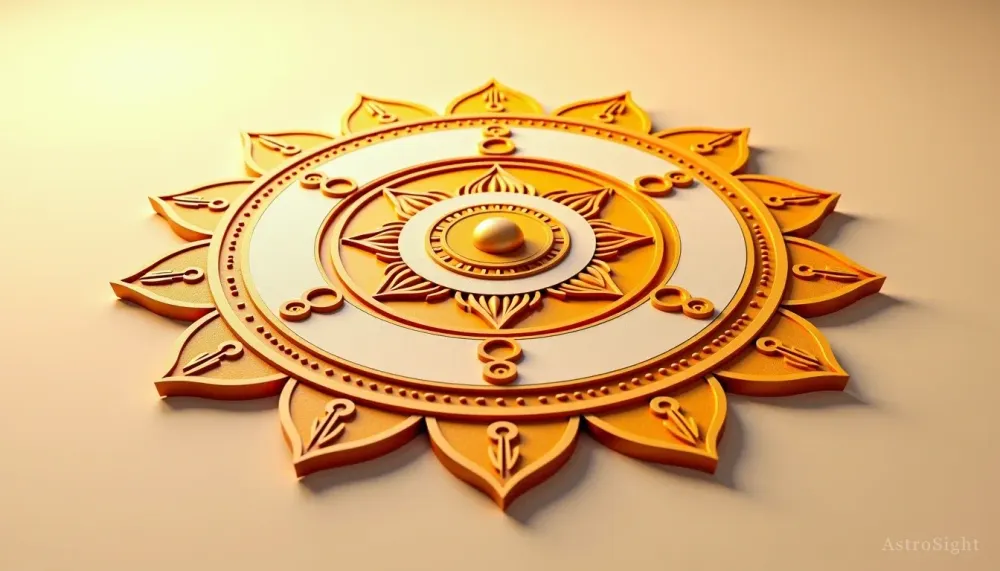
- Step 4 — Place a Vastu Yantra at the centre — Brahma Yantra or Vastu Purusha Mandala yantra placed at the centre, after proper consecration, amplifies the central energy.
- Step 5 — Burn aromatic substances regularly — Incense (especially sandalwood, frankincense, camphor) burned daily at the centre energetically purifies the space.
- Step 6 — Conduct daily morning practice — Brief morning meditation, prayer, or Aarti (light offering) in the central zone establishes daily energetic activation.
- Step 7 — Maintain absolute cleanliness — The central zone must be cleaned daily; even minor dust accumulation reduces Brahmasthan power.
- Step 8 — Annual Vastu Shanti Puja — Once yearly (often on Vastu Puja or annual home-anniversary date), a full puja conducted by a qualified priest renews the Brahmasthan's energy.
The specific elements that activate the Brahmasthan:
| Element | Activation effect |
|---|---|
| Natural light | Strongest activator; sunlight directly entering the Brahmasthan is ideal |
| Air circulation | Cross-ventilation through the centre clears stagnant energy |
| Cleanliness | Daily cleaning maintains energetic purity |
| Aromatic substances | Incense, camphor, ghee lamps energetically purify and activate |
| Sound | Daily mantra recitation, bells, conch sound activates the centre |
| Sacred imagery | Vastu Yantra, Brahma image, or Sri Yantra at the centre |
| Flowers and fresh elements | Living flowers refresh the energy |
| Lit lamps in evening | Especially ghee lamps; activate evening energy |
The activation results — practitioner observation:
- Within 7-14 days — Subtle shifts in household atmosphere; reduced low-grade tension.
- Within 30 days — Family members report better sleep, calmer interactions, clearer thinking.
- Within 90 days — Major life-area improvements visible (career, finances, health).
- Within 6-12 months — Substantial positive shift in household trajectory; chronic problems often resolve.
The morning Brahmasthan activation practice:
1. 5-10 AM window — Best timing for activation practice. 2. Open windows — Allow fresh air through the centre zone. 3. Light a ghee lamp — Or incense; light it at the centre. 4. Brief mantra or prayer — Om Brahmane Namah (108 times) or shorter dedication. 5. Sweep or wipe the centre — Even a brief cleaning establishes the day's energetic foundation. 6. Offer a flower or small natural element — Even a single flower placed at the centre suffices.
This daily practice takes 5-10 minutes and produces sustained Brahmasthan activation over time. Combined with the structural elements (open layout, natural light, sacred imagery), the daily practice maintains the centre's energetic quality.
What Happens If the Brahmasthan Is Blocked?
If the Brahmasthan is blocked by walls, pillars, heavy furniture, toilets, drains, or other obstructive elements, the documented effects include chronic family conflict, financial drain or stagnation, persistent low energy throughout the household, sleep disturbances for multiple family members, recurring health issues, stalled career and life progression, and a general "feeling of heaviness or restriction" that residents report without being able to identify its source. The effects compound over years of habitation; short-term residents in blocked-Brahmasthan homes experience milder effects than long-term residents.
The 8 documented effects of a blocked Brahmasthan:
- Chronic family conflict — Recurring arguments, low-grade tension, communication difficulties; family members find each other's presence subtly draining.
- Financial drain — Income comes but doesn't accumulate; expenses always slightly exceed income; major financial breakthroughs elusive.
- Persistent low energy — Family members report chronic fatigue without medical explanation; productivity stays below personal potential.
- Sleep disturbances — Multiple family members report poor sleep quality; insomnia, fragmented sleep, unusual dreams; often correlated with timing of moving in.
- Recurring health issues — Frequent minor illnesses, slow recovery, "always something" health pattern across the household.
- Stalled career progression — Career feels stuck; opportunities seem to dissolve before arrival; promotions and major moves delayed.
- Heaviness or restriction feeling — Residents describe the home as "heavy," "stuck," or "draining" without being able to articulate why.
- Spiritual blockages — Spiritual practices feel less effective; concentration during meditation difficult; sense of disconnection from inner life.
The severity-of-block matrix:
| Type of Brahmasthan block | Severity | Common manifestations |
|---|---|---|
| Heavy furniture in centre | Moderate | Sluggish energy; low-grade tension |
| Beam overhead in centre | Moderate-high | "Weight on chest" feeling; sleep affected |
| Pillar within the central zone | High | Persistent blockage feeling; major life-areas stalled |
| Wall passing through centre | High | Family fragmentation; communication issues |
| Staircase through centre | Very high | Chaotic energy; major life disruption |
| Toilet/bathroom at centre | Severe | Health issues; financial drain; persistent illness |
| Kitchen at centre | High | Family conflict; aggressive interaction patterns |
| Septic tank at centre | Most severe | Major chronic health issues; severe financial stagnation |
The classical Vedic-Vastu explanation:
The Brahmasthan is the "energetic heart" of the building — the central distribution point for cosmic energy entering through the structure. When this central zone is blocked, the energy cannot circulate properly to the surrounding rooms, producing the cumulative "heaviness" effect across all life areas. The specific manifestation depends on what is blocking — heavy furniture produces sluggishness; walls produce fragmentation; toilets produce drainage of vital energy (similar to how the body's central energy channels function in classical Indian medicine).
How long do blocked-Brahmasthan effects take to manifest?
- First 30 days after moving in — Mild discomfort; "settling in" feeling that doesn't resolve.
- 3-6 months — Sleep patterns begin shifting; subtle financial drains appear.
- 6-12 months — Career or relationship friction visible; family communication patterns shift.
- 2-3 years — Major life pattern stagnation; chronic issues entrench.
- 5+ years — Compound effects; sometimes major health or relationship breakdowns.
Why blocked-Brahmasthan effects are often missed:
- No single cause attribution — The effects spread across multiple life areas, so each individual problem seems to have its own cause (work issues, marital issues, health issues) rather than a common source.
- Gradual onset — Effects develop over months and years, so families adapt to lower energy levels without recognising the decline.
- Cultural acceptance of "this is just life" — Without Vastu awareness, the chronic patterns are accepted as ordinary life challenges rather than identifiable Vastu effects.
For families currently experiencing multiple chronic difficulties without clear causes, a Vastu assessment of the Brahmasthan is a worthwhile diagnostic step. If significant blockage is found, the remediation often produces measurable improvement within 30-90 days.
What Are the Vastu Remedies for a Wall in the Brahmasthan?
A wall passing through or within the Brahmasthan is one of the most common Vastu defects in modern apartments — typically a partition wall between rooms that happens to fall on or near the geometric centre. The Vastu remedies for a wall in the Brahmasthan range from non-structural energetic interventions to structural modification, with the appropriate level depending on the wall's position, the homeowner's ability to modify the structure, and the wall's specific energetic effects.
The 6-tier wall-in-Brahmasthan remediation framework:
- Tier 1 — Structural removal (if possible) — Removing a non-load-bearing wall that passes through the Brahmasthan is the most effective remedy. Cost: ₹10,000-50,000 for typical partition wall removal. Impact: very high.
- Tier 2 — Doorway creation — If full removal isn't feasible, creating a wide doorway or arch at the central point of the wall allows energy to flow through. Cost: ₹15,000-40,000. Impact: high.
- Tier 3 — Wall thinning or transparency — Replace solid wall with glass partition, lattice work, or open shelving at the central zone. Cost: ₹15,000-60,000. Impact: moderate-high.
- Tier 4 — Wall energising — Paint the wall section in Brahmasthan-supportive colours (white, light yellow, pale gold); hang Vastu yantra or sacred imagery at the central point. Cost: ₹2,000-10,000. Impact: moderate.
- Tier 5 — Wall surface treatment — Mirror facing the wall (carefully positioned to expand the perceived space); textured wall treatment that softens the wall's energy. Cost: ₹3,000-15,000. Impact: moderate.
- Tier 6 — Symbolic compensation — Place a Brahma Yantra, Sri Yantra, or Vastu Purusha Mandala yantra at the exact geometric centre even if a wall is present nearby. Cost: ₹500-5,000. Impact: low-moderate.
The remediation approach based on wall type:
| Wall type | Best remediation tier |
|---|---|
| Non-load-bearing partition | Tier 1 (removal) or Tier 2 (doorway) |
| Load-bearing wall | Tier 3 (transparency) or Tier 4 (energising) |
| External wall passing through Brahmasthan | Tier 4-5 (energising and treatment) |
| Wall between two essential rooms | Tier 2 (wide doorway) or Tier 3 (partial transparency) |
Specific wall-in-Brahmasthan remedies:
For walls between living room and bedroom passing through centre:
- Create a wide archway at the central point.
- Use glass or open shelving for the upper portion of the wall.
- Keep the central transition point free of heavy furniture.
- Place a Brahmasthan Yantra at the central transition.
For pillars within the Brahmasthan zone:
- Wrap the pillar in white or pale-gold fabric.
- Place a Brahma Yantra on the pillar facing each direction.
- Avoid placing heavy furniture against the pillar.
- Use the pillar as a meditation/altar pillar; transform the obstacle into a sacred element.
For beams crossing overhead at the Brahmasthan:
- Install a false ceiling that conceals the beam.
- Hang white or pale-gold fabric directly under the beam.
- Avoid placing seating directly under the beam.
- Use upward-facing lights to brighten the central zone, drawing attention away from the beam.
For staircases passing through Brahmasthan (most severe):
- This is the most difficult to remediate without structural modification.
- Light the staircase area brightly with white/cool light.
- Place a Vastu Yantra at the base of the stairs.
- Keep the area immediately under the staircase free of storage (don't use it as a closet).
- Consider relocating the staircase if construction is feasible.
The classical Vastu principle for wall-in-Brahmasthan remedies: the goal is to restore energetic flow through the central zone despite the physical wall. Tier 1 (physical removal) achieves this fully; lower tiers achieve it partially through energetic and symbolic compensation.
For severe blockages with multiple Brahmasthan defects, a qualified Vastu consultant can design a comprehensive remediation plan that addresses each defect with appropriate intervention. Total remediation costs for typical apartments range from ₹15,000 (energetic remedies only) to ₹2,00,000 (structural modifications) depending on the severity and approach chosen.
What Colour Should the Brahmasthan Be?
The colours recommended for the Brahmasthan in Vastu Shastra are white (primary), pale yellow, cream, light gold, and other light, neutral, warm tones that reflect the cosmic light-quality the Brahmasthan represents. Dark colours (black, navy, deep red, dark brown), heavy patterns, and aggressive imagery in the Brahmasthan zone are documented as energetically counterproductive.
The Brahmasthan colour hierarchy:
| Colour | Vastu effect | Recommended use |
|---|---|---|
| White | Primary recommended; reflects all wavelengths; symbolises purity and openness | Walls, ceiling, floor in central zone |
| Pale yellow | Warmth + light combination; supports digestive and mental energy | Wall accent or floor covering |
| Cream | Softer white variant; comfortable for daily living | Walls, soft furnishing |
| Light gold | Symbolises divine energy; Brahma's traditional colour | Accents, yantra background, decorative elements |
| Soft pink | Acceptable secondary; particularly in homes with strong feminine energy | Soft furnishing accents only |
| Pale blue | Acceptable in southern climates; cooling effect | Ceiling preferred over walls |
| Pale green | Acceptable secondary; supports growth energy | Plants, soft accents only |
Colours to avoid in the Brahmasthan zone:
- Black — Absorbs light; opposite of the Brahmasthan's light-quality.
- Navy blue — Too heavy for the central zone's required lightness.
- Dark red — Aggressive energy; overstimulates the central zone.
- Dark brown — Heaviness; opposite of openness required.
- Bright orange or red — Overstimulating; doesn't support central balance.
- Multiple bright competing colours — Visual chaos disrupts central energy.
The colour application by surface:
Walls in the Brahmasthan zone:
- Best: White or off-white throughout.
- Acceptable: Cream or pale yellow.
- Avoid: Any wall in the central zone painted in dark or aggressive colour.
Ceiling above the Brahmasthan:
- Best: White or pale sky-blue.
- The ceiling should be lighter than the walls (creates upward-energy flow).
- Avoid: Dark or patterned ceiling treatments.
Floor in the Brahmasthan:
- Best: Light marble, white tile, or pale-coloured wood.
- Acceptable: Cream or beige tile.
- Avoid: Dark marble or tile (especially black or dark grey).
Soft furnishings in the central zone:
- Best: White, cream, or pale gold cushions, rugs, drapes.
- Acceptable: Patterned items in light colour palette.
- Avoid: Dark heavy fabrics; black or dark furniture against light walls in the central zone.
The colour principle for the Brahmasthan: lightness, openness, and reflectivity. The colours that support the Brahmasthan all share these qualities; the colours that disrupt the Brahmasthan all share their opposites (heaviness, density, absorption).
For homes where the central zone currently has dark colours (often the case when previous owners painted feature walls in central living rooms), the colour-change remediation produces measurable improvement within 30-60 days. The cost of repainting a typical central-zone area is ₹3,000-15,000 — among the highest-ROI Vastu interventions available.
The Brahmasthan and the broader colour-direction map:
While the Brahmasthan favours light neutral colours, the surrounding zones have their own colour recommendations:
- North: Light blue or green
- Northeast: White, cream, light yellow
- East: White, light shades, sunrise tones
- Southeast: Red, orange (fire element)
- South: Red, terracotta, deep tones (Mars energy)
- Southwest: Brown, cream, heavy earth tones
- West: White, pale silver, sunset tones
- Northwest: White, pale silver, grey
The Brahmasthan's central neutral palette allows it to harmonise with all the surrounding direction-specific colour palettes, supporting the building's overall colour coherence.
How to Energise the Brahmasthan?
You energise the Brahmasthan through daily, weekly, and annual practices that combine structural elements (light, air, openness), devotional elements (mantras, yantras, deities), aromatic elements (incense, camphor), and practical maintenance (cleaning, freshness). The energising practices build cumulative energy in the central zone, producing sustained Vastu benefit over months and years.
The daily Brahmasthan energising practice:
- Morning (5-10 AM) — Open windows in or near the central zone; allow fresh air circulation for at least 30 minutes.
- Light a lamp — Ghee lamp (best), oil lamp, or incense at the central point. Light for 5-15 minutes daily.
- Brief mantra — Om Brahmane Namah (108 times) or similar dedication; 3-5 minutes daily.
- Quick cleaning — Sweep or wipe the central zone surface; even a 2-minute clean maintains energetic purity.
- Single fresh element — A flower, leaf, or natural element placed at the centre; refresh daily.
The weekly Brahmasthan deeper practice:
- Thursday or Friday (auspicious days) — Extended morning practice with longer puja (15-30 minutes).
- Camphor Aarti — Burning camphor at the centre while reciting Om Brahmane Namah and offering light to the central yantra.
- Floor wash with herbal water — Mix small quantity of Ganga jal, rose water, or turmeric water for cleansing the central floor.
- Fresh flowers offering — Replace any wilting flowers; place fresh flowers at the central yantra.
- Reading short Vedic verses — Brief reading from Bhagavad Gita, Vishnu Sahasranama, or local devotional text in the central zone.
The annual Brahmasthan ceremonies:
- Vastu Puja (annual) — Performed once yearly, typically on the anniversary of moving into the home or on traditional Vastu Puja date. Full ceremony with Vedic priest takes 2-4 hours.
- Diwali Lakshmi Puja — Lakshmi Puja during Diwali traditionally performed in or near the Brahmasthan.
- Akshaya Tritiya (April-May) — Special Vastu day; particularly auspicious for Brahmasthan ceremonies.
- Pournami (full moon) on a monthly basis — Brief monthly observance maintains annual ritual flow.
The yantra placement for sustained energisation:
| Yantra | Effect |
|---|---|
| Vastu Purusha Yantra | Direct Vastu activation; supports overall building energy |
| Brahma Yantra | Specifically energises the Brahma deity's resonance at the centre |
| Sri Yantra | Universal cosmic geometry; supports overall energy and prosperity |
| Vastu Pyramid set | Modern Vastu tool; 9-piece set placed at the central zone |
| Quartz crystal cluster | Energy-amplifying; placed at the centre for cumulative effect |
The energising-effect timeline:
- Day 1-7 — Subtle atmospheric shifts; family members may notice the home "feels different."
- Day 8-30 — Measurable improvements in mood, energy, sleep quality.
- Day 31-90 — Major life-area improvements become visible (career, finances, relationships).
- Day 91-180 — Sustained improvement; chronic issues often resolve; new opportunities arrive.
- Year 1+ — The Brahmasthan becomes a "self-sustaining" energy source; the daily practices become natural and require less conscious effort.
The energising practices for renters:
Renters can fully energise their Brahmasthan even without making structural changes:
- All daily practices (lamp, mantra, cleaning, flowers) are non-structural.
- Yantra placement requires no permanent installation.
- Colour through removable wall decals or paintings (if painting walls is restricted).
- Floor coverings (light-coloured rugs) cover dark floor tiles without permanent change.
- Furniture positioning to maintain centre openness doesn't require structural change.
The energising practices produce results regardless of ownership status; the effects accumulate over months and years of consistent practice.
What Are the Most Common Brahmasthan Mistakes to Avoid?
The most common Brahmasthan mistakes in modern Indian homes include placing heavy furniture in the centre, hanging chandeliers or heavy lights overhead, installing toilets at or near the centre, blocking the centre with walls or partitions, using dark colours in the central zone, ignoring beams or pillars in the centre, allowing clutter to accumulate, and treating the Brahmasthan as ordinary space rather than as the building's energetic heart. Most of these mistakes are made unintentionally by homeowners unfamiliar with Vastu principles; once recognised, they can be corrected through targeted remediation.
The top 10 Brahmasthan mistakes:
- Mistake 1 — Heavy furniture in the centre — Large sofa, dining table, heavy almirah occupying the central zone burdens the energy. Remedy — Move heavy items to the south or west walls; keep the centre open.
- Mistake 2 — Chandelier or heavy light overhead — Heavy hanging fixture above the central zone creates oppressive overhead pressure. Remedy — Replace with lighter recessed or surface-mount lighting; if chandelier is essential, choose a light, simple design.
- Mistake 3 — Toilet at or near centre — Most severe Brahmasthan defect; drains the central energy continuously. Remedy — Structural relocation if possible; if not, multiple compensating practices (camphor burning, yantras, light enhancement, multi-tier remediation).
- Mistake 4 — Wall passing through centre — Common in apartment partitions. Remedy — Wide doorway, transparency element, or removal if non-load-bearing.
- Mistake 5 — Dark colours in central zone — Heavy paint colours or dark soft furnishings. Remedy — Repaint in white, cream, or pale yellow; replace soft furnishings with light colours.
- Mistake 6 — Beam crossing overhead — Structural beam passing across the centre creates oppressive overhead energy. Remedy — False ceiling to conceal beam; bright lighting underneath; avoid placing seating directly below.
- Mistake 7 — Pillar within centre — Pillar physically blocks the central zone. Remedy — Wrap in white fabric; place yantra; transform into altar or meditation pillar.
- Mistake 8 — Clutter accumulation — Even without major furniture, gradual accumulation of items in the centre disrupts energy. Remedy — Daily clearing practice; "centre stays empty" rule.
- Mistake 9 — Kitchen at centre — Kitchen's fire element disturbs the Brahmasthan's neutral central energy. Remedy — Relocate kitchen if possible; if structural, use cooler colour palette and bright lighting to balance.
- Mistake 10 — Treating Brahmasthan as ordinary space — Most common mistake of all; homeowner doesn't know the central zone is special. Remedy — Vastu awareness; even basic daily practices (cleaning, lamp, openness) substantially improve the energy.
The hierarchy of mistakes by severity:
| Mistake severity | Examples |
|---|---|
| Mild | Heavy furniture in centre; dark colours; minor clutter |
| Moderate | Beam overhead; wall passing through; lack of light |
| Severe | Pillar within centre; staircase through; kitchen at centre |
| Most severe | Toilet/bathroom at centre; septic tank below centre |
The "what not to put in the Brahmasthan" comprehensive list:
- Heavy almirahs, wardrobes, dressers.
- Large dining tables (small dining is acceptable if Brahmasthan is in living-dining area).
- Heavy sofa sets or central seating arrangements.
- Television sets and entertainment systems.
- Computer workstations with multiple monitors.
- Pooja room (counterintuitively — pooja rooms should be northeast, not centre).
- Bathrooms, toilets, washing areas.
- Kitchen.
- Storage closets or pantries.
- Heavy storage shelves or bookcases.
- Aquariums (water-heavy installations).
- Large potted plants (small plants are acceptable).
- Religious altars with heavy idols (small altars with yantra/light idols are fine).
The "what to put in the Brahmasthan" supportive list:
- Open space (best).
- Small flowering plants.
- Vastu Yantra (centrally placed).
- Light fixtures providing soft illumination.
- Light-coloured rug or floor covering.
- Simple decorative elements (single candle, single flower vase).
- Light meditation cushion if used for daily practice.
- Small water feature (carefully designed; not always recommended).
- Skylight or window allowing natural light from above.
The "Brahmasthan-first" rule for furniture rearrangement: when arranging or rearranging furniture in any home, start with the Brahmasthan and work outward. Identify the central zone, keep it open, then arrange the rest of the home around this central principle. This approach produces substantially better Vastu outcomes than the typical "arrange furniture for functional convenience" approach. Use the birth chart calculator alongside Vastu analysis to identify whether your individual chart amplifies the importance of Brahmasthan optimization.
Align Your Space with Your Career Path
Vastu optimizes your environment. Your birth chart reveals your career potential. Get both aligned with a personalized analysis and actionable remedies.
Get Your Career ReportPersonalized Report
Wealth & Lifestyle Report
Vastu amplifies what your birth chart already shows — see your wealth yogas + home direction guide
- Personalized analysis based on YOUR exact birth chart
- Expert-prepared by Dr. Meenakshi Sharma
- Delivered as PDF within 24-48 hours
- Unlimited follow-up clarifications
By Dr. Meenakshi Sharma · Delivered in 24-48 hours

Shri Ankit Bansal
Vedic Astrologer · Numerology and Vastu Expert, 15+ Years
Shri Ankit Bansal is a renowned numerology and Vastu expert with over 15 years of specialized experience in these ancient Indian sciences. His extensive practice encompasses thousands of consultations in numerological analysis, name corrections, business numerology, and comprehensive Vastu assessments for residential and commercial properties. As a contributing writer for AstroSight, Shri Bansal combines his deep understanding of numerical vibrations with practical Vastu principles to provide holistic solutions that harmonize living and working spaces with cosmic energies. His expertise spans personal numerology charts, business name analysis, property Vastu audits, and remedial measures that blend traditional wisdom with modern lifestyle requirements. Through his methodical approach and proven track record, Shri Bansal has established himself as a trusted authority in helping clients optimize their environment and numerical influences for enhanced prosperity, health, and overall well-being.