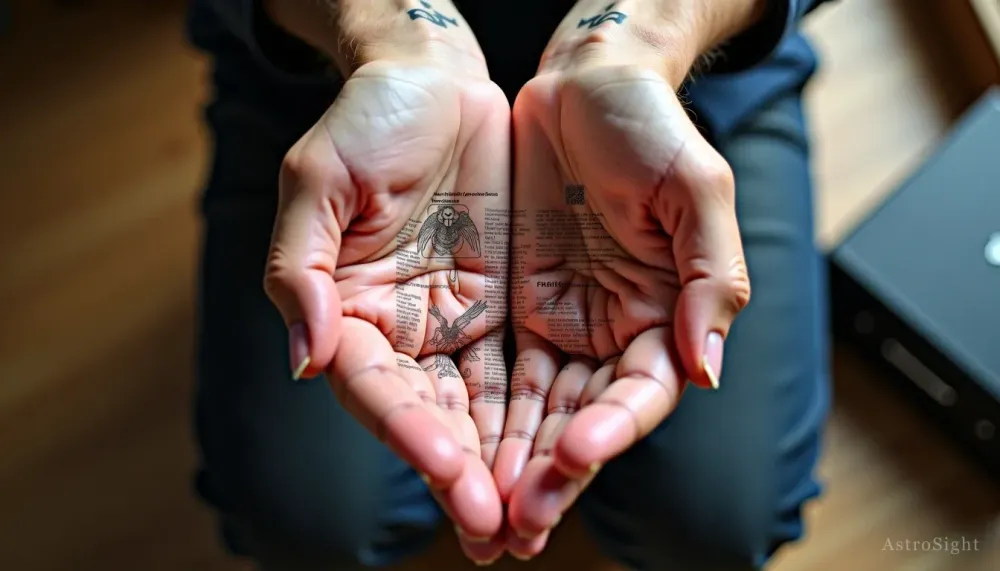
Marriage Line in Palmistry: How Many, Length & Meaning
As of 2026, the Marriage Line remains one of the most searched-for features in palmistry — it is rarely the first thing a classical palmist examines, but it is almost always the first thing a person wants to know about. This guide decodes the Marriage Line fully, drawing on Hasta Samudrika Shastra a
As of 2026, the Marriage Line remains one of the most searched-for features in palmistry — it is rarely the first thing a classical palmist examines, but it is almost always the first thing a person wants to know about. This guide decodes the Marriage Line fully, drawing on Hasta Samudrika Shastra and classical Indian palmistry principles, and separates what the line genuinely indicates from the many popular myths that have built up around it. Use the birth chart calculator to see how this applies to your personal Vedic chart.
Reviewed by Shri Ankit Bansal, Vedic Astrologer & Founder of AstroSight, 2026
What is the Marriage Line in Palmistry?
> Quick Answer: The Marriage Line in palmistry is one or more short horizontal lines located on the percussion edge of the palm — the outer side — between the base of the little finger and the Heart Line. Each line represents a significant union or deep intimate relationship. The term "marriage line" is the popular name; classical palmistry often calls them "union lines" or "affection lines" because they can represent deep relationships beyond formal marriage.
The Marriage Line — or Vivah Rekha in classical Indian palmistry — is found on the edge of the palm, not on the broad flat surface. It sits on what palmists call the percussion edge, the outer border of the hand from the little finger down to the wrist. The Marriage Line specifically occupies the zone between the base of the little finger and the Heart Line.
The name "Marriage Line" is both accurate and limiting. In classical Hasta Samudrika Shastra, these lines represent significant unions — relationships of deep emotional and karmic significance. In a cultural context where formal marriage was the primary form of serious union, all such lines were considered marriage lines. In contemporary reading, a deep relationship of significant commitment — whether formally married or not — registers on the palm in this location.
The Marriage Line is governed by Mercury, the planet associated with the little finger and its mount. Mercury governs communication, adaptability, and intimate exchange — all elements of significant partnership. The quality of a person's capacity for intimate union shows in this zone.
Where to Find the Marriage Line on Your Hand
> Quick Answer: Hold your palm with the little finger at the top and look at the outer edge of your palm — the side opposite the thumb. Find the Heart Line (the horizontal line running across the upper palm) and the base of your little finger. The Marriage Lines are the short horizontal lines between these two points on the outer edge of the palm.
Many beginners struggle to find the Marriage Lines because they look on the flat palm surface instead of the edge. Here is how to locate them precisely:
1. Hold your dominant hand palm-up, fingers pointing upward. 2. Look at the outer edge of your hand — the side that faces away from you, sometimes called the percussion edge. 3. Locate the Heart Line — the horizontal line running across the upper palm beneath the fingers. 4. Now look at the narrow strip of palm edge between the base of the little finger and where the Heart Line meets the palm's outer edge. 5. The Marriage Lines are the short horizontal lines (running from the edge into the palm) in this strip.
These lines may be very fine and require good light, possibly magnification, to see clearly. On some hands they are prominent; on others they are barely visible. The clearest and longest lines are the most significant.
How Many Marriage Lines: Single, Double, Multiple
> Quick Answer: One Marriage Line indicates one significant union. Two or three lines indicate multiple significant relationships — not simultaneously, but across a lifetime. Many faint lines together typically mean a person is strongly relationship-oriented and attracts many connections, but the clearest, deepest lines represent the most significant unions.
The number of Marriage Lines on the palm is one of the most discussed aspects of this feature. Classical reading:
One Marriage Line: A single, clear Marriage Line indicates one dominant significant union in the person's life. This is a person for whom one relationship defines the relational chapter of their experience — either in depth of commitment or duration. This does not mean they have no other relationships; it means one relationship is karmically and emotionally primary.
Two Marriage Lines: Two clear lines of roughly equal weight indicate two significant unions. In Hasta Samudrika Shastra, each line represents a relationship with substantial karmic weight — not necessarily two formal marriages, but two relationships that mark the person's life significantly.
Three or more clear lines: Three or more prominent lines indicate multiple significant unions across the lifetime. Each line, if clearly marked, represents a relationship of genuine emotional significance.
Many faint lines: When a person has numerous fine, faint lines in the Marriage Line zone, classical palmistry interprets this as a warm, relationship-oriented temperament — someone who invests emotionally in many connections and experiences romantic feeling frequently. The clearest and deepest among these multiple fine lines represents the most significant union.
No visible lines: An absence of clear Marriage Lines is not a sign that the person will not find love or partnership. It indicates that the Marriage Line dimension of life is not strongly marked karmically — the relationship chapter does not dominate the palm's narrative. Such people find fulfilling partnerships; the experience simply does not register as a primary karmic theme in the hand's record.
Marriage Line Length and What It Predicts
> Quick Answer: A long, clear Marriage Line extending well onto the palm indicates a stable, lasting relationship. A short Marriage Line indicates a briefer union or attraction — one that does not develop into a long, committed partnership. The line's length is a quality indicator for the relationship's duration and depth, not a prediction of the wedding date.
Long Marriage Line: A line that extends well from the percussion edge onto the palm, running a clearly visible distance horizontally, indicates a long, stable union. The relationship has endurance, commitment, and substance. When the line is also deep and clear — without interruptions — it indicates a particularly stable partnership.
Short Marriage Line: A short line barely extending from the edge indicates a relationship that begins with feeling and connection but does not develop into a long-term committed partnership. The emotional resonance is real — it is not a superficial connection — but the union is brief.
Medium-length line: The most common formation. Indicates a relationship of meaningful duration that forms a significant chapter of the person's life. Whether it is lifelong depends on other features of the line — its depth, clarity, and any markings.
Depth matters as much as length: A short but deeply incised Marriage Line indicates a brief but intensely significant relationship — something emotionally powerful even if brief. A long but faint line indicates a long-term connection that, despite its duration, lacks deep emotional intensity.
Breaks, Forks, and Islands in the Marriage Line
> Quick Answer: A break in the Marriage Line indicates a significant interruption or ending in that relationship. A fork downward at the end indicates separation. A fork upward indicates late happiness after difficulty. An island on the Marriage Line indicates a troubled period within the relationship — not necessarily its end, but a significant challenge that the partnership must navigate.
Breaks: A clean break in the Marriage Line means the relationship ends abruptly, or that a major disruption ends one phase and either a new phase or the relationship itself follows. An overlapping break (where the two sections briefly overlap) indicates a temporary separation followed by reunion, or a major disruption from which the relationship recovers.
Fork downward: When the Marriage Line ends with a fork that splits downward (toward the Heart Line), classical palmistry reads this as separation — the union ends in parting. The downward fork is one of the more concerning markings in the Marriage Line zone, but it indicates separation rather than tragedy. Many people show this marking and navigate the transition, sometimes going on to form better relationships afterward.
Fork upward: When the line ends with a fork pointing upward (toward the little finger), it indicates late happiness — a relationship that begins with difficulty or delay but resolves into genuine fulfillment. This formation is considered favorable in the long view even if the early phase of the relationship is challenging.
Fork at both ends: A fork at both the beginning and end of a Marriage Line indicates a relationship that begins with uncertainty and ends with it — a union that was never fully settled or committed from either party's perspective.
Islands: An island on the Marriage Line — a small oval shape where the line briefly splits and rejoins — indicates a period of trouble, tension, or difficulty within the relationship during the phase covered by the island. This is not a death knell for the relationship; it indicates a chapter of strain that the partnership must work through. If the line continues clearly after the island, the relationship recovers.
Chains: A chained Marriage Line — looking like a series of small links rather than a clean line — indicates a relationship that is continuously troubled, marked by repeated misunderstandings or ongoing tension throughout its duration.
Marriage Line and Timing of Union
> Quick Answer: The approximate timing of a union is read from the Marriage Line's position between the Heart Line and the base of the little finger. A line closer to the Heart Line corresponds to a relationship forming earlier in life. A line closer to the base of the little finger corresponds to a later-life union. The midpoint corresponds to roughly mid-life.
Timing a marriage or union from the Marriage Line is an approximate art, not a precise science. The zone between the Heart Line and the base of the little finger represents a life span in miniature:
1. Close to the Heart Line: Union forms in youth or early adulthood — late teens to mid-20s in most readings. 2. At or near the midpoint: Union forms in the 30s or early 40s. 3. Close to the base of the little finger: Union forms in later life — 50s or beyond.
Classical palmists use this positioning as a rough guide and calibrate to the individual's hand proportions. The precise timing is less reliable than the general indication — whether the union forms early, in mid-life, or late.
Marriage Line in Hasta Samudrika Shastra
> Quick Answer: In Hasta Samudrika Shastra, the Marriage Line zones fall under Mercury's domain and are read as records of karmic unions — relationships with significant soul-level significance. The tradition emphasizes reading the Marriage Lines in the context of the Heart Line and the overall hand, not as isolated predictors of matrimonial fate.
The classical Indian approach to the Marriage Line is framed by karma theory. In Hasta Samudrika Shastra, significant relationships are understood as karmic meetings — unions between souls whose karma is intertwined. The Marriage Line records these meetings on the palm.
This means that the number of lines, their quality, and their markings reflect the karmic weight of the relationship, not simply the practical circumstances of marriage. A deep, long Marriage Line indicates a relationship of substantial karmic significance — one where both souls have meaningful work to do together. A short, fine line indicates a relationship that passes more lightly, carrying less karmic weight even if it carries genuine emotional feeling.
Hasta Samudrika Shastra also emphasizes that the Marriage Line is read in context of the Heart Line. The Heart Line (Mana Rekha) governs the overall emotional capacity and the quality of the emotional self. A powerful, clear Heart Line with a strong Marriage Line indicates a person who both loves deeply and forms a significant, durable union. A fragile or chained Heart Line alongside a Marriage Line that shows breaks or downward forks indicates a person whose emotional nature makes lasting union genuinely challenging.
For a complete picture of your relational life in palmistry, the Marriage Line must be read alongside the full context of the major lines — a topic covered in depth at /palmistry/palmistry-lines-heart-head-life-fate-decoded. Combining palmistry with a birth chart reading — particularly looking at Venus, the 7th house, and its lord — provides the most complete picture of relationship karma.
Marriage Line vs. Relationship Line: The Distinction
> Quick Answer: "Marriage Line" and "relationship line" are often used interchangeably, but the classical distinction is that the Marriage Line specifically represents deep, committed unions with karmic significance. Not every romantic relationship registers as a Marriage Line. Casual or brief attractions do not typically produce these marks. Only relationships with genuine depth and karmic weight leave their mark in this zone.
The popular term "marriage line" creates a literalist trap — the assumption that every line in this zone represents a legal marriage. Classical palmistry's concept is broader and more nuanced.
The lines in this zone register relationships of significant depth and karmic importance. In different social and cultural contexts, this has always included: 1. Formal marriages 2. Long-term committed partnerships without formal marriage 3. Relationships of profound emotional impact that changed the person's life direction, even if brief 4. Deep karmic unions that carry significant soul-level weight
What does not typically register as a Marriage Line: 1. Casual dating or short-term attractions without emotional depth 2. Infatuations that remain unrequited or unexplored 3. Brief encounters, however pleasurable, that carry no lasting karmic significance
This distinction helps explain why some people with many relationships have only one or two Marriage Lines — their relationships that carry genuine karmic weight are few, even if their romantic history is broad. It also explains why some people with relatively conventional romantic histories show three clear lines — each of those relationships carried substantial soul-level significance.
Your Birth Chart Reveals Far More Than Palm Lines
Vedic astrology provides depth that palmistry cannot reach. Get a complete career and life direction analysis based on your exact birth chart.
Get Your Career ReportPersonalized Report
Janampatri (Birth Chart Report)
Your palm lines and your birth chart are two maps of the same destiny — see both together
- Personalized analysis based on YOUR exact birth chart
- Expert-prepared by Dr. Meenakshi Sharma
- Delivered as PDF within 24-48 hours
- Unlimited follow-up clarifications
By Dr. Meenakshi Sharma · Delivered in 24-48 hours

Shri Ankit Bansal
Vedic Astrologer · Numerology and Vastu Expert, 15+ Years
Shri Ankit Bansal is a renowned numerology and Vastu expert with over 15 years of specialized experience in these ancient Indian sciences. His extensive practice encompasses thousands of consultations in numerological analysis, name corrections, business numerology, and comprehensive Vastu assessments for residential and commercial properties. As a contributing writer for AstroSight, Shri Bansal combines his deep understanding of numerical vibrations with practical Vastu principles to provide holistic solutions that harmonize living and working spaces with cosmic energies. His expertise spans personal numerology charts, business name analysis, property Vastu audits, and remedial measures that blend traditional wisdom with modern lifestyle requirements. Through his methodical approach and proven track record, Shri Bansal has established himself as a trusted authority in helping clients optimize their environment and numerical influences for enhanced prosperity, health, and overall well-being.