Om Shanaye Namah Saturn Mantra: Meaning, Method, Benefits
The "Om Shanaye Namah" Saturn mantra (full form: "Om Sham Shanaishcharaya Namah") is the most widely-chanted Saturn (Shani) mantra in Vedic tradition — prescribed for strengthening Saturn's positive influence, mitigating Sade Sati (Saturn's 7.5-year transit through signs adjacent to natal Moon), and
The "Om Shanaye Namah" Saturn mantra (full form: "Om Sham Shanaishcharaya Namah") is the most widely-chanted Saturn (Shani) mantra in Vedic tradition — prescribed for strengthening Saturn's positive influence, mitigating Sade Sati (Saturn's 7.5-year transit through signs adjacent to natal Moon), and aligning with Saturn's karmic discipline themes. The mantra translates as "Om — salutations to Shani, the slow-moving one" — with "Shanaishcharaya" deriving from Sanskrit "shanaih" (slow) + "char" (mover) referring to Saturn's slow ~29.5-year orbit through the zodiac. The standard chanting protocol is 108 repetitions daily (corresponding to the sacred 108 nakshatra padas), performed during the appropriate hora (planetary hour) or specifically on Saturdays — Saturn's day in the Vedic Vara (weekday) tradition.
The reason understanding the Om Shanaye Namah Saturn mantra matters is that Saturn governs discipline, karma, longevity, hard work, and structural foundations in Vedic astrology — and its transits (Sade Sati, Dhaiya, individual Saturn transits) are widely considered among the most life-restructuring planetary periods. Saturn mantra chanting is one of several documented remedies alongside wearing blue sapphire (Neelam) under qualified guidance, charity (donating mustard oil, black sesame, iron, or food on Saturdays), and ethical/disciplined lifestyle adjustments. Important caveat: mantra chanting is a contemplative-spiritual practice — the documented benefits are primarily contemplative (focus, discipline, equanimity) rather than guaranteed material outcomes. Effects depend on consistency, pronunciation accuracy, and integration with other Saturn-related remedies and chart-based assessment. This guide covers what the Saturn mantra is, the meaning of Om Sham Shanaishcharaya Namah, Lord Shani's most beloved mantra, the beej mantra chanted 108 times, the vinyog (proper application), benefits, who should chant and when, safety and contraindications, integration with other remedies, and timeline for noticeable benefits. Reviewed by Shri Ankit Bansal, Vedic astrologer with 12+ years of practice prescribing planetary remedies. For your personal Saturn-position analysis, use the birth chart calculator.
What Is the "Om Shanaye Namah" Saturn Mantra and What Does It Mean?
The "Om Shanaye Namah" Saturn mantra is a Vedic mantra invoking Lord Shani (Saturn) — the planet of discipline, karma, longevity, and structural foundations in Vedic tradition. The full canonical form is "Om Sham Shanaishcharaya Namah" — though shortened variants "Om Shanaye Namah" or "Om Sham Shanaye Namah" are also widely used.
| Mantra element | Meaning |
|---|---|
| Om | The primordial sound; universal vibration |
| Sham (शं) | Saturn's beej (seed) syllable; concentrated Saturn vibration |
| Shanaishcharaya (शनैश्चराय) | "To the slow-moving one" — referring to Saturn's slow orbital motion (~29.5 years) |
| Namah (नमः) | "Salutations" or "I bow" |
| Combined meaning | "Om — salutations to Shani, the slow-moving one" |
Alternative Saturn mantras commonly used:
- "Om Sham Shanaishcharaya Namah" — most-cited canonical form
- "Om Praam Preem Praum Sah Shanaishcharaya Namah" — Tantric variant with full beej-mantra sequence
- Saturn Gayatri Mantra: "Om Kakdhwajaya Vidmahe, Khadgahastaya Dheemahi, Tanno Mandah Prachodayat" — 24-syllable extended Saturn invocation
- "Neelanjana samaabhaasam" — Saturn-stuti opening line
- Shani Stotram — fuller hymns to Lord Shani (various)
The mantra is in Sanskrit — traditional practice uses Sanskrit pronunciation as preserved in oral and written tradition. Approximate phonetic transliteration: "Om Shum Shun-ai-sh-cha-rai-ya Nah-mah".
What Is the Meaning of "Om Sham Shanaishcharaya Namah"?
"Om Sham Shanaishcharaya Namah" literally translates to "Om — salutations to Lord Shanaishchara" — the formal Sanskrit name for Saturn (Shani) — with the beej syllable "Sham" providing the concentrated vibrational invocation of Saturn's energy.
| Linguistic element | Etymology |
|---|---|
| Om (ॐ) | The primordial syllable; cosmic vibration; universal Brahman |
| Sham (शं) | Saturn's beej syllable — combines "sha" + nasalization |
| Shanaih (शनैः) | Sanskrit adverb meaning "slowly" |
| Char (चर) | Sanskrit verb root meaning "to move" |
| Shanaishcharaya (शनैश्चराय) | "To the slow-moving one" — dative case of Shanaishchara |
| Namah (नमः) | "Salutations" or "I bow"; formal Sanskrit salutation |
Lord Shani's iconography:
- Color: Dark blue or black
- Vehicle (vahana): Crow or vulture (sometimes buffalo)
- Weapons: Bow, arrows, trident, mace
- Day: Saturday (Shanivar)
- Direction: West
- Gemstone: Blue sapphire (Neelam)
- Metal: Iron, lead
- Color of offerings: Black sesame, mustard oil, iron items, dark cloth
- Mythology: Son of Sun (Surya) and Chhaya (Surya's shadow-wife); brother of Yama (god of death)
What Is the Most Beloved Mantra of Lord Shani?
The "Om Sham Shanaishcharaya Namah" mantra is widely considered the most beloved and most-chanted Lord Shani mantra in Vedic tradition — alongside Saturn-specific hymns including Shani Stotra and Dashrath-Krit Shani Stotram.
| Lord Shani mantra | Type | Typical chant count |
|---|---|---|
| Om Sham Shanaishcharaya Namah | Main mantra | 108 times daily |
| Saturn Gayatri Mantra | Extended Gayatri-form mantra | 108 or 1,008 times |
| Dashrath-Krit Shani Stotram | Hymn by King Dashrath | Once daily; multi-verse hymn |
| Neelanjana Samaabhaasam | Saturn stuti | Daily recitation |
| Sani Vajrapanjar Stotram | Protective Saturn stotra | Daily recitation |
| Shani Chalisa | 40-verse devotional praise | Daily on Saturdays |
| Shani Tantrokta Mantra | "Praam Preem Praum Sah Shanaye Namah" | 108 times; under qualified guidance |
| Shani Beej Mantra | Just "Om Sham" | 108-1,008 times |
Different lineages emphasize different mantras — the Vedic Saturn-mantra tradition is broad, with the simpler "Om Sham Shanaishcharaya Namah" being the most-accessible entry point for most practitioners. Tantric Saturn mantras (longer beej sequences) require qualified-teacher guidance due to the precise pronunciation and visualization protocols involved.
What Is the Saturn Beej Mantra and How Is It Chanted 108 Times?
The Saturn beej (seed) mantra is "Om Sham" — the concentrated single-seed-syllable invocation of Saturn's vibration — and the standard chanting protocol involves 108 repetitions, ideally with a rudraksha or black hakik (onyx) mala (rosary).
108 chants protocol (8-step process):
1. Sit in a comfortable cross-legged position (Padmasana or Sukhasana) with spine erect, facing East or West. 2. Take 3 deep cleansing breaths to settle into the practice. 3. Hold the mala in your right hand, starting at the bead next to the meru (head bead). 4. Chant "Om Sham" (or full "Om Sham Shanaishcharaya Namah") on each bead. 5. Move to the next bead for the next chant — 108 beads, 108 chants. 6. At the meru bead, stop — do not cross over (traditionally, you reverse direction for the next round). 7. If chanting multiple rounds, reverse direction at each meru. 8. End with gratitude meditation — 3-5 minutes of silent reflection.
| 108-chant protocol parameter | Detail |
|---|---|
| Why 108? | Sacred number; corresponds to 108 nakshatra padas (27 nakshatras × 4 padas), 108 Upanishads in some lineages, multiple cosmic correspondences |
| Mala material for Saturn | Rudraksha (most common), black hakik (onyx), iron beads (advanced) |
| Time of day | Saturday morning (preferred), evening; daily during Saturn hora |
| Duration of 108 chants | Approximately 10-20 minutes depending on speed |
| Frequency | Daily, particularly Saturdays; some practitioners 108 chants morning + evening |
| Visualisation | Lord Shani's form; or simply concentrate on the sound |
Practical notes:
- Pronunciation accuracy matters more than speed — slow, clear chanting is preferred over rushed mantras.
- Mental chanting (silent) is acceptable when vocal chanting is not appropriate (in public, at work).
- For Sade Sati periods, some practitioners increase to 1,008 chants daily — though this is intensive.
What Is the Vinyog (Proper Application) of Saturn Mantra Nyas?
Nyasa (न्यास) is the Vedic practice of "placing" or "establishing" specific syllables, mantras, or deity-energies on specific parts of the body — and Saturn mantra nyasa is the systematic ritual placement of the Saturn mantra on body locations to establish full energetic alignment with Saturn before extended mantra practice or specific Saturn-related ritual.
The vinyog (application) of Saturn mantra nyas involves 5 sequential steps:
| Nyasa step | Sanskrit name | Application |
|---|---|---|
| Rishi nyasa | Sage-placement | Touch the head; "Pippalada Rishaye Namah" (the sage who revealed the mantra) |
| Chhandas nyasa | Meter-placement | Touch the mouth; "Trishtup Chhandase Namah" (the metrical structure) |
| Devata nyasa | Deity-placement | Touch the heart; "Sham Shanaishcharaya Devataya Namah" |
| Beej nyasa | Seed-syllable-placement | Touch the genitals; "Sham Bijaya Namah" |
| Shakti nyasa | Power-placement | Touch the feet; "Krishna Shaktaye Namah" |
Why nyasa matters:
- Energetic preparation — establishes the practitioner's body as a container for the mantra-energy
- Concentration support — the systematic touching focuses attention before mantra recitation
- Tradition continuity — honors the lineage transmitting the mantra
- Protective function — establishes a protective field for extended ritual
Practical reality: most modern practitioners chanting "Om Sham Shanaishcharaya Namah" 108 times daily do NOT perform full nyasa — nyasa is typically reserved for extended ritual (e.g., Saturn-puja, Shani Yagna, navagraha-shanti) or deep practitioner-level mantra sadhana. Daily 108-chant practice without full nyasa is still beneficial and widely accepted.
For full nyasa practice, qualified-teacher guidance is essential — the specific Sanskrit pronunciation, body-touching sequence, and visualizations require proper transmission.
What Are the Benefits of Chanting Saturn Mantras?
The traditional benefits of chanting Saturn mantras include mitigation of Sade Sati (Saturn's 7.5-year transit) and Dhaiya (Saturn's 2.5-year transit) effects, support for Saturn's positive themes (discipline, hard work, longevity, structural building), and alleviation of Saturn-related health and life-area challenges.
| Traditional Saturn mantra benefit | Application area |
|---|---|
| Sade Sati support | For people in Sade Sati (Saturn in 12th/1st/2nd from natal Moon — currently Aquarius/Pisces/Aries Moon signs) |
| Dhaiya support | For people in Dhaiya (Saturn in 4th/8th from natal Moon) |
| Career discipline | Supports sustained career work, especially long-haul professions |
| Health (Saturn-related) | Bone, joint, dental, skin issues; chronic conditions |
| Karmic clearing | Past-karma resolution themes; ethical-discipline support |
| Financial discipline | Supports savings, debt reduction, long-term wealth-building (slow growth) |
| Relationship discipline | Supports committed relationships through challenging periods |
| Spiritual progress | Saturn's discipline supports sustained spiritual practice |
| Patience and equanimity | Saturn's themes of acceptance and patience |
| Mind focus | The discipline of daily 108-chant practice itself builds concentration |
Documented empirical benefits of regular mantra chanting (from modern research on mantra/meditation practice):
- Reduced heart rate, blood pressure (small but measurable effect)
- Parasympathetic activation (relaxation response)
- Improved focus and attention
- Reduced anxiety markers in some studies
- Beneficial breathing patterns during sustained chanting
Empirical effects are general meditation-practice benefits — not specifically Saturn-mantra benefits. The Saturn-specific traditional benefits remain part of the contemplative-spiritual framework, not empirically validated outcome predictions.
Who Should Chant Saturn Mantras and When?
Saturn mantras are particularly recommended for individuals currently in Sade Sati, Dhaiya, or Saturn Mahadasha/Antardasha periods — and during specific timing windows including Saturdays, Saturn hora, and Saturn transits.
| Who should chant Saturn mantras | Why |
|---|---|
| People in Sade Sati | Saturn transit through 12th/1st/2nd from natal Moon — direct Saturn-effect period |
| People in Dhaiya | Saturn transit through 4th/8th from natal Moon — pressure period |
| People in Saturn Mahadasha | 19-year period of Saturn-themed life chapter |
| People with Saturn in malefic placement | Saturn in 6th, 8th, 12th; debilitated in Aries; afflicted by malefics |
| People with weak Saturn | Low Shadbala; specific placements indicating Saturn weakness |
| People seeking discipline/patience | General Saturn-themed personal development |
| People with Saturn-related health concerns | Bone, joint, dental, chronic conditions (alongside medical care) |
| People in transit-difficult Saturn periods | Specific Saturn transits to natal Sun, Moon, lagna |
| When to chant | Best timing |
|---|---|
| Daily timing | Saturday morning (most auspicious); Saturday evening; or daily during Saturn hora |
| Saturn hora | Specific hours of the day governed by Saturn — calculate using Saturn hora calculator |
| Tilly and lunar phase | Krishna Paksha (waning moon) particularly favorable; specific Saturn-tithis |
| Saturn transit days | When Saturn changes signs (major transit days); Saturn-eclipse days |
| Saturn Mahadasha start | First few weeks of new Saturn Mahadasha |
| Annual | Specific Saturn-festival days (Shani Jayanti in May/June) |
Some practitioners chant Saturn mantras during Rahu Kaal, though this is a debated practice — some lineages caution against mantras during Rahu Kaal due to Rahu's interference with mantra energy.
What Are the Safety and Contraindications for Saturn Mantra Chanting?
Saturn mantra chanting is generally safe for most practitioners — but specific cautions apply for individuals with certain chart configurations or life circumstances where Saturn-mantra intensification could amplify undesirable themes.
| Contraindication / caution | Recommendation |
|---|---|
| Very strong/well-placed Saturn in birth chart | Use cautiously — amplifying already-strong Saturn can produce excessive discipline, isolation tendencies |
| Saturn as functional malefic for your lagna | For Cancer/Leo lagnas, Saturn rules dusthana houses — chanting requires careful framing |
| Saturn debilitation in own/exalted dasha | Mixed advice in classical literature; qualified astrologer guidance recommended |
| Severe depression or mental health crisis | Saturn's themes can deepen difficult emotional patterns; use with mental-health professional support |
| Pregnancy | Generally acceptable; some lineages recommend modified practice |
| Children under 12 | Generally not recommended without specific reason; Saturn's themes may be premature |
| Recent severe loss or grief | Sometimes contraindicated as Saturn's themes can deepen grief; some lineages recommend Jupiter or Sun mantras instead |
| Inappropriate pronunciation | Wrong pronunciation traditionally considered ineffective or counterproductive; learn from qualified source |
Universal best practices:
- Start with shorter sessions (54 or 27 chants) and build to 108.
- Maintain ethical and disciplined lifestyle alongside chanting — Saturn responds to integrity, not isolated practice.
- Combine mantra with charity (donating to elderly, disabled, mustard oil to needy) — Saturn-themed actions amplify mantra effect.
- Avoid intoxication during practice.
- Maintain bodily and mental cleanliness — bathing before chanting is traditional.
How Does Saturn Mantra Integrate with Other Saturn Remedies?
Saturn mantra chanting is most effective when combined with the full Saturn-remedy ecosystem — gemstone (blue sapphire under guidance), charity (dana), lifestyle alignment, and chart-based practices.
| Saturn remedy | Implementation |
|---|---|
| Mantra | Om Sham Shanaishcharaya Namah, 108 daily |
| Gemstone | Blue sapphire (Neelam), 3-5 carats, set in iron or silver, ring finger of middle finger (right hand), Saturday morning, after chart confirmation |
| Charity (dana) | Mustard oil, black sesame, iron items, black cloth, food to elderly/disabled on Saturdays |
| Worship | Saturday Shani temple visit; Shani Stotram recitation |
| Fasting | Optional Saturday fast (Shanivar vrat) |
| Color | Wear dark blue, black on Saturdays |
| Lifestyle | Disciplined work, ethical action, patience cultivation, service to underprivileged |
| Diet | Specific Saturn-friendly foods on Saturdays (kichdi, urad dal); some lineages recommend specific Saturday foods |
Critical warning on blue sapphire: blue sapphire (Neelam) is the most chart-specific gemstone in Vedic tradition — wearing it without qualified Vedic astrologer's chart confirmation can produce significant negative effects for individuals whose Saturn is functionally inauspicious. NEVER wear blue sapphire without explicit chart-based guidance.
How Long to Chant Saturn Mantras for Noticeable Benefits?
Most practitioners report subtle benefits within 2-4 weeks of daily 108-chant practice and substantial effects at 3-6 months of consistent practice — with deeper transformative effects emerging at 1-2 years for those in Saturn Mahadasha or Sade Sati.
| Practice duration | Typical reported benefit |
|---|---|
| Days 1-7 | Initial mind-stilling, mild concentration benefit |
| Weeks 2-4 | Establishing the daily discipline; subtle emotional steadiness |
| Months 1-3 | Noticeable patience cultivation; mood-stability improvements |
| Months 3-6 | Saturn-themed life-area improvements (career discipline, financial discipline) |
| Months 6-12 | Sustained life-area integration; many practitioners report perceptible transit-effects of Saturn becoming more manageable |
| Years 1-2 | Deeper transformative effects, particularly for those in Saturn Mahadasha or Sade Sati |
| Long-term (5+ years) | Saturn becomes a familiar contemplative companion; sustained spiritual integration |
Empirical note: the consistency of daily practice produces measurable contemplative benefits regardless of specific Saturn-related claims — the discipline of 108 chants daily is itself a Saturn-themed practice that cultivates Saturn's positive qualities.
For your personal Saturn-position analysis, the birth chart calculator generates your Vedic chart including Saturn's house, sign, dignity, and current dasha activation — information essential for tailoring Saturn-mantra practice to your specific chart.
Your Planetary Placements Are Unique
No two charts are alike. See how your specific planetary combinations shape career success and financial growth in a personalized report.
Get Your Financial ReportPersonalized Report
Financial Stability Report
Saturn/Rahu/Ketu transits have major financial implications — get your timing analysis
- Personalized analysis based on YOUR exact birth chart
- Expert-prepared by Dr. Meenakshi Sharma
- Delivered as PDF within 24-48 hours
- Unlimited follow-up clarifications
By Dr. Meenakshi Sharma · Delivered in 24-48 hours
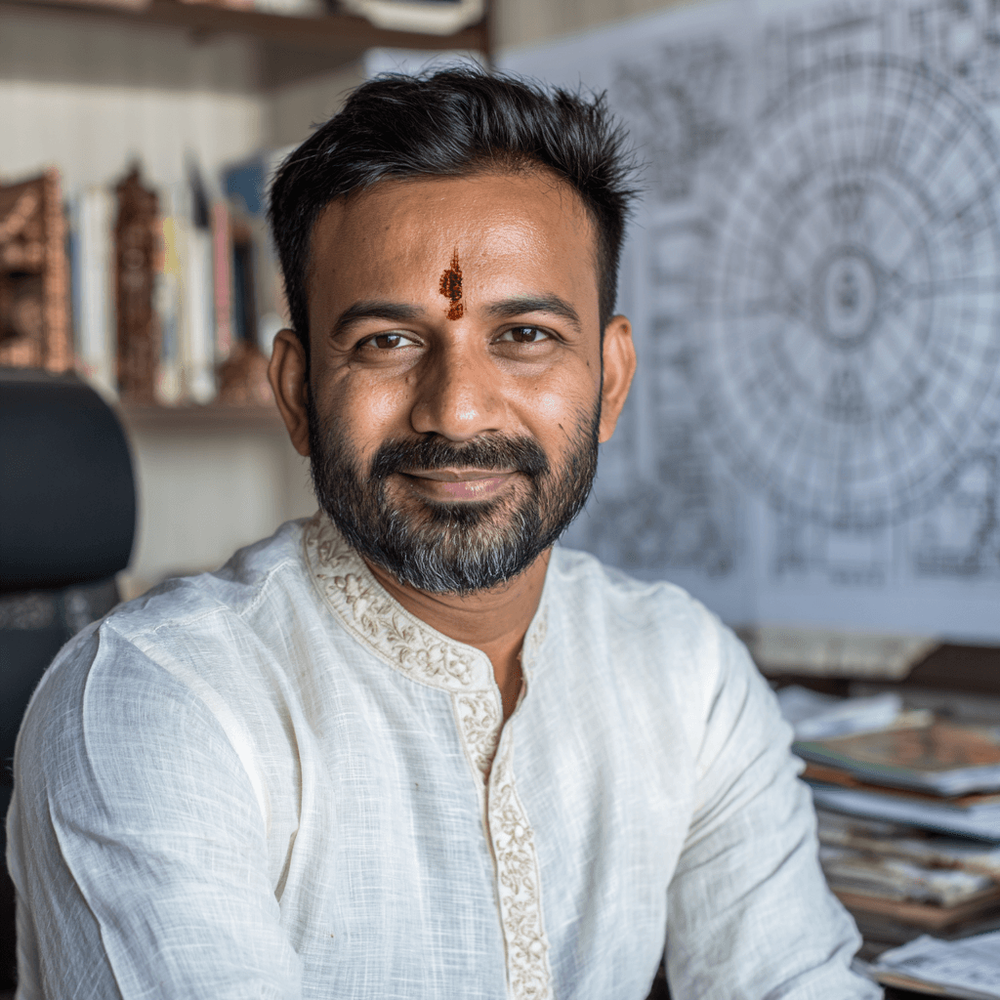
Shri Ankit Bansal
Vedic Astrologer · Numerology and Vastu Expert, 15+ Years
Shri Ankit Bansal is a renowned numerology and Vastu expert with over 15 years of specialized experience in these ancient Indian sciences. His extensive practice encompasses thousands of consultations in numerological analysis, name corrections, business numerology, and comprehensive Vastu assessments for residential and commercial properties. As a contributing writer for AstroSight, Shri Bansal combines his deep understanding of numerical vibrations with practical Vastu principles to provide holistic solutions that harmonize living and working spaces with cosmic energies. His expertise spans personal numerology charts, business name analysis, property Vastu audits, and remedial measures that blend traditional wisdom with modern lifestyle requirements. Through his methodical approach and proven track record, Shri Bansal has established himself as a trusted authority in helping clients optimize their environment and numerical influences for enhanced prosperity, health, and overall well-being.