
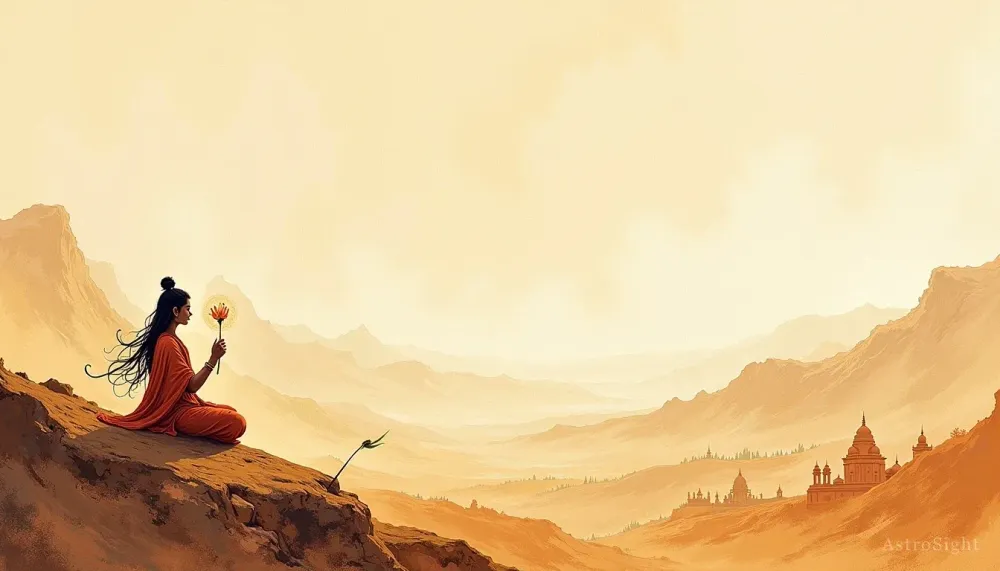
Shukra Mantra: For Venus, Love, Beauty & Material Comfort
Reviewed by Acharya Ravi Teja, Jyotish Acharya & Vedic Priest, Tirupati — as of May 2026. Use the birth chart calculator to see how this plays out in your personal Vedic chart.
Reviewed by Acharya Ravi Teja, Jyotish Acharya & Vedic Priest, Tirupati — as of May 2026. Use the birth chart calculator to see how this plays out in your personal Vedic chart.
Shukra — the Sanskrit name for Venus — stands among the most complex and consequential planets in the Vedic horoscope. In Brihat Parashara Hora Shastra, Maharishi Parashara designates Shukra as the Kalatrakaraka — the primary significator of marriage, the spouse, and conjugal relations. Beyond marriage, Shukra governs the entire domain of earthly pleasure: beauty, luxury, fine arts, music, sensuality, expensive vehicles, diamonds, silk, perfume, and material comfort. Shukra is simultaneously the teacher (guru) of the asuras — the divine beings who represent material desire and worldly power — and the lord of two powerful signs, Taurus and Libra, both signs associated with beauty, equilibrium, and abundance. When Venus is strong in the natal chart, the native attracts wealth, harmonious relationships, artistic talent, and social grace effortlessly. When Shukra is weak, afflicted, or poorly placed, the result is troubled marriages, financial instability, lack of refinement, and an inability to attract or sustain comfort. The Shukra mantra is the Vedic tool for rectifying Venus-related deficiencies and amplifying Venus-governed blessings in every department of life it touches.
> Quick Answer: The core Shukra mantra is OM SHUKRAYA NAMAH. Recite it 108 times every Friday using white flowers, white rice, and a connection to Goddess Lakshmi for love, beauty, and material prosperity.
The Vedic Shukra Mantra — OM SHUKRAYA NAMAH
The foundational Navagraha mantra for Venus is:
OM SHUKRAYA NAMAH
Om — the universal invocation that opens the channel between the reciter and the cosmic force being addressed. Shukraya — dative case of Shukra; "to Venus." Shukra literally means "bright, brilliant, pure, luminous" in Sanskrit — a direct reference to Venus as the brightest object in the night sky after the Moon. Namah — "I bow," the prostration that dissolves the ego-barrier between the practitioner and the planetary force.
Full meaning: I bow to Venus, the brilliant and luminous planet of love, beauty, and material abundance.
This mantra is drawn from the Navagraha Stotra canon preserved in the Skanda Purana. The Shukra verse of the Navagraha Stotra describes Venus as white-complexioned, riding a white horse, carrying a staff, a rosary, and a vessel, and wearing white garments — all the signatures of Shukra's nature as a planet of purity, whiteness, and material beauty. The mantra OM SHUKRAYA NAMAH is the concentrated salutation at the heart of this praise.
Recitation count: 20 repetitions daily as minimum (Venus's number in the Vedic numerological system); 108 as standard; 1,008 on Fridays for intensified Venus strengthening.
> Quick Answer: OM SHUKRAYA NAMAH addresses Venus directly and comes from the Skanda Purana's Navagraha Stotra. The minimum daily count is 20; 108 is standard; 1,008 on Fridays.
Shukra Gayatri — OM ASWADHWAJAYA VIDMAHE
The Gayatri form of the Venus mantra operates through the 24-syllable Chandas meter — the same sacred meter as the Savitri Gayatri of the Rigveda (III.62.10) — and carries the deepest vibratory imprint of the planet's nature.
The Shukra Gayatri is:
OM ASWADHWAJAYA VIDMAHE
MRIGAHASTAAYA DHIMAHI
TANNO SHUKRAH PRACHODAYAT
Aswadhwajaya — "He whose flag/banner bears the horse (Ashwa)." The horse is Shukra's vehicle (vahana). The horse in Vedic symbolism represents beauty, speed, freedom, and nobility — qualities central to Venus. The Ashwins, the twin horse-headed divine physicians of the Rigveda, are also associated with Venus energy through their connection to beauty and healing.
Vidmahe — "May we come to know / perceive."
Mrigahastaaya — "He who holds a deer in his hand." The deer (Mriga) is a symbol of gentleness, grace, and sensitivity — the defining emotional qualities of Shukra's influence.
Dhimahi — "We meditate upon."
Tanno Shukrah Prachodayat — "May Venus inspire and illuminate our understanding."
Full translation: May we come to know the one whose banner bears the horse. We meditate upon the one who holds the gentle deer. May Venus inspire and uplift our awareness.
The horse-banner of Shukra also links Venus to the concept of Ashwamedha — the royal horse sacrifice that symbolized sovereignty and expansive prosperity. In the context of the Shukra Gayatri, the horse-banner affirms that Venus presides over the kind of prosperity that is visible, beautiful, and socially elevated.
Recitation method: Sit facing north (direction of Kubera, the god of wealth — appropriate for Venus's material domain). Use a white or crystal mala. Light a rose or jasmine incense. Recite 108 times, visualizing soft white or silver light filling the heart center (Venus governs the heart).
> Quick Answer: Shukra Gayatri is OM ASWADHWAJAYA VIDMAHE / MRIGAHASTAAYA DHIMAHI / TANNO SHUKRAH PRACHODAYAT. "Ashwa" (horse) is Venus's vehicle. Recite 108 times facing north with white or crystal mala.
The Beej Mantra — SHUM
The beej (seed) mantra for Venus is SHUM (also written SHU in some traditions, but SHUM with the anusvara nasal closure is the complete form).
Phonetic breakdown: 1. SH — the sibilant Sha (Sha-kara), derived from the first syllable of Shukra; this phoneme carries the vibratory fingerprint of Venus 2. U — the vowel that softens and rounds the sound, corresponding to Venus's quality of comfort and receptivity 3. M — the anusvara, the nasal humming close that seals the syllable and turns its resonance inward, toward the subtle body
In the Shakta Tantra tradition, SHUM is also associated with the Goddess energy in her graceful, Lakshmi-like form. This is consistent with the tight mythological relationship between Shukra and Lakshmi: both govern material abundance, beauty, and divine grace. Reciting SHUM therefore simultaneously invokes Venus the planet and Lakshmi the goddess — the two powers that together govern the entire domain of earthly prosperity and relationship.
Practical use of SHUM: 1. Recite SHUM silently before any social interaction, job interview, or romantic meeting where making a beautiful impression matters 2. Use SHUM as a mental anchor during any creative or artistic work 3. For relationship healing, recite SHUM 108 times while holding a rose quartz crystal 4. The classical Purascharana for Venus involves 16,000 SHUM recitations over 40 days beginning on a Friday
> Quick Answer: The beej mantra for Venus is SHUM — derived from Shukra. It resonates with both Venus (planet) and Lakshmi (goddess). Use before social interactions and creative work. The full Purascharana is 16,000 repetitions over 40 days.
The Shukra Stotra from Navagraha Puja
The complete Navagraha Stotra verse for Shukra, recited in traditional Navagraha Puja, is:
Himakundha Mrinalabham Daityaanam Paramam Gurum
Sarvashaastra Pravaktaaram Bhargavam Pranamamyaham
Transliteration and meaning: 1. Himakundha Mrinalabham — "Radiant as snow, as the white kunda flower, as the stalk of a lotus." All three comparisons emphasize the brilliant whiteness of Venus. The kunda flower (Jasminum multiflorum) is one of the most fragrant of white flowers and is traditionally offered to Venus. The lotus stalk's whiteness refers to the inner, unseen purity of the plant — suggesting that Shukra's beauty is not merely superficial but carries an inner luminosity. 2. Daityaanam Paramam Gurum — "The supreme teacher of the Daityas (asuras)." Shukra (also called Shukracharya) is the legendary preceptor of the demonic powers in the Puranic narratives. He holds the secret of Mritasanjivani — the knowledge of reviving the dead — a power that even the divine teacher Brihaspati (Jupiter) does not possess. This positions Shukra as the master of the most hidden knowledge. 3. Sarvashaastra Pravaktaaram — "The one who expounds all the sciences (shastras)." Shukracharya is credited with composing the Shukraniti — a treatise on statecraft and social organization — affirming his role as master of practical knowledge. 4. Bhargavam — "Descendant of Bhrigu." Shukra's lineage traces to the sage Bhrigu, one of the Prajapatis and the founder of the Bhrigu Samhita (the legendary astrological text containing horoscopes for all souls). 5. Pranamamyaham — "I offer my prostrations."
Full translation: I bow to the one radiant as snow, kunda flower, and lotus stalk — the supreme teacher of the asuras, the expounder of all sciences, the descendant of Bhrigu.
This stotra is recited 20 times in the Shukra-specific section of the Navagraha Homa. At the Kanipakam Vinayaka temple and at Venus shrines in South India, this stotra forms the core of the Friday Navagraha abhishekam (ritual bathing of the planetary deities).
> Quick Answer: The Shukra Stotra is "Himakundha Mrinalabham Daityaanam Paramam Gurum / Sarvashaastra Pravaktaaram Bhargavam Pranamamyaham." It praises Venus as snow-white, the teacher of the asuras, and the master of hidden knowledge.
Friday (Shukravar) Protocol
Friday is Shukravar — Venus's day. Of all the weekly planetary protocols, the Friday Venus worship is the most visually beautiful and the most directly tied to a goddess: Lakshmi, the consort of Vishnu and the supreme deity of prosperity and beauty.
Timing: Friday sunrise through noon is the primary window. The Venus hora on Friday (first hora after sunrise) is the most potent period. A secondary powerful window is Friday sunset, when Venus the evening star becomes visible on the western horizon.
Sacred materials: 1. White flowers — jasmine (chameli), kunda, white rose, or white lotus. Offer 20 white flowers to Lakshmi and to the Venus yantra. 2. White rice — wash 20 handfuls of raw white rice with milk, then offer with a silver spoon. The milk-rice combination (kheer) is Lakshmi's preferred offering. 3. Sugarcane or sweet foods — Venus governs sweet taste (Madhura Rasa) in Ayurveda. Offering white sweets (white kheer, white halwa, or coconut laddoo) pleases Shukra. 4. Camphor, rose water, and jasmine incense — for fragrance, which Venus governs in the five-sensory domain (Shukra governs sight/beauty and scent/fragrance in the Tanmatra system). 5. White or silver cloth — cover the altar or worship space in white. 6. Diamond or white topaz — Shukra's gemstone is diamond (Vajra in Sanskrit). White sapphire and white topaz are the accessible alternatives. Place the stone near the lamp during the Friday puja.
Lakshmi connection: The Lakshmi Tantra, a Pancharatra text, directly equates Lakshmi's grace (Anugraha Shakti) with Venus's astrological influence. Performing Lakshmi Puja on Fridays is the most traditional form of Shukra strengthening across all regional Vedic traditions. The Kanakabhishekam (golden shower ritual) to Lakshmi, performed at major temples on Fridays, is specifically prescribed in the Agama Shastra for those experiencing Venus Mahadasha difficulties.
Full Friday protocol: 1. Bathe before sunrise; wear white or off-white clothing 2. Decorate the altar with white flowers 3. Offer white rice with milk and white sweets 4. Light jasmine incense and rose water spray 5. Recite Lakshmi Ashtottara (108 names of Lakshmi) or Sri Suktam 6. Recite OM SHUKRAYA NAMAH 108 times 7. Recite Shukra Gayatri 20 times 8. Recite Shukra Stotra 3 times 9. Donate white cloth or white sweets to women (Venus is feminine in Vedic astrology) 10. Avoid non-vegetarian food and alcohol
> Quick Answer: The Friday Venus protocol uses white flowers, white rice with milk, white sweets, jasmine incense, and diamond or white topaz. Lakshmi worship is the primary Friday Venus strengthening method. Recite OM SHUKRAYA NAMAH 108 times.
Shukra Mahadasha — The 20-Year Venus Period
The Shukra Mahadasha — the major period ruled by Venus in the Vimshottari Dasha system — lasts 20 years, the longest Mahadasha of any planet except Shani (19 years) and Ketu (7 years). This 20-year period is among the most consequential in a person's life, and its quality depends entirely on Venus's placement, strength, and associations in the natal chart.
When Shukra Mahadasha is active:
For a well-placed Venus: The 20-year period is marked by increased prosperity, beautiful surroundings, romantic fulfillment, creative achievement, luxury, and social elevation. Marriage often occurs during Venus Mahadasha when Venus is strong. The arts — music, cinema, design, fashion — flourish under a benefic Venus period.
For an afflicted Venus: The same 20 years can bring troubled relationships, financial excesses, health issues related to Venus-governed body parts (kidneys, reproductive system, skin, thyroid), and uncontrolled indulgence in sensory pleasures. Rahu conjunct Venus (the combination described in BPHS as causing unconventional or obsessive love) during the Mahadasha creates especially turbulent relationship karma.
Common manifestations requiring mantra intervention: 1. Delayed or broken marriage during Venus Mahadasha 2. Financial comfort followed by sudden loss (Venus in dusthana houses 6, 8, 12) 3. Kidney disorders or skin conditions 4. Artistic stagnation despite talent 5. Excessive attachment to material pleasure
The prescribed Shukra Mahadasha sadhana: When Venus Mahadasha begins, start the 40-day Shukra Purascharana: 16,000 SHUM recitations in total, with daily Friday sessions of minimum 400 repetitions. Continue OM SHUKRAYA NAMAH 108 times every Friday throughout the 20-year period. Wear white sapphire or white topaz (after astrological confirmation of Venus's nature in your chart — Venus as a yogakaraka or functional benefic).
The Jataka Parijata (a classical Jyotisha text) states that even a debilitated Venus (in Virgo, its sign of debilitation) can be rendered benefic through regular mantra practice and gemstone use when the practitioner maintains the Friday protocol throughout the Mahadasha.
> Quick Answer: Shukra Mahadasha lasts 20 years. When Venus is afflicted, it brings relationship difficulties, financial instability, and health issues (kidneys, skin). Begin the 40-day Purascharana (16,000 SHUM) when the Mahadasha starts and maintain the Friday protocol throughout.
---
Personalized Report
Janampatri (Birth Chart Report)
Get your complete personalised Vedic birth chart analysis
- Personalized analysis based on YOUR exact birth chart
- Expert-prepared by Dr. Meenakshi Sharma
- Delivered as PDF within 24-48 hours
- Unlimited follow-up clarifications
By Dr. Meenakshi Sharma · Delivered in 24-48 hours

Acharya Ravi Teja
Expert in Vedic Astrology Remedies, 18+ Years
Acharya Ravi Teja is a distinguished remedial astrology expert with over 18 years of specialized experience in the therapeutic and corrective aspects of Vedic astrology. His extensive practice focuses on prescribing and implementing powerful astrological remedies including gemstone recommendations, yantra installations, mantra practices, and comprehensive dosha mitigation strategies. As a contributing writer for AstroSight, Acharya Ravi Teja shares his profound knowledge of remedial measures that address planetary afflictions, karmic imbalances, and doshas such as Manglik, Kaal Sarp, and Pitra Dosha. His expertise encompasses the precise selection of authentic gemstones based on individual birth charts, the consecration and placement of sacred yantras for specific purposes, and the guidance of targeted mantra practices for spiritual and material well-being. Through his methodical approach and deep understanding of remedial astrology, Acharya Ravi Teja has successfully helped thousands of clients neutralize negative planetary influences and enhance positive cosmic energies, establishing himself as a trusted authority in the field of astrological remedies and spiritual healing.


