

Pitru Dosha: Symptoms, Causes & Tarpan Remedies
_Reviewed by Shri Ankit Bansal, Vedic Astrology Consultant with 15+ years of experience. As of 2026._
_Reviewed by Shri Ankit Bansal, Vedic Astrology Consultant with 15+ years of experience. As of 2026._
---
Pitru Dosha (also written Pitra Dosha) is an astrological and karmic condition linked to unfulfilled obligations toward one's ancestors (Pitrus) — souls of deceased family members who have not received proper Shraddha (ritual nourishment) or whose deaths involved unresolved suffering. As of 2026, Pitru Dosha is identified in a birth chart primarily through the affliction of the Sun (karaka for father and ancestors) in the 9th house, or through the 9th lord being weak or conjunct Rahu, Ketu, or Saturn.
The Pitru Paksha fortnight — a 16-day period in the Hindu calendar (typically September-October) during which the Sun transits Virgo and the Moon cycles through its dark phase — is the dedicated annual window for performing Tarpan, Shraddha, and other ancestral rites. In 2026, Pitru Paksha runs from September 17 to October 2. Missing these rites consistently across generations is the primary karmic mechanism that creates Pitru Dosha.
The Sanskrit term "Pitru" means "father" in a broad ancestral sense — encompassing all paternal and maternal ancestors across multiple generations. The Garuda Purana, which dedicates extensive sections to ancestor rites, states that when the living fail to offer Tarpan (water libations), the Pitrus remain in a state of longing and their dissatisfaction creates obstacles in the lives of their descendants.
The Brihat Parashara Hora Shastra addresses ancestor-related afflictions in the context of 9th house analysis. BPHS Chapter 34 states that when the 9th house lord is weak or the 9th house is occupied by malefics, the native's dharma (including ancestor duties) is compromised, producing obstacles in life across multiple domains.
Pitru Dosha is not a cause for panic — it is a signal that a specific karmic debt needs attention. Understanding it accurately, without alarmism, is the first step to resolving it. You can check the condition of your 9th house and the Sun's placement at the birth chart calculator.
What are the astrological indicators of Pitru Dosha in a birth chart?
Pitru Dosha in the birth chart is identified through the following specific configurations:
Primary indicator: The Sun (Surya) is afflicted in the 9th house — meaning conjunct Rahu, Ketu, or Saturn in the 9th house. The 9th house governs dharma, father, and ancestral legacy. The Sun is the natural karaka for the father and the paternal lineage. When the Sun is compromised here, the ancestral connection is weakened.
Secondary indicators: 1. The 9th lord is weak (debilitated, combusted by the Sun, or in an enemy sign) in any house 2. The 9th lord is conjunct Rahu or Ketu anywhere in the chart 3. Saturn occupies the 9th house alone (without benefic aspect) 4. Rahu or Ketu is in the 5th house (5th house governs putra — children and past-life karma) 5. The Moon is afflicted in the 4th house (4th house governs the maternal lineage)
K.N. Rao, in his teachings on ancestral karma in Vedic astrology, notes that the most unambiguous Pitru Dosha configuration is the Sun-Rahu conjunction (called Grahan Yoga) in the 9th house — this combines the ego of self-projection with the shadow node directly in the house of the father and dharma.
What causes Pitru Dosha to form across generations?
The Garuda Purana (Chapters 10-12) describes five primary causes of Pitru Dosha formation:
1. Failure to perform Shraddha: The most direct cause. When a family stops performing the annual Shraddha (ritual feeding of Brahmins on behalf of ancestors) or Tarpan (water offerings at rivers), the Pitrus are deprived of their ritual nourishment. The Garuda Purana states that 3 generations of such neglect creates persistent Pitru Dosha.
2. Death under unnatural circumstances: When an ancestor died by accident, suicide, or violence and was not given proper last rites (Antyesti), that soul's departure was incomplete. Incomplete departures create karmic threads that affect descendants.
3. Abandonment of elders: When aged parents or grandparents were not cared for in their final years, or were sent to institutions without family support, the accumulated karma of that neglect becomes part of the family's karmic inheritance.
4. Taking ancestral property without consent: When a family member acquired ancestral property (land, house, jewelry) through deception or without appropriate distribution among rightful heirs, the aggrieved souls generate an energetic disturbance.
5. Disrespect for women in the lineage: When women in the family were mistreated, prevented from their rights, or abandoned, their suffering generates a karmic debt called Stri Dosha that compounds the Pitru Dosha.
What are the symptoms of Pitru Dosha in a family?
Classical and regional Vedic texts describe certain recurring patterns in families affected by Pitru Dosha. These are reported patterns — not guaranteed outcomes — and should be assessed within the full context of the family's situation.
Recurring health issues in the family: Particularly conditions affecting the same organ or body system across multiple generations. For example, if the grandfather, father, and son all develop liver or spinal conditions, classical interpretation considers this a potential Pitru Dosha marker.
Persistent financial obstacles: A family that repeatedly builds wealth and loses it, or that faces property disputes across generations, is described in the Garuda Purana as potentially bearing Pitru Dosha.
Delays in marriage or children: Repeated marriage delays or difficulty conceiving children (particularly male progeny in the traditional view) are cited. The 5th house (children) and 7th house (marriage) are both connected to the ancestral lineage's blessings.
When a marriage prospect does appear, pairing this kind of ancestral review with a formal Ashtakoota matching check gives families the broader compatibility picture alongside the dosha analysis.
Accidents and untimely deaths: A pattern of short lifespans or accidents in a family lineage is cited in the Garuda Purana as a marker of Pitru Dosha, particularly when deaths occur at similar ages across generations.
Important: these symptoms do not automatically indicate Pitru Dosha. Medical conditions have medical causes, and financial setbacks have economic causes. Pitru Dosha is one lens for understanding persistent patterns, not a replacement for practical and medical assessment. I've seen clients who were told by one astrologer that every difficulty in their life was Pitru Dosha, which led them to spend money on repeated pujas while ignoring actionable life changes. The correct approach is to address both the karmic dimension and the practical dimension simultaneously.
What is Pitru Paksha and when does it occur in 2026?
Pitru Paksha is the 16-day period dedicated entirely to ancestral rites in the Hindu calendar. It falls during the dark fortnight of the month of Bhadrapada (or Ashwin, depending on regional calendar tradition), when the Sun is in Virgo and is associated with Pitru Loka (the realm of ancestors).
In 2026, Pitru Paksha runs from September 17 (Purnima Shraddha — for those whose ancestor died on a full moon) to October 2 (Mahalaya Amavasya — Sarvapitri Amavasya). Mahalaya Amavasya on October 2, 2026 is the most important single day of Pitru Paksha — it is the day on which Shraddha and Tarpan are performed for ALL ancestors regardless of their known death tithi (date).
Each day of Pitru Paksha corresponds to a specific lunar tithi, and Shraddha is ideally performed on the tithi that matches the ancestor's death tithi. If the exact death tithi is unknown (which is common for ancestors more than 2-3 generations back), Mahalaya Amavasya covers all.
How is Tarpan performed?
Tarpan is the daily water libation offered to ancestors during Pitru Paksha and also on every Amavasya (new moon) throughout the year. The ritual is typically performed by the senior male of the family (though women can perform it), standing in flowing water (river, lake, or ocean), or at home using a copper vessel.
Step-by-step Tarpan method:
1. Stand facing south (the direction of the ancestors — Pitru Disha) in waist-deep water if possible, or at a clean altar at home 2. Apply a tilak of sesame paste (black til) on the forehead 3. Fold the sacred thread (yajnopavita) into Pitru Mudra position 4. Take water in both cupped hands mixed with: black sesame seeds (til), barley (jau), and white flowers (preferably kush grass) 5. Recite the Pitru Tarpan Mantra: "Devascha Pitruncha Manushyaancha Bhootaani, Tarpayaami Tarpayaami Tarpayaami" 6. Offer the water by letting it flow through the fingers toward the south (southward flow = toward Pitru Loka) 7. Repeat 3 times for each named ancestor (father, grandfather, great-grandfather, and equivalent maternal lineage) 8. Conclude with the Pitru Gayatri: "Om Pitru Devaabhyo Vidmahe Jagat Dhaatrubhyo Dhiimahi Tanno Pitarah Prachodayaat"
The minimum daily Tarpan takes 15-20 minutes. The complete Shraddha ritual (which includes Brahmin feeding and the full Pitru Puja) takes 3-4 hours and is performed once annually on the appropriate tithi.
How is Shraddha puja different from Tarpan?
Tarpan and Shraddha are related but distinct ancestral rites.
Feature | Tarpan | Shraddha
- Frequency — Daily (or on each Amavasya) — Annual (during Pitru Paksha on correct tithi)
- Medium — Water libations — Food offerings + Brahmin feeding
- Duration — 15-30 minutes — 3-6 hours
- Location — River/water body or home — Home or riverside
- Officiating — Self (male family head) — Qualified purohit
- Core item — Black sesame + water — Pinda (rice balls), sesame, milk
Shraddha is the more complete ritual. The Garuda Purana (Chapter 10) describes the Pinda Daan (offering of rice balls) as the primary vehicle through which nourishment reaches the Pitrus. Three Pindas are offered: one for the father, one for the paternal grandfather, and one for the paternal great-grandfather. Additional Pindas are offered for the maternal lineage.
What is Gaya Teertha and why is it significant for Pitru Dosha?
Gaya (in Bihar state, approximately 100 kilometers south of Patna) is considered the most sacred site for ancestral rites in all of Vedic tradition. The Vayu Purana dedicates multiple chapters to the Gaya Mahatmya, stating that Pinda Daan performed at Gaya delivers liberation (moksha) to 7 generations of ancestors — a power no other tirtha possesses.
The Vishnupada Temple at Gaya marks the location where Vishnu's footprint pressed into stone during the defeat of the demon Gayasur. The demon's final request was that his body remain sacred ground for ancestor rites, and Vishnu granted this boon. The Falgu River flowing through Gaya is the place where Pinda Daan is performed.
Lord Rama and Sita are described in the Valmiki Ramayana as performing Pinda Daan at Gaya for King Dasharatha — establishing the precedent for Gaya pilgrimage as the highest form of Pitru Dosha remedy.
For those unable to travel to Gaya, the next-best options are Prayagraj Triveni Sangam, Haridwar, Varanasi (Kasi Vishwanath), and the Rameshwaram sea confluence.
What is the Papa Shanka remedy for Pitru Dosha?
Papa Shanka (literally "doubts about sin/karma") is a remedial puja performed when the exact nature of the ancestral karma creating Pitru Dosha is unclear. This puja is performed at a qualified temple or by a learned purohit and involves:
1. Recitation of the Pitru Sukta from the Rigveda 2. Offering of Navadhan (9 grains) and 12 types of fruits 3. A coconut offered in the name of the afflicted ancestor 4. Daan (donation) of rice, sesame, and clothing to a Brahmin family 5. Planting a peepal tree (the tree most closely associated with the Pitrus) near a temple or public space
The peepal tree is said to be the actual abode of the Pitrus on earth. Watering it regularly, particularly on Saturdays and Amavasya (new moon) days, is one of the simplest ongoing Pitru Dosha remedies accessible to any person regardless of their ritual knowledge.
What is the difference between astrological Pitru Dosha and the ritual interpretation?
A distinction worth drawing clearly: Pitru Dosha in the astrological sense and Pitru Dosha in the ritual/religious sense are related but not identical.
Astrological Pitru Dosha refers specifically to planetary configurations in the birth chart (Sun afflicted in 9th house, weak 9th lord, etc.). It is a horoscope-based diagnosis that an astrologer makes by examining the chart.
Ritual Pitru Dosha refers to the spiritual condition of a family whose ancestral rites have been neglected — this can affect anyone regardless of their birth chart. A person without any astrological Pitru Dosha indicators can still benefit from performing Tarpan and Shraddha because these are dharmic duties (kartavya) that every householder owes to their ancestors.
The Brihat Parashara Hora Shastra treats Pitru Dosha as a chart-based condition. The Garuda Purana treats it as a universal family condition triggered by ritual neglect. Both frameworks point to the same remedy: performing the proper ancestral rites with sincerity and regularity.
You can explore your 9th house, the Sun's placement, and ancestral indicators in your full birth chart at the birth chart calculator.
Understand How Doshas Shape Your Life Path
Doshas influence more than relationships — they affect career timing, health, and life direction. Get a personalized D1 and D10 chart analysis with remedies specific to your chart.
Get Your JanampatriPersonalized Report
Janampatri (Birth Chart Report)
Understand how this dosha affects your full chart — get your complete Janampatri
- Personalized analysis based on YOUR exact birth chart
- Expert-prepared by Dr. Meenakshi Sharma
- Delivered as PDF within 24-48 hours
- Unlimited follow-up clarifications
By Dr. Meenakshi Sharma · Delivered in 24-48 hours
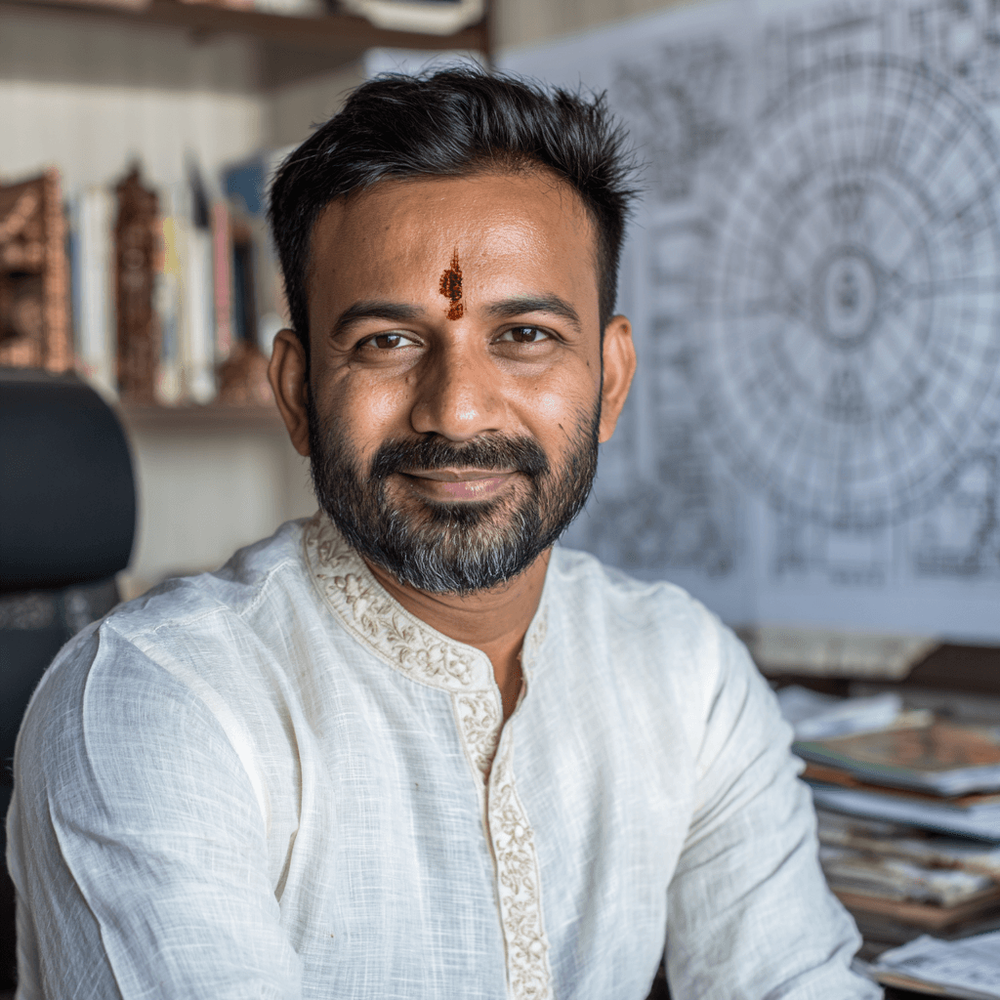
Shri Ankit Bansal
Vedic Astrologer · Numerology and Vastu Expert, 15+ Years
Shri Ankit Bansal is a renowned numerology and Vastu expert with over 15 years of specialized experience in these ancient Indian sciences. His extensive practice encompasses thousands of consultations in numerological analysis, name corrections, business numerology, and comprehensive Vastu assessments for residential and commercial properties. As a contributing writer for AstroSight, Shri Bansal combines his deep understanding of numerical vibrations with practical Vastu principles to provide holistic solutions that harmonize living and working spaces with cosmic energies. His expertise spans personal numerology charts, business name analysis, property Vastu audits, and remedial measures that blend traditional wisdom with modern lifestyle requirements. Through his methodical approach and proven track record, Shri Bansal has established himself as a trusted authority in helping clients optimize their environment and numerical influences for enhanced prosperity, health, and overall well-being.


