
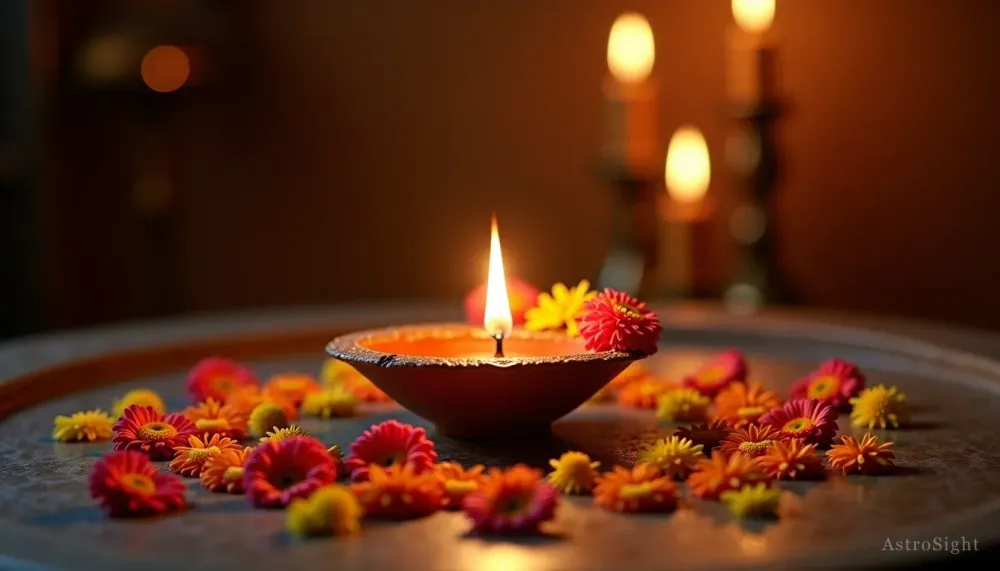
Ganesha Mantra for Removing Obstacles: Complete Guide
Lord Ganesha is the supreme remover of obstacles in Vedic tradition. Learn the most powerful Ganesha mantras including Om Gam Ganapataye Namah, proper chanting methods, and complete worship protocols.
Why Is Lord Ganesha Called the Obstacle Remover?
When life throws obstacles in your path—career blocks, relationship troubles, failed ventures, or inexplicable bad luck—Vedic tradition turns to Lord Ganesha, the elephant-headed deity whose primary role is removing barriers between you and your goals. The Mudgala Purana and Ganesha Purana extensively describe his powers as Vighneshwara (Lord of Obstacles) and Vighnaharta (Remover of Obstacles). This dual title reveals something crucial: Ganesha doesn't merely remove obstacles—he is the lord over all obstacles, meaning he can both create and remove them according to cosmic necessity.
In my consultation practice, I consistently observe that clients who establish a sincere practice of Ganesha mantra experience subtle but tangible shifts in how obstacles manifest in their lives. Rather than sudden magical resolution, most experience a gradual opening of previously blocked pathways. A job application that sat unanswered for months suddenly receives attention. A family conflict that seemed intractable finds unexpected common ground. A business deal that appeared dead revives. These are the fingerprints of Ganesha's grace—not flashy miracles, but the quiet removal of invisible barriers.
The Mythology Behind Ganesha's Power
According to the Shiva Purana, Parvati created Ganesha from her body's essence (some texts say from turmeric paste mixed with her bodily oils) to guard her privacy while she bathed. When Shiva—whom Ganesha didn't recognize as his father—tried to enter, Ganesha stood firm and refused passage. Even when Shiva's attendants (ganas) attacked, Ganesha defeated them all. Ultimately, Shiva himself had to intervene, and in the ensuing conflict, Ganesha's head was severed.
When Parvati discovered what had happened, her grief threatened to destroy the universe. To restore balance, Shiva sent his ganas to bring the head of the first creature they found sleeping with its head facing north. They returned with an elephant's head, which Shiva attached to Ganesha's body, bringing him back to life. Shiva then blessed Ganesha as the remover of all obstacles—he would be worshipped first before all other deities, and no auspicious endeavor could succeed without his blessing.
This mythology carries deep symbolic meaning. Ganesha's original duty was to guard the threshold—the boundary between outer and inner worlds. This is precisely why he controls obstacles: he stands at every doorway, every transition point, every threshold between where we are and where we wish to go. His blessing opens these doors; his absence keeps them closed.
The Deep Symbolism of Ganesha's Form
Every aspect of Ganesha's unique form carries profound meaning for spiritual seekers. The Ganapati Atharvashirsha Upanishad declares: "Tvam mula prakriti" (You are the primordial nature). Understanding his iconography deepens mantra practice:
- Elephant head — Represents supreme wisdom (buddhi) and the power to remember dharmic principles. Elephants never forget, symbolizing the importance of remembering our true nature. The large head also signifies that thinking—clear, wise thinking—is the greatest tool for overcoming obstacles. The trunk can uproot trees or pick up a needle, representing the ability to handle both massive obstacles and subtle blockages.
- Single tusk (Ekadanta) — According to the Mahabharata, Ganesha broke his own tusk to write the epic as Sage Vyasa dictated it. This represents sacrifice for higher knowledge, discrimination between essential and non-essential, and the willingness to give up personal comfort for dharmic purpose. The single tusk also symbolizes non-duality—transcending the pairs of opposites that create most human suffering.
- Large belly (Lambodara) — Contains all the universes within it, representing the cosmic principle that everything exists within consciousness. Practically, it signifies the ability to digest and transform all experiences—including obstacles—into wisdom. Nothing disturbs a large belly; similarly, nothing should disturb the equanimity of a Ganesha devotee.
- Four arms — Holding an axe (parashu) to cut obstacles, a rope (pasha) to pull devotees toward liberation, a modak sweet representing the rewards of spiritual practice, and one hand in abhaya mudra granting fearlessness. Some iconographic forms show a tusk, lotus, or other items.
- Mouse vehicle (Mushika Vahana) — The mouse represents desire, which can gnaw through anything and multiply endlessly if uncontrolled. Ganesha sitting on the mouse shows mastery over desire—not its elimination, but its proper direction. The mouse can also enter the smallest spaces, symbolizing that Ganesha's grace penetrates even the most subtle obstacles that we may not consciously recognize.
What Types of Obstacles Does Ganesha Remove?
The Ganesha Purana categorizes obstacles into several distinct types, each requiring slightly different approaches while all falling under Ganesha's jurisdiction. Understanding these categories helps you approach your practice with appropriate expectations and methods.
External Obstacles (Bahya Vighna)
These are visible obstacles in the material world: career blockages, business failures, legal troubles, financial difficulties, relationship conflicts, health issues, and practical problems that impede progress. In Jyotish terms, these often correlate with difficult planetary transits or dasha periods affecting specific houses in your chart. External obstacles typically respond well to consistent mantra practice, though the timeline varies based on the karmic weight involved.
In my experience, clients facing external obstacles—such as a delayed property sale, a stalled promotion, or immigration paperwork that keeps getting rejected—often see movement within 21-40 days of committed practice. The obstacles don't always disappear entirely; sometimes they transform, revealing that what seemed like a blockage was actually redirection toward something better.
Delayed marriage is one of the external obstacles I see most often, and before recommending mantra practice alone I usually suggest the family first run a detailed Ashtakoota analysis to rule out a genuine compatibility mismatch behind the repeated match failures.
Internal Obstacles (Antara Vighna)
These arise from within: fear, doubt, laziness, anger, attachment, pride, jealousy, and mental disturbances that prevent us from taking right action. The Mudgala Purana personifies these as demons (asuras) that Ganesha defeats in his eight incarnations. Internal obstacles are often more challenging than external ones because we frequently don't recognize them or mistakenly identify with them as 'just who we are.'
Ganesha mantra works on internal obstacles by gradually shifting the vibrational quality of the mind. Many practitioners report that their procrastination diminishes, their courage increases, and their mental clarity improves—often before any external circumstances change. This is Ganesha working from the inside out.
Karmic Obstacles (Prarabdha Vighna)
These stem from actions in past lives, crystallized into current life circumstances. The Brihat Parashara Hora Shastra (BPHS) describes how planetary positions at birth reflect karmic patterns that will manifest as obstacles in specific life areas. Karmic obstacles require the most patience—they cannot be simply wished away, but Ganesha's grace can soften their impact, accelerate their resolution, and help us learn the lessons they carry without excessive suffering.
Classical texts suggest that while prarabdha karma must be experienced, the manner and intensity of that experience can be modified through sincere spiritual practice. A difficult Saturn transit that might otherwise bring crushing delays may instead bring manageable challenges that still teach patience but don't destroy the devotee's peace.
Spiritual Obstacles (Adhyatmika Vighna)
For those on a spiritual path, obstacles to meditation, obstacles to understanding scripture, obstacles to finding a genuine teacher, and obstacles to maintaining practice are common. The Ganapati Atharvashirsha specifically addresses these, describing Ganesha as the gateway to all vidyas (knowledge systems). Traditionally, students begin any course of learning—whether Sanskrit, music, astrology, or Vedanta—with Ganesha worship precisely because he removes obstacles to learning and spiritual development.
What Are the Most Powerful Ganesha Mantras?
The Ganapati Atharvashirsha and various Tantric texts provide numerous mantras for invoking Ganesha's obstacle-removing power. The right mantra depends on your specific situation, your level of practice, and your spiritual inclination. Here are the most effective mantras, arranged from basic to advanced, with detailed guidance on each.
Basic Ganesha Mantra (Mool Mantra)
"Om Gam Ganapataye Namah"
Pronunciation: Om Gam Guh-nuh-puh-tuh-yeh Nah-mah-ha
Meaning: "Om" invokes the cosmic principle; "Gam" is Ganesha's bija (seed) mantra containing his essence; "Ganapataye" means "to the Lord of all beings (ganas)"; "Namah" means "I offer my salutations." Together: "I offer salutations to the Lord of all beings."
This is the most versatile Ganesha mantra, suitable for daily practice and effective for all types of obstacles. The Mantra Mahodadhi describes it as "sarvakamada"—fulfilling all desires. No initiation is required. Chant 108 times with a rudraksha or lotus seed mala, maintaining focus on Ganesha's form or the mantra's sound vibration.
Ganesha Beej (Seed) Mantra
"Om Gam"
This condensed mantra contains the concentrated essence of Ganesha's energy. Use it for quick invocation before any task, mental chanting when facing sudden obstacles, continuous repetition during difficult situations, or when time doesn't permit full practice. Minimum 21 times for effect. The bija "Gam" vibrates at the frequency of obstacle removal itself—short but potent, like a key that opens locked doors.
Vakratunda Mahakaya Mantra
"Vakratunda Mahakaya Suryakoti Samaprabha
Nirvighnam Kuru Me Deva Sarva Karyeshu Sarvada"
Meaning: "O Lord with curved trunk (Vakratunda) and massive body (Mahakaya), whose brilliance equals millions of suns (Suryakoti Samaprabha), please make all my endeavors obstacle-free (Nirvighnam), always (Sarvada), in all undertakings (Sarva Karyeshu)."
This shloka from the Narada Purana is ideal for recitation before starting any new venture. Unlike the mool mantra which is chanted 108 times, this verse is typically recited 3, 11, or 21 times with full focus on its meaning. It's particularly powerful before important meetings, exams, business launches, or any significant new beginning.
Runa Harta Mantra (Debt Removal)
"Om Ganesh Rinang Chhindhi Varenyam Hoong Namaah Phutt"
Meaning: "O Ganesha, cut away my debts (Rinang Chhindhi), bestow blessings (Varenyam)." The syllables "Hoong" and "Phutt" are power syllables that cut through obstacles.
This specialized mantra addresses financial obstacles and debt specifically. "Rina" includes not only monetary debt but also karmic debts and obligations that burden us. Chant 108 times on Wednesdays, combining the practice with charitable giving. The Lal Kitab tradition particularly recommends this mantra alongside practical remedies like feeding ants or offering jaggery to Ganesha.
Siddhi Vinayak Mantra
"Om Namo Siddhi Vinayakaya Sarva Karyakarta Sarva Vighnprashamnay Sarvarjaya Vashyakarnaya Sarvajan Sarvastree Purush Akarshanya Shreem Om Swaha"
This advanced mantra invokes Ganesha as "Siddhi Vinayak"—the bestower of accomplishment and success. It's more complex and traditionally recommended after establishing basic practice. Use this mantra when facing major obstacles that simpler mantras haven't resolved, or when seeking success in specific ambitious endeavors. The mantra includes attraction (akarshana) energy that draws favorable circumstances.
Ganapati Atharvashirsha
For serious practitioners, the complete Ganapati Atharvashirsha Upanishad is the most powerful Ganesha practice. This ancient text, attributed to the Atharva Veda tradition, describes Ganesha's cosmic nature and contains multiple mantras within it. Traditionally recited at sunrise, it's said that "he who studies this Atharvashirsha is freed from all obstacles... he attains all fulfillment, he becomes freed from great obstacles, freed from great misfortunes." Learning proper pronunciation from a teacher is recommended.
Understand Your Obstacle Patterns
Your birth chart reveals karmic obstacles and the planetary periods affecting different life areas. Get personalized insights into your current challenges and the most effective remedial timing.
Get Your Career ReportHow Should You Practice Ganesha Mantra Correctly?
The Mantra Shastra texts emphasize that proper practice method significantly affects mantra efficacy. A mantra chanted carelessly a thousand times yields less fruit than one chanted correctly a hundred times. The following guidelines synthesize classical instructions with practical wisdom from experienced practitioners.
Optimal Timing for Practice
Brahma Muhurta (approximately 4:00-5:30 AM) is considered supreme for all mantra practice. During this time, the mind is naturally sattvic (pure), worldly distractions are minimal, and prana (life force) flows most freely through the subtle channels. If this timing isn't practical, the period after sunrise (6:00-7:30 AM) remains excellent.
Evening practice (5:30-7:00 PM) during sandhya (twilight) is the second-best option. The transition between day and night creates a natural portal that amplifies mantra vibration. Avoid practicing immediately after meals, during late night hours (except for specific tantric practices), or when mentally agitated.
Wednesday (Budhvar) is Ganesha's day. The Muhurta Chintamani notes that mantras chanted on Wednesday carry enhanced effectiveness for Ganesha worship. Important new practices should ideally be started on this day.
Physical Preparation
- Purification: Take bath or at minimum wash face, hands, and feet. Wear clean clothes—traditionally yellow, orange, or red fabrics please Ganesha, though any clean clothes suffice.
- Seating: Sit on an asana (seat)—traditionally a woolen blanket, kusha grass mat, or cotton cloth. Avoid sitting directly on the floor or on synthetic materials. Face East (best) or North.
- Altar setup: Place a Ganesha image or murti before you at eye level. Light a ghee lamp (preferable) or oil lamp. Burn incense—sandalwood or natural fragrances. Offer fresh flowers if available, especially red flowers or durva grass.
- Mala selection: Rudraksha mala (best), lotus seed (kamal gatta) mala, or crystal (sphatik) mala are traditional for Ganesha. Sandalwood and tulsi malas are also acceptable. Avoid using a mala used for other deity worship.
The Practice Procedure
- Begin with three deep breaths to center yourself. Then chant "Om" three times slowly, feeling the vibration in your entire body.
- Take sankalpa (intention): State your purpose mentally or aloud: "I am chanting this Ganesha mantra for [specific obstacle or general blessing]." Be clear but not demanding—request rather than command.
- Touch the mala to the Ganesha image or to your forehead (ajna chakra), then hold in your right hand draped over the middle finger, using thumb to move beads. Never use the index finger, which is associated with ego.
- Begin chanting. Move one bead per complete mantra repetition. Maintain steady rhythm—not too fast (which causes carelessness) or too slow (which invites distraction).
- Complete 108 repetitions (one full mala). If doing multiple rounds, turn the mala around at the meru (summit) bead without crossing it—crossing the meru is considered inauspicious.
- End with a prayer of gratitude and dedication, offering the merit of your practice for the benefit of all beings or for your specific intention.
Practice Duration and Commitment
Minimum effective practice: One mala (108 repetitions) daily for 21 consecutive days. This establishes the mantra's vibration in your subtle body.
Standard practice: One mala daily for 40 consecutive days. The number 40 (chaalees) is considered a complete transformational cycle in Vedic tradition. Most serious obstacles begin shifting noticeably within this period.
Intensive practice: For deep karmic obstacles, commit to 108 days of practice. Some practitioners undertake a "purascharana"—completing 1.25 lakh (125,000) repetitions, which typically takes several months.
To understand which planetary periods might be creating obstacles in your life, use our Dasha Calculator for personalized timing insights.
What Should You Offer to Lord Ganesha?
The Ganesha Purana and Mudgala Purana specify particular offerings that please Lord Ganesha and amplify mantra effectiveness. While sincere devotion matters more than elaborate offerings, traditional items carry specific energetic resonance that enhances worship.
Ganesha's Essential Offerings
Durva Grass (Most Sacred): This is Ganesha's favorite offering, mentioned repeatedly in the Mudgala Purana. Offer 21 blades per offering, each blade with 3-5 joints (trisara or panchapallavi). Must be fresh green, never yellow or wilted. According to legend, Ganesha was once burned by the intensity of the sun's rays and cooled himself by rolling in durva grass—hence his special affinity for it. This grass symbolizes immortality, continuous growth, and cooling of obstacles' heat.
Modak (Supreme Sweet): Ganesha's favorite sweet, these dumplings are made of rice flour with coconut-jaggery filling. The shape resembles a closed lotus bud, symbolizing potential waiting to unfold. Offer 21 pieces on special occasions (Ganesh Chaturthi, Sankashti) or 1-3 pieces for daily worship. The Ganesha Purana states that one who offers modak to Ganesha never faces poverty.
Red Flowers: Red hibiscus (japa pushpa) is most preferred—it shares the color of Ganesha's energy and is associated with his shakti (power). Red roses are an acceptable alternative, as are marigolds for festival occasions. Avoid white, blue, or thorny flowers for Ganesha worship. Flowers represent the flowering of devotion and the beauty of a mind turned toward the divine.
Fruits: Bananas are Ganesha's favorite fruit, representing abundance and easy sustenance. Coconuts (always with husk intact) represent the ego that must be broken to reveal the sweet water of devotion within. Pomegranates, mangoes, and seasonal fruits are all appropriate. Offer fruits whole, not cut.
Special Offerings for Specific Obstacles
- For education/knowledge obstacles: Place books before the murti for blessing, offer pen and paper, include Saraswati elements like white flowers alongside the red. Students should touch their books to Ganesha's feet before beginning study.
- For wealth/financial obstacles: Place coins before the idol, add yellow flowers (marigold), have account books and business documents blessed. The Lal Kitab recommends offering jaggery (gud) for financial difficulties.
- For marriage/relationship obstacles: Offer paired fruits (two bananas, two coconuts), turmeric-kumkum, and sweets in pairs. Couples can worship together for relationship harmony.
- For health obstacles: Offer tulsi leaves alongside standard items, include milk in the naivedya, and apply sandalwood paste to the murti while praying for health restoration.
Dana: The Practice of Charitable Giving
Classical texts consistently recommend charitable giving (dana) as an essential component of obstacle removal. When Ganesha removes an obstacle, expressing gratitude through charity completes the energy circuit and prevents future obstacles. The Brihat Parashara Hora Shastra emphasizes that remedial practices without corresponding dana yield diminished results.
Charity aligned with Ganesha's nature includes: supporting children's education (Ganesha is patron of learning), feeding poor children (he is himself depicted as a divine child), donating books and educational materials, and supporting orphanages or schools for underprivileged children. Give according to your capacity, with genuine intention rather than as a transaction.
When Is the Best Time for Ganesha Worship?
The Muhurta Chintamani and Ganesha-specific texts identify particular times when worship produces amplified results. While Ganesha can be worshipped at any time—and daily practice at whatever time you can manage is better than occasional practice at 'perfect' times—aligning with these cosmic rhythms enhances effectiveness.
Daily Timing
Brahma Muhurta (4:00-5:30 AM) stands supreme. The veil between material and spiritual realms is thinnest, the mind is naturally sattvic, and distractions are minimal. Mantras chanted during this time penetrate deeper into consciousness.
Sandhya periods (dawn and dusk transitions) are also powerful. The junction between day and night creates natural energy portals. Traditional Hindus perform sandhya vandana at these times, and Ganesha practice aligns well with this rhythm.
Weekly Timing
Wednesday (Budhvar) is Ganesha's primary day, ruled by Mercury (Budha), who shares Ganesha's association with intellect, learning, and successful communication. Mantras chanted on Wednesday carry naturally enhanced effectiveness. Schedule important pujas, begin new practices, and perform intensive worship on this day when possible.
Tuesday is also significant—some traditions consider Ganesha's connection to Mars (Tuesday's ruler) through his role as obstacle-destroyer. Tuesday worship is particularly effective for overcoming enemies and aggressive obstacles.
Monthly Timing: The Power of Chaturthi
Chaturthi (4th lunar day) in both Shukla (waxing) and Krishna (waning) Paksha holds special power for Ganesha worship. The number four is sacred to Ganesha—he has four arms, and Chaturthi (literally 'fourth') is his tithi.
Vinayaka Chaturthi (Shukla Chaturthi each month) is specifically prescribed for obstacle removal and new beginnings. Starting important projects on this day invokes Ganesha's blessing automatically.
Sankashti Chaturthi (Krishna Paksha Chaturthi each month) is the major monthly Ganesha observance. "Sankashti" means "deliverance from troubles"—this day specifically addresses obstacle removal. The traditional practice includes fasting until moonrise, then sighting the moon and breaking fast. Particularly powerful is Angaraki Chaturthi—when Sankashti falls on a Tuesday.
Annual Timing
Ganesh Chaturthi (August-September) is the 10-day supreme festival when Ganesha energy is most accessible on earth. The Ganesha Purana states that Ganesha actually manifests during this period—his energy descends into properly installed murtis. This is the ideal time to start new mantra practices, request major obstacle removal, and establish or deepen your relationship with Ganesha. All practices performed during these ten days carry multiplied merit.
Best times to begin a new practice: Ganesh Chaturthi festival (ideal), any Chaturthi (very good), any Wednesday (good), your birthday (personal power alignment), or Full Moon (enhanced energy). Avoid beginning during Rahu Kala or during inauspicious planetary hours.
What Results Can You Expect from Ganesha Mantra?
Experienced practitioners recognize that Ganesha mantra works progressively rather than dramatically. In my observation of hundreds of devotees over two decades of practice, the transformation typically follows predictable phases—though individual timelines vary significantly based on the nature and severity of obstacles, the practitioner's sincerity, and karmic factors visible in the birth chart.
Progressive Timeline of Effects
Days 1-7: Subtle internal shifts begin. Most practitioners notice improved sleep quality, reduced anxiety, and a gentle sense of protection. Minor synchronicities appear—small positive coincidences that suggest something is responding to your practice. Mental clarity often improves. Dreams may feature Ganesha or elephants. These are signs that the mantra is beginning to work in your subtle body.
Days 8-21: Small external obstacles begin clearing. A phone call you'd been waiting for arrives. A minor conflict resolves unexpectedly. You find yourself with more energy and motivation. Negative thought patterns that seemed automatic begin losing their grip. Confidence in daily activities increases. The mantra begins feeling natural, like a friend rather than a discipline.
Days 22-40: Major obstacles show visible movement. Blocked situations that seemed permanent begin opening. Manifestation of specific prayers becomes evident. The spiritual connection with Ganesha deepens—many practitioners report feeling his presence or receiving guidance through intuition. Others notice that problems they'd been struggling with simply stop being problems, not through dramatic resolution but through shift in perspective or circumstance.
Days 41-108: Transformation becomes visible to others. Life circumstances show significant improvement. A continuous flow of small blessings creates a sense of supported living. The deep relationship with Ganesha is established—he becomes a living presence rather than an abstract deity. Many practitioners continue lifelong practice even after initial obstacles clear, having discovered the joy of this ongoing relationship.
Common First Signs of Ganesha's Grace
- Unexpected help appearing from unknown sources—a stranger offers exactly what you need
- Long-standing issues suddenly finding resolution without your direct intervention
- Dreams featuring Ganesha, elephants, or receiving gifts/blessings
- Finding Ganesha images unexpectedly in daily life—on billboards, in shops, in unexpected contexts
- A pervading feeling of being protected and guided through difficulties
- Increased overall luck—things just seem to go your way more often
- Mental obstacles dissolving—fear, doubt, and procrastination diminishing
- Improved relationships as internal obstacles to connection clear
It's important to understand that individual chart factors always modify these general timelines. Your current planetary dasha periods significantly influence how quickly obstacles clear and what form that clearing takes. For personalized guidance, generate your birth chart to understand your unique configuration.
The Astrological Connection: Ganesha and Ketu
In Vedic astrology, each planet has a presiding deity whose worship serves as the primary remedy for that planet's afflictions. The Brihat Parashara Hora Shastra and other classical Jyotish texts consistently assign Lord Ganesha as the presiding deity of Ketu, the south lunar node. Understanding this connection reveals why Ganesha worship is particularly powerful for certain types of obstacles.
Ketu's Nature and Ganesha's Remedy
Ketu represents the karmic past, spiritual detachment, sudden events, and obstacles that arise from previous life patterns. When Ketu is afflicted in the birth chart or creating difficulties through transit or dasha, obstacles often appear in mysterious ways—things that 'should' work simply don't, without any apparent reason. Efforts seem to evaporate. Success remains just out of reach.
Ganesha's headless origin story connects him symbolically to Ketu (which is depicted as a headless torso in Jyotish iconography). Just as Ganesha received a new head and transformed from obstacle to obstacle-remover, Ketu's challenging energy can be transformed through Ganesha worship from blocking force to liberating power.
Those experiencing Ketu Mahadasha or Antardasha will find Ganesha mantra particularly responsive. Similarly, if Ketu is transiting sensitive points in your chart (over natal Moon, Sun, or Ascendant), dedicated Ganesha practice provides significant relief.
Ganesha Worship for Saturn Obstacles
While Saturn (Shani) has his own presiding deity, Ganesha worship serves as an excellent complementary remedy for Saturn afflictions. Saturn is the planet of delays, obstacles, restrictions, and karma—all domains where Ganesha's intervention proves helpful. During Sade Sati (Saturn's 7.5-year transit over the natal Moon), many practitioners find that combining specific Saturn remedies with Ganesha worship creates the most effective relief.
Check your Sade Sati status to understand if Saturn is currently affecting your chart. If you're in Sade Sati, adding Ganesha practice to your remedial routine addresses the obstacle-energy directly while Saturn-specific remedies address the karmic lessons involved.
Integrating Ganesha Practice with Your Chart
For maximum effectiveness, align your Ganesha practice with your personal chart factors:
- Begin practice during your favorable dasha periods when possible—mantras take root more easily during supportive planetary configurations
- If Ketu is strong in your chart, you may have natural affinity for Ganesha—practice may feel effortless and results may come quickly
- If Mercury is well-placed, Wednesday practice will be especially effective
- Match your practice intensity to the severity of current planetary afflictions—difficult transits warrant more intensive practice
Classical Foundations and Scriptural Authority
Ganesha worship has deep roots in the most ancient Vedic and Tantric traditions, lending it both spiritual authority and time-tested effectiveness. Unlike newer practices, Ganesha mantra has been refined over thousands of years by countless practitioners, with the most effective methods preserved and transmitted through lineages.
Primary Scriptural Sources
The Ganapati Atharvashirsha Upanishad is the most authoritative text on Ganesha's nature and worship. Attributed to the Atharva Veda tradition, it declares: "He who studies this Atharvashirsha is freed from all obstacles... he attains the four kinds of spiritual attainment (dharma, artha, kama, moksha)." This text is recited during serious Ganesha worship and is considered the highest form of Ganesha practice for those who can learn its proper pronunciation.
The Ganesha Purana and Mudgala Purana provide extensive mythology, worship procedures, and the deeper philosophy behind Ganesha's role as Vighneshwara. The Mudgala Purana describes eight incarnations of Ganesha, each defeating a particular internal obstacle (asura)—pride, jealousy, anger, etc. These texts form the foundation of Ganapatya tradition, one of the six major Hindu denominations.
The Narada Purana contains various Ganesha stotras (hymns) and shlokas, including the famous Vakratunda Mahakaya verse. The Shiva Purana and Brahmavaivarta Purana provide mythological context and worship guidelines.
The Tantric Tradition
Beyond the Puranic tradition, extensive Tantric literature addresses Ganesha worship. Texts like the Mantra Mahodadhi and various Agama scriptures provide detailed instructions for advanced practices including yantra worship, specific mantras for specific purposes, and sophisticated ritual procedures. These practices require initiation (diksha) from a qualified guru and are beyond the scope of self-directed practice.
However, the basic mantras provided in this guide—particularly "Om Gam Ganapataye Namah"—are classified as "siddha mantras" or "open mantras" that do not require formal initiation. They can be practiced by anyone with sincere devotion. The tradition holds that Ganesha himself serves as the inner guru for those who approach him with pure hearts.
Why Begin All Endeavors with Ganesha?
The universal Hindu practice of invoking Ganesha before any auspicious activity stems from his mythological blessing as "Prathamapujya"—first to be worshipped. The Shiva Purana describes how Shiva declared that all worship, all ceremonies, all new beginnings must first honor Ganesha, or they will face obstacles.
This isn't mere tradition—it reflects deep understanding of how consciousness works. Beginning with obstacle removal creates clear pathways for subsequent action. It's like clearing the road before driving rather than hoping to navigate around obstacles as you encounter them. The wisdom of consistent Ganesha practice addresses obstacles at their root—the karmic and energetic level—rather than merely dealing with surface manifestations as they arise.
Common Mistakes to Avoid in Ganesha Practice
In my years of guiding practitioners, I've observed certain patterns that diminish the effectiveness of Ganesha practice. Avoiding these common mistakes helps ensure your efforts produce maximum fruit.
Transactional Attitude
The most common mistake is approaching Ganesha worship as a transaction—"I will chant X times in exchange for Y result." While sankalpa (intention) is important, reducing the practice to a cosmic vending machine undermines its effectiveness. Ganesha is a living presence to be related with, not a mechanism to be operated. Approach practice with devotion, gratitude, and openness to receiving what's best for you—which may differ from what you think you want.
Inconsistent Practice
Many practitioners begin with enthusiasm, chanting 324 times daily, then gradually reduce to nothing. This pattern—intensity followed by abandonment—is less effective than steady, moderate practice maintained over time. One mala (108 times) daily for six months surpasses five malas daily for two weeks followed by nothing. Commit to what you can actually sustain.
Mechanical Chanting
Chanting while mentally planning your day, replaying conversations, or otherwise distracted provides minimal benefit. The Mantra Shastra texts describe four levels of speech—para (transcendent), pashyanti (visionary), madhyama (mental), and vaikhari (audible). Mechanical verbal chanting touches only the grossest level. Real mantra practice engages deeper levels through attention, intention, and devotion.
Impatience and Expectation
Checking daily whether your obstacle has been removed is like repeatedly digging up a seed to see if it's growing. Some obstacles require months or years of practice to fully dissolve. Others transform rather than disappear—the challenging situation remains, but your relationship to it shifts. Trust the process. The classical texts recommend practicing for 40 days before evaluating results.
Neglecting Supporting Practices
Mantra alone, while powerful, works best in concert with aligned action. If chanting for career obstacles while refusing to update your resume, take interviews, or develop skills, you limit how grace can work through practical channels. Ganesha removes obstacles; you still need to walk through the door once it opens. Similarly, neglecting charity (dana) and ethical conduct diminishes results.
Wrong Timing for Viewing the Moon
Tradition strongly advises against viewing the moon on Ganesh Chaturthi (the main festival day). This relates to a curse in the Bhagavata Purana where those who view the moon on this day become subject to false accusations. While modern practitioners debate the significance, avoiding moon-gazing on this specific day shows respect for tradition and removes a potential obstacle source.
Explore Astrosight Services
Personalized Report
Janampatri (Birth Chart Report)
Understand how this dosha affects your full chart — get your complete Janampatri
- Personalized analysis based on YOUR exact birth chart
- Expert-prepared by Dr. Meenakshi Sharma
- Delivered as PDF within 24-48 hours
- Unlimited follow-up clarifications
By Dr. Meenakshi Sharma · Delivered in 24-48 hours

Dr. Meenakshi Sharma
PhD in Vedic Astrology, 20+ Years Experience
Dr. Meenakshi Sharma is a distinguished Vedic astrologer with a PhD in Vedic Astrology and over 20 years of professional experience in the ancient science of Jyotisha. Her extensive practice encompasses thousands of chart readings, predictive analyses, and remedial consultations, making her uniquely qualified to bridge traditional Vedic wisdom with contemporary applications. As a contributing writer for AstroSight, Dr. Sharma specializes in natal chart analysis, predictive astrology, and Vedic remedial measures, sharing her deep knowledge through insightful articles that make complex astrological concepts accessible to practitioners at all levels. Her approach combines rigorous academic training with ethical consultation standards, empowering clients through education and practical guidance while maintaining authentic adherence to classical Vedic principles.


