Sukh Samriddhi Yantra for Family Happiness: Complete Guide
The Sukh Samriddhi Yantra creates harmonious family environments where emotional fulfillment (Sukh) and material abundance (Samriddhi) flourish together. Combining Lakshmi, Ganesha, and domestic blessing energies, this yantra transforms household atmosphere and family relationships.
The Sukh Samriddhi Yantra (Happiness and Prosperity Yantra) represents one of the most comprehensive domestic blessing tools in the Vedic tradition. Specifically designed to create harmonious family environments where both emotional fulfillment (Sukh) and material abundance (Samriddhi) flourish together, this yantra combines the energies of domestic deities including Lakshmi, Ganesha, and Saraswati. When installed in the home and worshipped with the mantra "Om Sukh Samriddhi Vardhanam Dehi Dehi Swaha" chanted daily, families experience improved household harmony, strengthened relationships, and enhanced material prosperity.
Does your family have material comforts but lacks genuine joy? Do you watch wealthy families struggle with discord while simpler households radiate contentment? Perhaps love abounds in your home but financial stress creates constant tension that undermines relationships? These common patterns reveal a fundamental truth that Vedic wisdom has long recognized: true family wellbeing requires both dimensions—happiness (sukh) and prosperity (samriddhi)—working in harmony.
The Sukh Samriddhi Yantra addresses this complete picture of family welfare. Rather than focusing solely on wealth accumulation or emotional healing, it creates the balanced conditions where both can flourish, supporting everyone who dwells within the home—from the eldest grandparent to the youngest child.
What Is the Sukh Samriddhi Yantra and Its Vedic Foundation?
The Sukh Samriddhi Yantra is a sacred geometry that harmonizes two essential family energies, drawing upon principles described in classical texts including the Yantra Chintamani and various Grihastha Dharma (householder path) scriptures. The name itself reveals its purpose: "Sukh" means happiness, contentment, and emotional fulfillment, while "Samriddhi" denotes prosperity, abundance, and material flourishing.
In Vedic philosophy, these two dimensions are not separate pursuits but intertwined aspects of dharmic household life. The Brihat Parashara Hora Shastra discusses how planetary combinations in a birth chart that promise wealth without happiness—or happiness without resources—create imbalanced lives. The Sukh Samriddhi Yantra addresses this at the household level, creating an energetic environment where both qualities naturally arise together.
Understanding Sukh (Happiness)
The sukh dimension of this yantra addresses:
- Emotional fulfillment and mental tranquility — The deep contentment that comes from feeling secure, loved, and at peace within one's own home
- Peaceful relationships among family members — Reduced conflicts, improved communication, and genuine affection flowing naturally between household members
- Joy in daily life and contentment — Finding pleasure in simple moments, shared meals, and everyday family interactions
- Harmony across generations — Respectful relationships between elders and youth, with wisdom flowing downward and respect flowing upward
- Psychological wellbeing — Reduced anxiety, depression, and stress among household members
Understanding Samriddhi (Prosperity)
The samriddhi dimension encompasses:
- Material abundance and financial stability — Sufficient resources to meet family needs without constant financial anxiety
- Resource sufficiency for all family needs — From basic necessities to educational opportunities, healthcare, and reasonable comforts
- Growing wealth and security — Progressive improvement in family financial position over time
- Protection against financial setbacks — Resilience during economic difficulties, unexpected expenses, and income disruptions
- Auspicious timing for major purchases — Natural alignment with favorable moments for property, vehicles, and major investments
The Five Divine Energies Invoked
The yantra channels five primary deity energies, each contributing specific blessings to family welfare:
- Lakshmi — The goddess of prosperity and abundance, bringing material wealth, beauty, and the grace that makes a house feel like a welcoming home
- Ganesha — The remover of obstacles and bringer of harmony, clearing blocks to family happiness and ensuring new beginnings succeed
- Saraswati — The goddess of knowledge, culture, and education, blessing children's learning and maintaining cultural refinement in the household
- Kuber — The divine treasurer, ensuring wealth preservation and preventing the dissipation of accumulated resources
- Vastu Purusha — The cosmic being dwelling in every structure, harmonizing the home's energy field with natural forces
How Does the Sukh Samriddhi Yantra Create Family Harmony?
In Vedic philosophy, happiness and prosperity are not separate goals pursued independently but intertwined aspects of family welfare that either support or undermine each other. The classical texts recognize this interdependence: without prosperity, material worries create stress that corrodes happiness; without happiness, even abundant wealth feels meaningless and fails to bring fulfillment.
The Grihastha Ashrama (householder stage) teachings in texts like the Manusmriti and Dharma Sutras emphasize that maintaining a harmonious household capable of supporting all family members while participating in dharmic activities represents one of life's highest achievements. The Sukh Samriddhi Yantra specifically supports this ideal.
The Sacred Interconnection of Sukh and Samriddhi
The yantra works by strengthening the natural relationship between happiness and prosperity:
- Creating emotional foundation enables wise financial decisions — When family members feel secure and loved, they make better choices about money, avoiding impulsive spending or fear-based hoarding
- Appreciating what exists attracts more abundance — The gratitude that accompanies genuine happiness creates an energetic resonance with Lakshmi's blessings
- Family harmony reduces stress-related expenses — Medical costs, therapy, and the expenses of discord (separate living, legal fees) diminish in harmonious households
- United families pool resources more effectively — Cooperation enables larger investments, shared expenses, and mutual support during difficulties
- Homes radiating peace attract opportunities — People naturally want to do business with, employ, and help those whose households feel welcoming
The Yantra's Sacred Geometric Structure
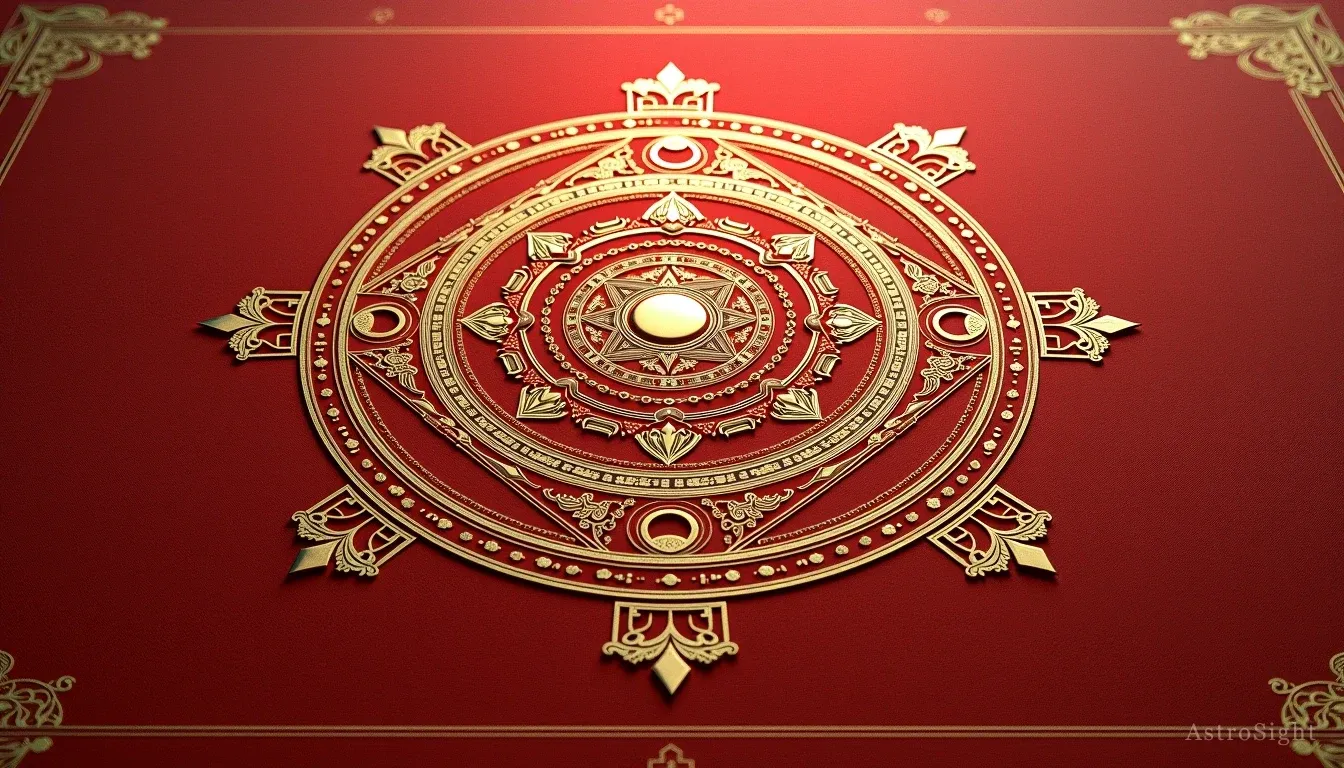
The Sukh Samriddhi Yantra incorporates specific sacred patterns, each carrying meaning and function:
- Central Bindu — Representing family unity, the single point from which all family blessings radiate
- Lotus Petals — Multiple petals representing various dimensions of family blessing—health, wealth, education, relationships, spiritual growth
- Interlocking Triangles — Balancing the energies of giving and receiving, masculine and feminine, material and spiritual
- Bhupura (Outer Square) — The protective boundary representing the physical household, containing and protecting the blessings within
- Lakshmi-Ganesha Symbols — Integrated iconography combining prosperity energies with obstacle-removal power
Astrological Factors Addressed by the Yantra
From a Jyotish perspective, certain planetary configurations create challenges for family happiness and prosperity that this yantra specifically addresses. Those with afflicted 4th house (home, mother, emotional security) often struggle with domestic peace regardless of external success. Weak or afflicted Moon creates emotional instability affecting all household members. Venus afflictions—particularly from Saturn, Rahu, or Mars—disturb marital harmony and domestic comfort. Challenging 2nd house placements affect family wealth accumulation.
The Sukh Samriddhi Yantra provides energetic support that helps mitigate these challenging configurations, though it works best when combined with appropriate planetary remedies specific to individual charts. Consider using our birth chart calculator to understand your specific planetary influences affecting family life.
What Comprehensive Benefits Does the Sukh Samriddhi Yantra Provide?
Families who consistently worship the Sukh Samriddhi Yantra report transformations across multiple life dimensions. While individual results depend on the complete family karmic picture, the overall chart configurations of family members, and the sincerity of practice, the yantra addresses several key areas.
Relationship Harmony Benefits
- Reduced family conflicts — Arguments decrease in both frequency and intensity; disagreements resolve more easily
- Improved communication — Family members find it easier to express feelings, needs, and concerns without triggering defensive reactions
- Generational harmony — Improved relationships between parents, children, grandparents, and in-laws
- Marital relationship enhancement — Deeper connection, renewed romance, and better partnership between spouses
- Sibling cooperation — Competition transforms into mutual support; inheritance and property disputes become less contentious
Financial Stability Benefits
- Household income improvement — Primary earners often experience enhanced career opportunities, raises, or business growth
- Natural spending reduction — Unnecessary expenses decrease as contentment grows, reducing the need for retail therapy or status purchases
- Savings accumulation — Money stops mysteriously disappearing; family begins building financial reserves
- Major purchase goals achieved — Home ownership, vehicle purchase, and education funding become achievable
- Reduced financial anxiety — Worry about money diminishes even before material circumstances fully change
Health and Wellbeing Benefits
The stress reduction from improved harmony naturally supports better health outcomes:
- Improved family health overall — Chronic conditions may stabilize; acute illnesses may resolve more quickly
- Reduced stress-related ailments — Headaches, digestive issues, hypertension, and anxiety-related symptoms often improve
- Better sleep quality — Family members sleep more peacefully in a harmonious household
- Increased energy levels — Less energy drained by conflict means more vitality for positive activities
Children's Welfare Benefits
Children are particularly sensitive to household energy, and the yantra supports their flourishing:
- Enhanced academic focus — Saraswati's blessing and a peaceful home environment support learning
- Improved behavior — Children acting out often calm in harmonious environments
- Health protection — Children in blessed households often experience fewer illnesses
- Positive character development — Growing up in a sukh-samriddhi environment shapes children's personalities positively
- Natural joy and playfulness — The lightness of a harmonious home allows children's natural happiness to flourish
Discover Your Complete Family Prosperity Profile
Understand how your birth chart influences family life, relationships, and household prosperity. Get personalized guidance on timing for major family decisions.
Get Your Career ReportHow Do You Install the Sukh Samriddhi Yantra Properly?
Proper installation of the Sukh Samriddhi Yantra follows specific guidelines derived from classical tantric texts. The installation ceremony, called Prana Pratishtha, infuses the yantra with life-energy and establishes the connection between the sacred geometry and the divine forces it represents.
Optimal Timing for Installation
Classical texts like the Muhurta Chintamani emphasize the importance of auspicious timing for yantra installation:
- Best days — Friday (Venus governs family and relationships) or Thursday (Jupiter governs expansion and blessings)
- Special occasions — Diwali, Dhanteras, family anniversaries, wedding anniversaries, Griha Pravesh (house-entering ceremony), or the day a new family member joins the household
- Lunar phase — Shukla Paksha (waxing moon), ideally approaching Purnima (full moon) when lunar energy supports growth and fullness
- Favorable nakshatras — Rohini (nourishment), Pushya (prosperity), Hasta (skill), and Shravana (sacred listening) are particularly auspicious
- Times to avoid — Amavasya (new moon), eclipses, and inauspicious muhurtas like Rahu Kaal
Ideal Placement Locations
Where you place the yantra significantly affects its influence on household energy:
- Living room — Where family gathers; the yantra's blessing spreads during shared time together
- Puja room — The spiritual center of the home, if a dedicated space exists
- Dining room — Represents food abundance and the blessing of shared meals
- Northeast corner (Ishanya) — The most auspicious zone per Vastu Shastra, associated with divine blessings
- Height guidelines — Place 3-4 feet from floor, approximately eye level when seated for worship
- Locations to avoid — Bedrooms (too private), bathrooms, south corners, and areas with heavy foot traffic
Required Installation Materials
Gather these items before beginning the installation ceremony:
- Sukh Samriddhi Yantra (copper, brass, or silver—copper is most common)
- Gangajal (sacred Ganges water) for purification
- Panchamrit (mixture of milk, curd, honey, ghee, and sugar)
- Yellow and red flowers (21 minimum)
- Ghee lamps, camphor for aarti, sandalwood incense
- Fresh fruits (5 varieties) and Indian sweets
- Family photograph including all members
- Yellow or red cloth for altar base
- Kumkum (vermillion) and haldi (turmeric) powder
- Rice grains (akshata)
Complete Installation Puja Procedure
All family members should participate if possible—collective energy amplifies the blessing. The Yantra Chintamani emphasizes that household yantras gain power from family participation.
Preparation: Everyone bathes and wears clean, preferably traditional clothes. Clean the installation area thoroughly and sprinkle Gangajal to purify the space. Arrange all materials within easy reach.
Yantra Purification: Hold the yantra and purify it with Gangajal while chanting "Om Gam Ganapataye Namaha" three times to invoke Ganesha's blessing. Then apply the panchamrit sequence—milk, then curd, then honey, then ghee, then sugar water—rinsing with pure water between each. Dry the yantra gently with a clean cloth.
Establishment: Place the yantra on the altar with the cloth base. Light all lamps and incense. Place the family photograph before the yantra. Each family member offers flowers in turn, from youngest to eldest, each stating one blessing they seek for the family.
Mantra Chanting: Chant the main mantra together 108 times: "Om Sukh Samriddhi Vardhanam Dehi Dehi Swaha." Use a mala (prayer beads) to count. Visualize the home filling with golden light and each family member thriving in health, happiness, and prosperity.
Conclusion: Offer fruits and sweets. Perform aarti with camphor, with all family members participating—circling the flame clockwise and taking blessing by waving hands over the flame and touching eyes or head. Share prasad together. Store any blessed items in the kitchen for prosperity symbolism.
What Are the Daily and Weekly Worship Routines?
Consistent worship maintains the yantra's active blessing. The Mantra Mahodadhi emphasizes that household yantras require regular attention to sustain their beneficial influence—not elaborate rituals, but sincere daily acknowledgment.
Daily Morning Practice (5-10 minutes)
The first family member to wake ideally performs this simple routine:
- Light a lamp at the yantra (even a small diya is sufficient)
- Chant the mantra 11-27 times: "Om Sukh Samriddhi Vardhanam Dehi Dehi Swaha"
- Take a moment of gratitude for the family
- Set a positive intention for the day ahead
- Offer a mental prayer for each family member's wellbeing
Evening option: Any family member may light the lamp with brief acknowledgment and thanks for the day's blessings. This is particularly meaningful when the whole family can gather briefly before dinner.
Weekly Family Worship (Sunday Mornings Recommended)
Once weekly, gather all available family members for a more substantial worship session:
- Extended mantra chanting (54-108 times)
- Offer fresh flowers
- Discuss the upcoming week as a family
- Set collective intentions and share individual needs
- Share a meal together afterward
Monthly Purnima (Full Moon) Observance
On each full moon, perform a special puja that mirrors the original installation in simplified form:
- Complete offerings of flowers, incense, and sweets
- Review family blessings received during the month
- Set intentions for the coming lunar cycle
- Share a special family meal together
- Express gratitude for the yantra's protection
Special Occasion Worship
Perform enhanced worship during:
- Family birthdays and anniversaries
- Before major family decisions
- When welcoming new family members
- During festivals, especially Diwali and Navaratri
- When family members face challenges
- Before children's examinations or important events
What Mantras Support the Sukh Samriddhi Yantra?
Mantras activate and energize the yantra, creating a living connection between the sacred geometry and the divine forces it represents. The Mantra Mahodadhi provides extensive guidance on household prosperity mantras that align with yantra worship.
Primary Sukh Samriddhi Mantra
The main mantra is: "Om Sukh Samriddhi Vardhanam Dehi Dehi Swaha"
Meaning: "O Divine Energy, grant us increase in happiness and prosperity. Give, give. I offer this into the sacred fire."
This mantra directly invokes the two blessings the yantra provides, with the repetition "Dehi Dehi" (give, give) emphasizing the request for continuous blessing, and "Swaha" dedicating the practice to the divine fire that transforms intention into manifestation.
Supporting Mantras for Specific Needs
Add these mantras to address specific family requirements:
- For relationship harmony: "Om Shanti Shanti Shanti" (11 times) — Invokes peace at all three levels: physical, mental, and spiritual
- For prosperity enhancement: "Om Shreem Mahalakshmyai Namaha" (21 times) — Directly invokes Lakshmi's abundant blessing
- For obstacle removal: "Om Gam Ganapataye Namaha" (11 times) — Clears blocks to family happiness and success
- For children's education: "Om Aim Saraswatyai Namaha" (21 times) — Invokes blessing for learning and academic success
- For wealth preservation: "Om Shreem Om Hreem Shreem Hreem Kleem Shreem Kleem Vitteshvaraya Namaha" (11 times) — Kuber mantra for protecting accumulated wealth
Mantra Chanting Guidelines
- Pronunciation matters but intention matters more—chant with devotion even if pronunciation isn't perfect
- Use a mala (108 beads) for counting during longer sessions
- Morning hours (Brahma Muhurta, 4-6 AM) are most powerful, but any sincere time works
- Chant facing east or north when possible
- Maintain regularity—daily practice of 11 repetitions exceeds occasional practice of 108
What Results Can Families Realistically Expect?
Results from the Sukh Samriddhi Yantra unfold progressively with consistent practice. The Yantra Chintamani notes that domestic yantras require patient cultivation but create lasting transformation in household wellbeing. Individual experiences vary based on existing karmic patterns, the severity of current challenges, and the sincerity of practice.
Initial Phase (First Two Weeks)
During the initial period, families typically notice:
- Subtle shifts in home atmosphere—the space may feel lighter or more welcoming
- Arguments may feel less intense, even if frequency hasn't yet decreased
- Communication becomes slightly easier
- A developing sense of peace, particularly during worship times
- Some families experience initial intensification of issues as old patterns surface for clearing
Development Phase (Weeks 3-8)
As practice continues, more noticeable changes emerge:
- Financial flow often improves—unexpected income, better deals, reduced expenses
- Relationships begin to deepen and heal
- Health issues may begin stabilizing
- Children often show improvement in behavior and focus
- Visitors frequently comment on the home's peaceful energy
Established Phase (Two Months and Beyond)
With consistent long-term practice:
- Consistent household harmony becomes the new baseline
- Prosperity becomes sustained rather than occasional
- Family bonds strengthen across generations
- The home becomes known as a peaceful, welcoming place
- Major life events (weddings, births, career milestones) unfold more auspiciously
Important Caveats
It's important to understand that:
- The yantra supports and enhances sincere effort—it doesn't replace practical action
- Deep-seated family issues may require additional approaches (counseling, individual astrological remedies)
- Individual family member charts affect overall household fortune
- Consistency matters more than intensity—regular simple practice exceeds occasional elaborate rituals
- The yantra creates conditions for blessing; family members must be open to receiving and acting upon opportunities
Complementary Practices for Enhanced Family Blessing
The Sukh Samriddhi Yantra works most effectively when supported by complementary practices that align the entire household with prosperity and harmony.
Vastu Alignment
Ensure your home's Vastu is as supportive as possible:
- Keep the northeast corner clean, light, and clutter-free
- Ensure the entrance is well-lit and welcoming
- Remove broken items and repair what can be fixed
- Keep the kitchen clean and the stove in good working order
- For serious Vastu defects, consider adding a Vastu Dosh Nivaran Yantra
Complementary Yantras
The following yantras work synergistically with the Sukh Samriddhi Yantra:
- Kuber Yantra — For enhanced wealth preservation
- Santan Gopal Yantra — For couples seeking children
- Vastu Dosh Nivaran Yantra — If home has Vastu defects
- Saraswati Yantra — For households with students
Family Practices That Amplify Yantra Benefits
- Regular family meals together — Shared eating strengthens bonds and allows the yantra's blessing to flow through food
- Joint participation in festivals — Especially Diwali, when Lakshmi worship amplifies the yantra's prosperity aspect
- Charitable giving as a family — Dana (giving) creates space for receiving
- Respecting elders — Seeking and honoring blessings from older family members
- Friday Venus worship — Venus governs domestic harmony; honoring Venus on Fridays supports the yantra's work
For personalized guidance on planetary remedies that would support your family's specific needs, check your daily horoscope and consider getting a detailed birth chart analysis.
Classical Foundation and Spiritual Significance
The Sukh Samriddhi Yantra draws upon deep principles within Vedic tradition. The Yantra Chintamani describes the sacred geometry of prosperity yantras as creating a dwelling place for divine energies within the physical structure of the home. When properly installed and worshipped, the yantra becomes a portal through which celestial blessings flow into the domestic sphere.
The concept of home as sacred space (griha as kshetra) appears throughout Vedic literature. The Vastu Shastra describes every dwelling as having a resident cosmic being (Vastu Purusha) whose satisfaction determines household welfare. The Sukh Samriddhi Yantra serves to please this cosmic resident while simultaneously invoking the blessings of prosperity deities.
In the Grihastha Dharma (householder ethics), maintaining a prosperous, harmonious household capable of supporting family members, hosting guests, and contributing to community welfare represents one of life's highest achievements. The Sukh Samriddhi Yantra specifically supports this ideal, recognizing that spiritual accomplishment and worldly wellbeing need not be separate pursuits.
May your home be filled with lasting happiness and abundant prosperity. May the blessings of Lakshmi, Ganesha, Saraswati, Kuber, and Vastu Purusha create an environment where every family member thrives.
Om Sukh Samriddhi Vardhanam Dehi Dehi Swaha.
Explore Astrosight Services
Personalized Report
Career Report Bundle
Your Navamsa and Dashamsha are covered in your Career Report — see your exact vocational path
- Personalized analysis based on YOUR exact birth chart
- Expert-prepared by Dr. Meenakshi Sharma
- Delivered as PDF within 24-48 hours
- Unlimited follow-up clarifications
By Dr. Meenakshi Sharma · Delivered in 24-48 hours

Shri Ankit Bansal
Numerology and Vastu Expert, 15+ Years of experience
18 + Years of Experience
100+ Readers
Shri Ankit Bansal is a renowned numerology and Vastu expert with over 15 years of specialized experience in these ancient Indian sciences. His extensive practice encompasses thousands of consultations in numerological analysis, name corrections, business numerology, and comprehensive Vastu assessments for residential and commercial properties. As a contributing writer for AstroSight, Shri Bansal combines his deep understanding of numerical vibrations with practical Vastu principles to provide holistic solutions that harmonize living and working spaces with cosmic energies. His expertise spans personal numerology charts, business name analysis, property Vastu audits, and remedial measures that blend traditional wisdom with modern lifestyle requirements. Through his methodical approach and proven track record, Shri Bansal has established himself as a trusted authority in helping clients optimize their environment and numerical influences for enhanced prosperity, health, and overall well-being.