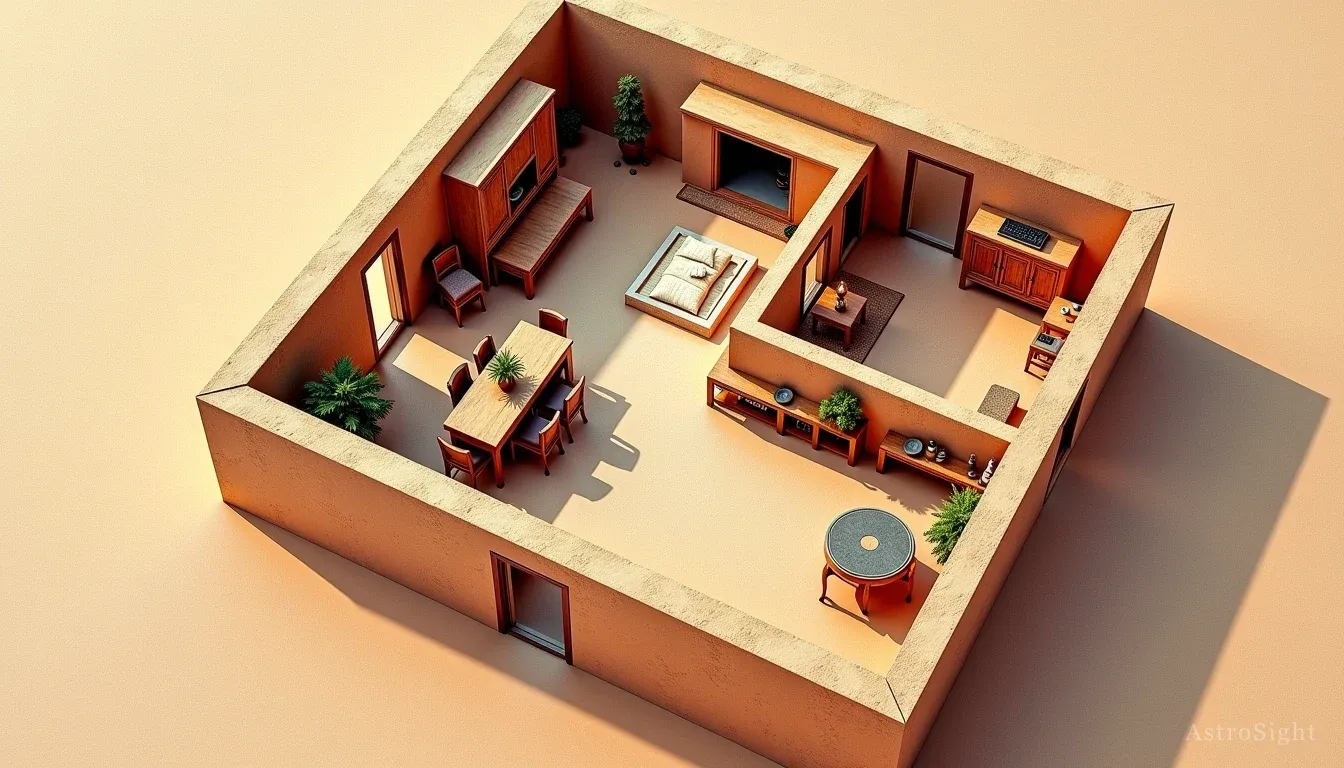
Three Side Road Plot Vastu: Complete Guide
A three side road plot in Vastu Shastra refers to a plot of land bordered by roads on three of its four sides — leaving only one side connected to neighbouring land or a wall. Vastu classification of three-side road plots depends entirely on which three sides have the roads and which side does not —
A three side road plot in Vastu Shastra refers to a plot of land bordered by roads on three of its four sides — leaving only one side connected to neighbouring land or a wall. Vastu classification of three-side road plots depends entirely on which three sides have the roads and which side does not — because the directional combinations produce very different energetic results. Some three-side road configurations are considered highly favourable (such as north-east-west road combinations) while others are considered challenging (such as south-west-east combinations with the closed side facing north-east). The classical Vastu texts including Mayamatam and Vastu Shilpa Shastra treat road-position analysis as a central diagnostic factor because roads bring moving energy (chala vastu) to the plot, and the direction of this energy determines whether the residents will experience prosperity or difficulty.
The reason three-side road plots matter more than people realise is that they are increasingly common in modern urban Indian real estate — particularly corner plots in planned colonies and DLF/Godrej/private township developments — and buyers often face the choice of paying a premium for "extra exposure" without understanding the Vastu implications. A favourable three-side road plot can support above-average prosperity for the residents; an unfavourable configuration can produce persistent financial pressure, family discord, and health issues despite a beautiful-looking property. This guide covers what three-side road plots are technically in Vastu, whether they are good or bad (the 8 possible combinations analysed), which side-road hits are favourable and which are not, T-junction effects, dead-end road effects, triangular plot considerations, two-side and four-side road comparisons, and the remedial measures for challenging configurations. Reviewed by Shri Ankit Bansal, Vedic astrologer with 12+ years of practice including 200+ Vastu consultations. Use the birth chart calculator for integrated astrology-Vastu analysis of your specific situation.
Is a Three Side Road Plot Vastu Compliant?
A three side road plot is Vastu compliant or non-compliant depending on which three sides have the roads — the answer is conditional, not absolute. The classical analysis identifies 4 favourable and 4 challenging combinations among the 8 possible three-side road arrangements. The diagnosis is determined by the direction of the closed side (the side without road) and the direction of the roads themselves.
Three-side road plots constitute approximately 8 to 12% of urban Indian residential plots, with corner plots in planned colonies most commonly producing this configuration. Standard residential plot sizes affected range from 1,200 to 4,500 square feet, with the typical Indian urban plot being 1,800 to 2,400 square feet.
The 8 possible three-side road configurations:
| Configuration | Closed side | Roads on | Vastu rating |
|---|---|---|---|
| North-East-West | South | N, E, W roads | Favourable |
| North-East-South | West | N, E, S roads | Conditionally favourable |
| North-West-South | East | N, W, S roads | Challenging |
| East-South-West | North | E, S, W roads | Challenging |
| East-North-South | West | E, N, S roads | Favourable |
| South-West-East | North | S, W, E roads | Challenging |
| West-North-East | South | W, N, E roads | Favourable |
| South-West-North | East | S, W, N roads | Challenging |
The general Vastu principle:
- Northeast (Ishaan) energy should flow into the plot — so the east and north sides being road-exposed is favourable.
- Southwest (Nairutya) should be closed and grounded — so the southwest closed side is the most favourable closed-side configuration.
- The northeast corner should not be cut or compromised by intersecting roads.
The Vastu Mandala system is documented in the classical text Mayamatam (dating to the 5th to 7th century CE, approximately 1,500 years ago) and Brihat Samhita by Varahamihira (6th century CE, around 550 CE). For a typical 1,800 square foot plot, each Vastu zone occupies approximately 22 square feet in the 81-square grid framework. Three-side road plots typically command 15-30% premium in modern Indian real estate when the configuration is favourable (north and east roads especially), or 10-20% discount when unfavourable (southwest road exposure).
Why some three-side road plots are favourable:
| Configuration | Why it's favourable |
|---|---|
| N, E, W roads + South closed | Brings northeast and east energy in; grounds south wall |
| N, E, S roads + West closed | Brings beneficial directional energies in; closes west (less critical) |
| W, N, E roads + South closed | Brings positive energies in; grounds south |
Why some three-side road plots are challenging:
| Configuration | Why it's challenging |
|---|---|
| E, S, W roads + North closed | North (wealth direction) is closed off |
| N, W, S roads + East closed | East (rising sun direction) is closed off |
| S, W, N roads + East closed | East and northeast energy blocked |
| S, W, E roads + North closed | North energy and Kubera direction blocked |
The key questions to ask about any three-side road plot:
1. Which side is closed? (most important factor) 2. Is the closed side in the southwest? (most favourable) 3. Is the northeast corner open and well-exposed? (essential) 4. Are the road widths balanced? (relative to property size) 5. Is there a T-junction directly hitting the plot? (separate analysis)
The classical Vastu framework operates over millennia — Mayamatam dating to the 5th-7th century CE (approximately 1,500 years ago) and Brihat Samhita by Varahamihira to 6th century CE (around 550 CE). The Vastu Mandala overlay on a typical 1,800 square foot plot produces 81 zones of approximately 22 square feet each, with Brahmasthan (center 9 zones) requiring 200-250 square feet of open space and 6-8 hours of natural sunlight daily.
For your specific three-side road plot Vastu analysis, work with a qualified Vastu consultant who can examine the exact configuration. Use the birth chart calculator for integrated astrology-Vastu analysis.
Which Side Road Hit Is Good in Vastu?
A "side road hit" in Vastu refers to a road that directly faces or strikes a particular side of the plot — and the classical rule is that the east and north road hits are favourable, while the south and west road hits require careful evaluation and the southwest road hit is generally unfavourable. The directional rules derive from the Vastu Purusha Mandala's directional energy distribution.
The 8 directional road-hit rules:
| Direction of road hit | Vastu rating | Effect |
|---|---|---|
| East (Purva) | Favourable | Brings Sun energy, fortune |
| North (Uttara) | Favourable | Brings Kubera (wealth) energy |
| Northeast (Ishaan) | Highly favourable | Brings most subtle divine energy |
| West (Pashchima) | Conditionally favourable | Acceptable if other Vastu rules respected |
| Southwest (Nairutya) | Challenging | Disturbs the grounding direction |
| South (Dakshina) | Conditionally challenging | Yama's direction, requires evaluation |
| Southeast (Agneya) | Conditionally favourable | Fire direction; depends on entry |
| Northwest (Vayavya) | Conditionally favourable | Wind direction; movement-friendly |
The east road hit (most favourable):
When a road faces the east side of the plot:
- Sunrise energy enters the home through the east-facing entrance.
- Promotes growth, fortune, daily energy.
- Supports education, leadership, public dealings.
- Generally produces positive financial and health outcomes.
This is one of the most desirable Vastu configurations and is reflected in higher property values for east-facing plots in Indian real estate.
The north road hit (favourable):
When a road faces the north side of the plot:
- Kubera energy (wealth deity) enters from the north.
- Promotes prosperity, financial growth, savings.
- Supports business expansion, investment.
- North-facing entrance is often considered second-best to east-facing.
The west road hit (conditionally favourable):
When a road faces the west side of the plot:
- Varuna energy (cosmic order) enters from the west.
- Can support stable income, established success.
- Best for established businesses rather than start-ups.
- Sometimes preferred for later-life prosperity.
The south road hit (conditionally challenging):
When a road faces the south side of the plot:
- Yama energy (death, transformation) enters from the south.
- Traditionally considered challenging.
- However: strong south wall and appropriate planning can convert this to favourable.
- Some businesses (legal, transformation-related) actually benefit.
The southwest road hit (challenging):
When a road faces the southwest side of the plot:
- Disturbs the Nairutya (southwest) grounding direction.
- Can produce financial drainage, instability.
- Most challenging single-direction configuration.
- Requires significant remedial measures.
The northeast road hit (most favourable):
When a road faces the northeast corner of the plot:
- Brings the most subtle and divine energy.
- Highly favourable for spiritual development, prosperity.
- Excellent for homes and educational institutions.
- Most prized in traditional Vastu analysis.
The 4-side road hit (all four sides exposed):
When all four sides have roads:
- The plot becomes essentially isolated.
- Both very favourable AND very challenging effects possible.
- Highly dependent on the specific dimensions and entrance choice.
- Often produces either extraordinary success or extraordinary difficulty.
For specific analysis of which side road affects your plot, work with a qualified Vastu consultant or use the birth chart calculator for integrated astrological-Vastu assessment.
What Is a House Where Three Roads Meet?
A house where three roads meet typically refers to T-junction plots or three-way intersection plots — and the Vastu analysis depends entirely on which direction the meeting-point road points toward the house. The classical Vastu term for this configuration is "Veedhi Shoola" — meaning "the spear of the road" — referring to the road that points like a spear directly toward the plot from a three-way intersection.
The three road meeting configurations:
| Configuration | What it means | Vastu effect |
|---|---|---|
| T-junction with house at the top of T | Road dead-ends at the house | Strong impact (positive or negative depending on direction) |
| Y-junction with house at the fork | Two roads merge before the house | Movement-energy effect |
| 3-way crossing with house at corner | Three intersecting roads meet near house | Diffuse but complex effect |
The Veedhi Shoola (T-junction) rules:
When a road dead-ends at your plot, the direction of the approaching road determines the effect:
| Approaching road direction | Effect on house |
|---|---|
| From east | Favourable; brings Sun energy in |
| From north | Favourable; brings Kubera energy in |
| From northeast | Highly favourable |
| From west | Mixed; requires evaluation |
| From south | Challenging; requires remediation |
| From southwest | Most challenging; significant remediation needed |
Why T-junctions matter:
A T-junction creates concentrated energy flow toward the plot — like a funnel directing the road's "chala vastu" (moving energy) into the house. This concentration:
- Amplifies the directional energy (positive or negative).
- Creates persistent influence rather than passing energy.
- Affects the resident's life-direction continuously.
- Produces measurable effects on family fortunes.
The favourable T-junctions:
| Approaching from | Why favourable |
|---|---|
| East | Sun energy concentrated, supportive of growth |
| North | Wealth energy concentrated, supportive of prosperity |
| Northeast | Most beneficial; supports spiritual and material growth |
The challenging T-junctions:
| Approaching from | Why challenging |
|---|---|
| South | Yama energy concentrated, requires care |
| Southwest | Most disturbing; requires significant remediation |
| Specifically southwest corner approach | Considered most karmic |
T-junction remedies:
For challenging T-junctions, classical Vastu prescribes:
1. Reflective barriers: Mirrors at appropriate positions to deflect energy. 2. Buffer zones: Garden, fence, or wall between road and house. 3. Crystal placement: Specific crystals at the receiving wall. 4. Wind chimes: Movement and sound to break the concentrated energy. 5. Vastu Shanti Puja: Specific remedial ritual. 6. Tree planting: Specific trees at the approaching corner. 7. Wall design: Curved walls to deflect rather than absorb.
Modern remedies for severely affected T-junctions:
- Pyramidal structures at the approaching corner.
- Specific yantras placed at the receiving wall.
- Vaastu Dosha Nivaran Puja annually.
- Conscious shifting of bedroom and prayer room positions to less-affected areas.
The 3-way crossing:
When three roads meet at a single point near your house:
- The effect is diffuse — energy flows in multiple directions.
- Specific analysis required for each road's direction.
- Less concentrated than T-junction but still significant.
- Movement energy present throughout the day.
For specific analysis of three-roads-meet configurations, work with a qualified Vastu consultant and consider integrated astrological assessment via the birth chart calculator.
Is Triangle Plot Good or Bad in Vastu?
Triangular plots are generally considered challenging in Vastu Shastra — the classical texts describe them as producing financial pressure, family discord, and unstable life-patterns for residents. The reason is that triangular plots violate the fundamental Vastu principle of geometric balance: the 9×9 = 81 Vastu Purusha Mandala assumes a roughly rectangular or square plot, and triangular shapes create disproportionate Mandala distortion.
| Plot shape | Vastu rating | Reason |
|---|---|---|
| Square | Excellent | Perfect Mandala balance |
| Rectangle (1:1 to 1:2 ratio) | Excellent | Good Mandala alignment |
| Rectangle (1:2 to 1:3 ratio) | Acceptable | Some imbalance manageable |
| Triangle | Challenging | Mandala distortion; specific corner issues |
| L-shaped | Conditionally challenging | Cut corners produce specific Vastu issues |
| Irregular polygon (5+ sides) | Challenging | Multiple Mandala disturbances |
Why triangular plots are challenging:
1. The Mandala doesn't fit: The 9×9 Mandala assumes 4 corners and 4 sides. Triangular plots have only 3 corners and 3 sides.
2. Specific corner-energy distortion: One of the three corners becomes either much more acute or much more obtuse than other corners — disturbing the directional energy balance.
3. Brahmasthan (central) compromise: The central zone (Brahmasthan) is hard to position correctly in a triangular plot.
4. Asymmetric energy flow: Energy flows unevenly across triangular plots, producing chronic imbalances.
5. Practical construction issues: Building rectangular rooms on a triangular plot creates wasted space and awkward angles.
The three types of triangular plots:
| Type | Description | Severity |
|---|---|---|
| Acute triangle | One sharp angle (less than 60°) | Most challenging |
| Right triangle | One 90° angle | Moderate challenge |
| Equilateral | All three angles equal (60°) | Less common; specific issues |
The classical effects of triangular plot residence:
- Financial pressure: Money flows out unevenly; savings difficult.
- Family discord: Disagreements emerge over the unbalanced energy.
- Career instability: Career direction shifts frequently.
- Health issues: Often digestive, nervous-system related.
- Relationship friction: Marriage and partnership challenges.
Modern Vastu remedies for triangular plots:
If you already own or must use a triangular plot, the following remedies are documented:
Level 1 — Boundary modifications:
- Modify the boundary to create a near-rectangular usable area inside the triangle.
- Plant a small garden on the unused triangular corner.
- Build the main house on the rectangular portion.
- Convert the sharp corner into a less-used area (garden, parking).
Level 2 — Interior modifications:
- Avoid building rooms with the sharp triangular corners.
- Place toilets, storage at the sharpest corner (which is least favourable).
- Place prayer room, master bedroom at the more rectangular section.
- Ensure the Brahmasthan is preserved in the rectangular portion.
Level 3 — Remedial measures:
- Vastu Shanti Puja before construction.
- Specific yantras at challenging corners.
- Crystal grids at imbalanced zones.
- Daily Vastu prayers to acknowledge and harmonise.
- Annual Vastu Pooja for ongoing energy maintenance.
Level 4 — Lifestyle adjustments:
- Consistent dharmic practice by residents.
- Annual donations in the affected directions.
- Specific prayers to balance the energy.
- Awareness of the configuration's tendencies.
When triangular plots can work:
Despite the general challenge, specific configurations can be acceptable:
- Acute angle facing northeast: Sometimes works because northeast is sacred direction.
- Plot subdivision: If only the rectangular portion is built upon.
- Specific business uses: Some commercial uses tolerate the configuration.
- Spiritual/retreat purposes: Sometimes triangular plots suit ashrams or hermitages.
The honest framing:
Triangular plots can be lived on successfully with proper remediation and conscious management, but they require significantly more attention than rectangular plots. If buying property, rectangular plots are strongly preferred for ease of Vastu compliance and resale value.
For your specific triangular plot Vastu analysis, work with a qualified Vastu consultant and consider integrated astrological assessment via the birth chart calculator.
What Is a Two Side Road Plot Vastu?
A two side road plot is a corner plot with roads on two adjacent or opposite sides — and the Vastu analysis depends on which two sides carry the roads. Two-side road plots are generally considered favourable in Vastu Shastra when the road directions align with positive energetic flow, and they often command premium prices in Indian real estate.
The two-side road combinations:
| Combination | Configuration | Vastu rating |
|---|---|---|
| East + North | Adjacent (NE corner exposed) | Highly favourable |
| East + South | Adjacent (SE corner exposed) | Conditionally favourable |
| North + West | Adjacent (NW corner exposed) | Favourable |
| South + West | Adjacent (SW corner exposed) | Challenging |
| East + West | Opposite | Conditionally favourable |
| North + South | Opposite | Favourable |
The east + north corner plot (highly favourable):
When roads are on east and north sides:
- Northeast corner is fully exposed to incoming energy.
- Maximum sunrise and Kubera (wealth) energy.
- Most prized configuration in Indian Vastu real estate.
- Property prices typically 20-30% higher than rectangular non-corner plots.
- Excellent for residential and commercial use.
The north-east corner plot supports the strongest Vastu compliance for entrance positioning (multiple favourable entrance options).
The south + west corner plot (challenging):
When roads are on south and west sides:
- Southwest corner is fully exposed to road energy.
- Disturbs the Nairutya grounding direction.
- Can produce financial drainage and instability.
- Requires significant remedial measures.
- Lower property values typically reflect this challenge.
The north + south (opposite) corner plot:
When roads are on north and south sides:
- Balanced configuration with movement on both axes.
- East and west sides closed.
- Reasonable Vastu compliance with proper entrance choice (north-facing typically preferred).
- Wind and energy flow through the plot east-west axis.
The east + west (opposite) corner plot:
When roads are on east and west sides:
- Strong sun-energy axis.
- North and south sides closed.
- Best for east-facing entrance (Sun-supportive).
- Can support strong career growth.
Two-side road plot advantages:
1. Multiple entrance options: Can choose the most favourable direction. 2. Better ventilation: Air flow on multiple sides. 3. Better natural light: Sun exposure on multiple sides. 4. Higher resale value: Premium in Indian real estate. 5. Lower internal density: Less neighbour proximity.
Two-side road plot disadvantages:
1. More road noise: From multiple directions. 2. Less privacy: Exposed on two sides. 3. More dust/pollution: From multiple road sources. 4. Vastu sensitivity: Energy flow on two sides requires careful management.
The premium:
Northeast corner plots typically command 15-30% premium in Indian real estate over comparable non-corner plots. This premium reflects:
- Better Vastu compliance.
- Better aesthetic positioning.
- Better natural light and ventilation.
- Cultural preference for corner plots in Indian context.
For your specific two-side road plot Vastu analysis, use the birth chart calculator for integrated astrology-Vastu assessment.
What Are the Effects of T-Junction Plot Vastu?
A T-junction plot Vastu refers to a configuration where a road dead-ends at or near your plot, creating a "T" pattern. This configuration is called Veedhi Shoola ("road spear") in Sanskrit and is considered one of the most significant Vastu factors because the dead-ending road concentrates energy directly into the plot.
The T-junction analysis by approaching road direction:
| Direction of approaching road | Vastu effect | Severity |
|---|---|---|
| From east | Favourable | Brings Sun energy directly |
| From northeast | Highly favourable | Most beneficial energy flow |
| From north | Favourable | Brings Kubera energy directly |
| From northwest | Conditionally favourable | Movement-energy supportive |
| From west | Mixed | Requires evaluation |
| From southwest | Most challenging | Significant remediation needed |
| From south | Challenging | Yama energy concentrated |
| From southeast | Conditionally challenging | Fire-energy in living areas |
Why T-junctions concentrate energy:
A T-junction creates a funnel effect:
- The road acts as an energy channel carrying chala vastu (moving energy).
- At the dead-end, this energy converges.
- The plot at the dead-end receives this concentrated energy.
- The effect is persistent (24/7) rather than passing.
The favourable T-junctions in detail:
East-approaching T-junction:
- Sun rises in the east; sun's rays travel along the road.
- Concentrated solar energy flows into the plot.
- Promotes growth, vitality, fortune.
- Excellent for educational, growth-oriented residences.
North-approaching T-junction:
- Kubera (wealth deity) is in the north.
- Concentrated wealth energy flows into the plot.
- Promotes prosperity, financial success.
- Excellent for business residences.
Northeast-approaching T-junction:
- Most subtle and sacred directional energy.
- Highly beneficial for spiritual and material development.
- Rare configuration but extremely valuable when present.
The challenging T-junctions in detail:
Southwest-approaching T-junction:
- Concentrates energy at the grounding direction.
- Disturbs the Nairutya (southwest) stability.
- Can produce financial drainage, instability, family discord.
- Most karmic configuration; requires significant remediation.
South-approaching T-junction:
- Concentrates Yama (death/transformation) energy.
- Can produce health concerns, family transitions.
- Traditionally challenging but manageable with remediation.
Detailed T-junction remedies:
Boundary remedies:
- Buffer wall (3-5 feet thick) between road and house.
- Tall trees at the receiving corner (specific species: Ashoka, Banana).
- Garden zone between road and house.
- Curved wall to deflect energy.
Structural remedies:
- Avoid bedroom at the receiving wall.
- Place storage room at the receiving wall.
- Strong wall with no windows at the receiving point.
- Specific pyramidal structures at corners.
Energetic remedies:
- Mirrors strategically placed to deflect energy.
- Crystal grids at receiving wall.
- Specific yantras (e.g., Sri Yantra, Vastu Yantra) at challenging corners.
- Wind chimes to break and deflect energy.
- Saffron flag at receiving corner (traditional Indian practice).
Ritual remedies:
- Vastu Shanti Puja before occupancy.
- Annual Vastu Dosha Nivaran.
- Daily Vastu prayer by residents.
- Specific deity worship based on the approaching direction.
Lifestyle adjustments:
- Conscious management of the configuration.
- Regular cleaning of the receiving wall and corner.
- Specific colour scheme (avoid red on receiving wall, prefer cooling colours).
- Plant species at the receiving boundary.
The honest assessment:
T-junction plots can be profitable real estate investments when the approaching road direction is favourable. They are challenging investments when the direction is unfavourable. Always identify the approaching direction first before evaluating a T-junction plot.
For specific T-junction analysis, work with a qualified Vastu consultant and consider integrated astrological-Vastu assessment via the birth chart calculator.
What Is Dead End Road Plot Vastu?
A dead-end road plot Vastu refers to a plot at the terminating end of a road (also called cul-de-sac in modern real estate). The Vastu analysis is similar to T-junction analysis — the road's energy concentrates at the dead-end — but with the specific difference that dead-end plots are at the road's terminal point rather than at a T-intersection.
The 8 dead-end road directional analyses:
| Dead-end road approaches from | Vastu rating | Effect |
|---|---|---|
| East | Favourable | Sun energy supports growth |
| North | Favourable | Kubera energy supports prosperity |
| Northeast | Highly favourable | Most beneficial concentration |
| Northwest | Conditionally favourable | Movement-energy useful |
| West | Mixed | Requires careful analysis |
| Southwest | Most challenging | Severe Nairutya disturbance |
| South | Challenging | Yama energy concentrated |
| Southeast | Conditionally challenging | Fire-energy needs management |
Dead-end vs. T-junction differences:
While the directional rules are similar:
- T-junction: Road ends at a road perpendicular to it; energy flows along the approaching road into the perpendicular road.
- Dead-end: Road ends at a property; energy flows along the road into the property.
- Dead-end is typically more concentrated because there's no escape route for the energy.
The east-facing dead-end plot (favourable):
When the road approaches from the east and dead-ends at your plot:
- Sun energy flows directly into the plot.
- East-facing entrance ideal at the receiving wall.
- Promotes daily growth, vitality, fortune.
- Often premium-priced in Indian real estate.
The north-facing dead-end plot (favourable):
When the road approaches from the north and dead-ends at your plot:
- Kubera energy flows into the plot.
- North-facing entrance can work well.
- Promotes wealth accumulation, business stability.
- Premium real estate consideration.
The southwest-facing dead-end plot (most challenging):
When the road approaches from the southwest and dead-ends at your plot:
- Severe Nairutya disturbance.
- Most karmic configuration in dead-end Vastu.
- Significant financial and family pressures documented.
- Significant remediation required before residence.
Dead-end road plot remedies:
The remedies follow the T-junction protocol:
Boundary remedies:
- Thick buffer wall at the receiving boundary.
- Tall, dense plantation at the receiving corner.
- Garden buffer zone.
- Curved boundary wall.
Structural remedies:
- Avoid bedrooms at the receiving wall.
- Strong, windowless wall at receiving point.
- Storage or toilet at the receiving wall (if direction permits).
Energetic remedies:
- Vastu yantras at the receiving corner.
- Crystal grids at the receiving boundary.
- Strategic mirror placement to deflect energy.
- Wind chimes to disperse concentration.
The east-facing dead-end advantage:
Modern Indian real estate developers increasingly value east-facing dead-end plots because:
- Premium Vastu position for residential use.
- Cul-de-sac peace combined with positive energy.
- Lower traffic noise than through-street plots.
- Higher resale value.
If you're choosing between dead-end plots:
- Prioritise east-facing or north-facing.
- Avoid southwest-facing.
- Consider integrated astrology-Vastu analysis.
For specific dead-end plot analysis, work with a qualified Vastu consultant or use the birth chart calculator.
How to Remedy a Challenging Vastu Plot?
The remedial measures for a challenging Vastu plot operate at 6 documented levels — boundary, structural, interior, energetic, ritual, and lifestyle — and the integrated approach combines multiple levels to address the specific configuration. Significant remediation typically requires investment of ₹50,000 to ₹5,00,000 depending on plot size, severity of issues, and chosen remediation depth.
Level 1 — Boundary modifications:
- Buffer wall: 3-5 feet thick wall on challenging direction (₹50,000-2,00,000).
- Tall trees: Plant Ashoka, Banana, or Banyan at challenging corners (₹5,000-15,000).
- Garden buffer: 8-10 feet garden zone between road and house (₹20,000-50,000).
- Curved walls: Deflect rather than absorb energy (₹30,000-1,00,000).
Level 2 — Structural modifications:
- Avoid bedrooms at challenging walls.
- Place storage/toilets at challenging directions.
- Strong windowless walls at receiving points.
- Specific entrance positioning at favourable direction.
- Pyramidal structures at corners (cost: ₹3,000-15,000 each).
Level 3 — Interior modifications:
- Prayer room at northeast corner.
- Master bedroom at southwest corner.
- Kitchen at southeast corner.
- Children's room at west or northwest.
- Brahmasthan kept open.
Level 4 — Energetic remedies:
- Specific yantras at challenging positions (₹500-5,000 each): - Sri Yantra for general prosperity. - Vastu Yantra for plot harmony. - Kubera Yantra for wealth. - Specific deity yantras for specific issues.
- Crystal grids at challenging corners (₹2,000-10,000).
- Mirrors to deflect energy (varies).
- Wind chimes to disperse concentration (₹500-3,000).
- Pyramid placement at challenging corners.
Level 5 — Ritual remedies:
- Vastu Shanti Puja before occupancy (₹5,000-50,000).
- Annual Vastu Dosha Nivaran Puja (₹3,000-20,000).
- Bhumi Puja at plot purchase.
- Griha Pravesh Puja at moving in.
- Specific deity worship based on the affected direction.
Level 6 — Lifestyle remedies:
- Daily Vastu prayer by residents.
- Specific colour schemes matching directional energies.
- Regular cleaning of challenging zones.
- Conscious management of the configuration.
- Plant care of remedial trees and plants.
Total remediation cost estimates:
| Severity | Cost range | Time horizon |
|---|---|---|
| Minor Vastu issues | ₹50,000 to ₹1,00,000 | 1-3 months |
| Moderate issues | ₹1,00,000 to ₹3,00,000 | 3-6 months |
| Significant issues | ₹3,00,000 to ₹5,00,000 | 6-12 months |
| Severe issues + reconstruction | ₹5,00,000 to ₹15,00,000+ | 1-2 years |
These cost ranges reflect approximately 2-15% of typical property value for ₹50,00,000 to ₹1,00,00,000 properties common in Indian urban contexts. Buffer wall construction typically costs ₹3,000 to ₹8,000 per running metre for standard 6 to 8 feet height walls. Plantation of mature trees (Ashoka, Banyan) at challenging corners costs ₹5,000 to ₹15,000 per tree with 2 to 3 year establishment period.
The cost-benefit calculation:
For a ₹50,00,000 property (50 lakh) with significant Vastu issues:
- Remediation investment: ₹3,00,000 (6% of property value).
- Without remediation: Persistent issues throughout residency.
- With remediation: Manageable Vastu situation, better life-quality.
- Resale value: Possibly higher after remediation.
The investment is generally worthwhile for properties with manageable issues.
When to walk away from a Vastu-challenged plot:
- Multiple severe Vastu issues simultaneously.
- Triangular or irregular shape with no rectangular usable area.
- Southwest-facing dead-end with no remediation budget.
- Remediation cost exceeds 20% of property value.
- Original construction prevents practical modifications.
For specific Vastu remediation analysis for your plot, work with a qualified Vastu consultant and consider integrated astrological-Vastu assessment via the birth chart calculator — the astrology layer helps identify which specific residents are most affected and which remedial direction will be most beneficial for them personally.
Align Your Space with Your Career Path
Vastu optimizes your environment. Your birth chart reveals your career potential. Get both aligned with a personalized analysis and actionable remedies.
Get Your Wealth ReportPersonalized Report
Wealth & Lifestyle Report
Vastu amplifies what your birth chart already shows — see your wealth yogas + home direction guide
- Personalized analysis based on YOUR exact birth chart
- Expert-prepared by Dr. Meenakshi Sharma
- Delivered as PDF within 24-48 hours
- Unlimited follow-up clarifications
By Dr. Meenakshi Sharma · Delivered in 24-48 hours

Shri Ankit Bansal
Vedic Astrologer · Numerology and Vastu Expert, 15+ Years
Shri Ankit Bansal is a renowned numerology and Vastu expert with over 15 years of specialized experience in these ancient Indian sciences. His extensive practice encompasses thousands of consultations in numerological analysis, name corrections, business numerology, and comprehensive Vastu assessments for residential and commercial properties. As a contributing writer for AstroSight, Shri Bansal combines his deep understanding of numerical vibrations with practical Vastu principles to provide holistic solutions that harmonize living and working spaces with cosmic energies. His expertise spans personal numerology charts, business name analysis, property Vastu audits, and remedial measures that blend traditional wisdom with modern lifestyle requirements. Through his methodical approach and proven track record, Shri Bansal has established himself as a trusted authority in helping clients optimize their environment and numerical influences for enhanced prosperity, health, and overall well-being.