Akarshan Yantra: Vedic Guide to Attraction & Love
The Akarshan Yantra is a sacred geometric instrument rooted in Tantric tradition for enhancing personal magnetism and attracting harmonious relationships. Learn the classical prana pratishtha methods, proper mantras from Mantra Mahodadhi, and Vastu-compliant placement for authentic practice.
What Is the Akarshan Yantra in Vedic Tradition?
The Akarshan Yantra is a sacred geometric instrument rooted in the Tantric tradition, designed to enhance personal magnetism and attract harmonious relationships. The word Akarshan derives from Sanskrit, meaning "to draw toward oneself"—and this yantra embodies that principle through precise geometric patterns that classical texts describe as resonant with Venus and Moon energies.
In my consultation practice, I frequently encounter individuals who struggle with attraction and connection despite possessing wonderful qualities. The ancient Rishis recognized that attraction operates on subtle energetic principles beyond mere physical appearance or social skills. The Yantra Chintamani, a classical text on yantra science, explains that properly consecrated yantras function as material vessels for divine energy—transforming abstract cosmic forces into tangible influences within one's environment.
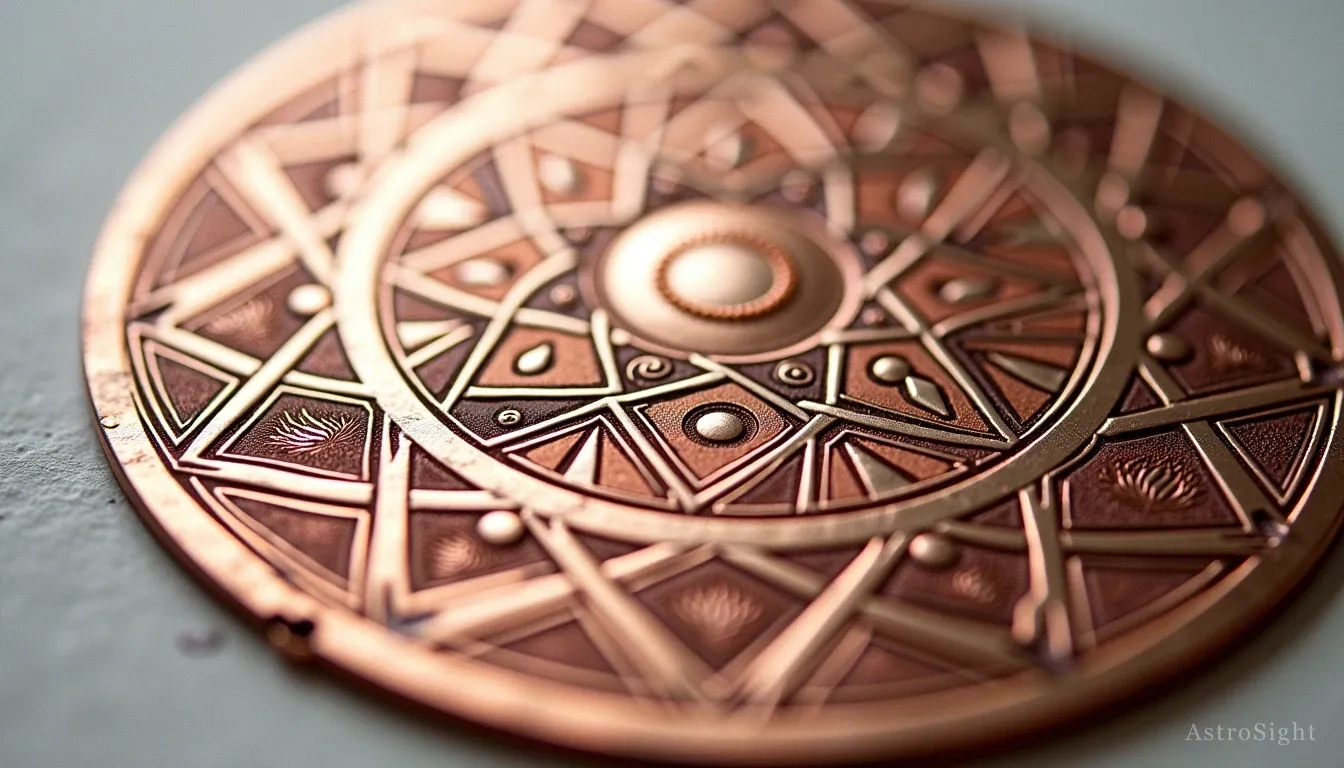
The central bindu (point) of the Akarshan Yantra represents individual consciousness, while surrounding geometric patterns create pathways for cosmic energy flow. The interlocking triangles symbolize the union of Shiva (masculine) and Shakti (feminine) principles—essential for understanding attraction as a dance of complementary energies rather than mere pursuit.
The Planetary Foundation: Venus and Moon
According to Brihat Parashara Hora Shastra, Venus (Shukra) governs love, beauty, artistic expression, and the capacity to attract and be attracted. The Moon (Chandra) rules emotions, nurturing instincts, and the receptive aspects of relationship. The Akarshan Yantra's geometric design creates resonance with both these planetary energies, addressing attraction from complementary angles—Venus for magnetic charm and Moon for emotional depth.
The outer lotus petals of the yantra act as receivers, capturing beneficial vibrations associated with these planets. When properly energized through prana pratishtha (the life-giving ceremony), the yantra becomes a living spiritual instrument rather than mere decorative geometry.
It's important to understand that the yantra's effectiveness depends entirely on proper consecration, correct placement, and consistent worship. A yantra purchased and placed without appropriate rituals remains dormant—the Mantra Mahodadhi is clear that spiritual instruments require activation through prescribed methods.
Who Benefits Most from the Akarshan Yantra?
While the Akarshan Yantra can benefit anyone seeking to enhance attractive qualities, certain individuals experience particularly meaningful results based on their astrological configurations and life circumstances. In my years of practice, I've observed that those with specific Venus afflictions or relationship patterns in their birth charts often find this yantra especially supportive.
Astrological Indicators for Akarshan Yantra
From a Jyotish perspective, the following birth chart configurations suggest particular benefit from this yantra:
- Venus debilitated in Virgo — Creates challenges in expressing and receiving love naturally
- Venus combust (within 8° of Sun) — Overshadows Venusian qualities with ego concerns
- Venus afflicted by Saturn or Rahu — Creates delays, obstacles, or unconventional patterns in relationships
- Weak 7th house or 7th lord — Partnership house afflictions benefit from Venusian support
- Current Venus Mahadasha or Antardasha — Planetary periods amplify corresponding yantra effects
You can explore your Venus placement using our free birth chart calculator to understand your specific planetary configuration.
Life Circumstances Indicating Benefit
Beyond astrological indicators, certain life situations align well with Akarshan Yantra practice:
- Singles sincerely seeking life partners who have struggled despite genuine efforts
- Married couples experiencing emotional distance seeking to rekindle intimacy
- Those in long-distance relationships needing to strengthen emotional bonds
- Business professionals seeking to enhance their ability to attract beneficial partnerships
- Individuals recovering from relationship trauma who wish to open themselves to new connections
Ethical Boundaries in Practice
Classical Tantric ethics are clear on this point: the Akarshan Yantra should never be used with manipulative intentions. Attempting to attract a specific person against their will violates cosmic law and creates negative karmic consequences. The Kularnava Tantra warns that misuse of spiritual tools for selfish manipulation rebounds on the practitioner. This yantra works best when used to enhance your natural magnetism and create receptivity to compatible souls—not to override another's free choice.
How to Properly Consecrate the Akarshan Yantra
The installation process (sthapana) for the Akarshan Yantra requires careful attention to timing, direction, and ritual purity. The Yantra Chintamani emphasizes that an improperly installed yantra delivers minimal results, while a correctly energized yantra can become a powerful spiritual support. In my practice, I've seen the difference proper consecration makes—it transforms the yantra from decorative object to living instrument.
Selecting the Auspicious Time (Muhurta)
Timing is foundational in Vedic practice. The Muhurta Chintamani provides detailed guidance on selecting auspicious moments for yantra installation:
- Shukla Paksha (waxing moon) — The growing moon supports new beginnings and increasing energy
- Friday (Shukravar) — Venus's day naturally supports Venus-associated yantras
- Shukra Hora — Venus planetary hour provides additional potency; calculate based on local sunrise
- Venus-ruled Nakshatras — Bharani, Purva Phalguni, or Purva Ashadha enhance Venus connection
- Avoid Rahu Kaal and Yamaganda — These inauspicious periods should be avoided for all spiritual installations
The Prana Pratishtha Ceremony
Prana pratishtha literally means "establishing life force." This ceremony transforms the yantra from geometric pattern into spiritual instrument. Here is the traditional method I guide my clients through:
Preparation: Select your bedroom, puja room, or a clean, quiet space. Bathe and wear clean clothes (white or light colors are traditional). Clean the area thoroughly, ideally with water containing a few drops of Gangajal. Place a clean red or pink cloth on an elevated surface.
Yantra Purification: Immerse the yantra in a mixture of raw milk, Gangajal, and rose water for approximately 30 minutes. This removes any negative impressions from manufacturing and handling. Gently clean with a soft cloth and allow to dry naturally—never use heat.
Installation Ritual: Light a ghee lamp and rose or sandalwood incense. Offer fresh flowers—red roses are particularly appropriate for attraction purposes. Apply a small tilak of kumkum or sandalwood paste to the central bindu. With focused intention, chant the Akarshan Beej Mantra 108 times while gazing softly at the yantra's center.
The Mantra Mahodadhi describes this moment as when the yantra "awakens"—when your concentrated intention and the mantra's vibration together infuse the geometric form with living spiritual energy.
Understand Your Venus Placement
Your birth chart reveals your unique Venus configuration and relationship patterns. Get personalized insights into your attraction potential and timing with a comprehensive chart analysis.
Get Your Career ReportEssential Mantras for Akarshan Yantra Practice
The vibrational power of mantras activates and amplifies the yantra's inherent energy. The Mantra Mahodadhi, one of the most authoritative texts on mantra science, explains that mantras are not merely words but precise sound formulas that create specific effects in consciousness and the subtle energy field.
Primary Akarshan Mantra
The foundational mantra for this practice is:
"Om Hreem Akarshaya Namaha"
This mantra should be chanted 108 times daily using a Sphatik (crystal) or Rudraksha mala. The seed syllable Hreem carries the combined energy of solar vitality and lunar receptivity, creating a balanced attractive force. "Akarshaya" invokes the principle of drawing toward, while "Namaha" indicates humble surrender to divine will.
Venus Beej Mantra for Planetary Support
For those with Venus afflictions in their birth chart, the Shukra Beej Mantra provides planetary support:
"Om Draam Dreem Draum Sah Shukraya Namaha"
This planetary mantra, prescribed in classical Jyotish texts, strengthens Venus's positive expressions—enhancing beauty, charm, artistic sensibility, and relationship harmony. For intensive remedy, traditional practice prescribes 16,000 repetitions over 40 days. For regular maintenance alongside yantra worship, 108 daily repetitions suffice.
Guidelines for Effective Mantra Practice
From my experience guiding practitioners, these principles significantly enhance mantra effectiveness:
- Consistency over intensity — Daily practice of 108 repetitions builds cumulative energy more effectively than sporadic intensive sessions
- Sankalpa (intention) — Before chanting, clearly state your intention without naming specific individuals; focus on qualities you wish to embody and attract
- Proper pronunciation — Sanskrit mantras carry power through precise sound; learn from a qualified teacher or authentic recording
- Sattvic lifestyle support — Traditional texts recommend avoiding tamasic foods (onion, garlic, meat) during intensive practice periods
- Fixed practice time — Morning (Brahma Muhurta) or evening twilight are traditionally considered most potent
Vastu-Compliant Placement for the Akarshan Yantra
Yantra placement follows precise Vastu principles that optimize energy flow and maximize effectiveness. The Vastu Shastra texts describe how different directions carry different energetic qualities, and proper placement aligns the yantra with supportive cosmic forces.
Optimal Placement Locations
- Bedroom (most recommended for attraction purposes) — Place on the east wall at a height visible from your sleeping position. The bedroom placement influences your aura during rest, when the subconscious is most receptive
- Puja room — If you maintain a dedicated worship space, install alongside other yantras. Position according to planetary associations—Venus-related yantras traditionally placed in the southeast
- Northeast corner of living space — Suitable for general attraction benefits affecting all household members; particularly appropriate for those using the yantra for business or social purposes
Placement Guidelines
Height: Position at eye level when seated for worship (approximately 3.5 to 4 feet from floor). This allows comfortable visual focus during meditation and mantra practice.
Direction: The yantra should face west, so the worshiper faces east—the direction associated with new beginnings and spiritual illumination.
Environment: Ensure natural or lamp light reaches the yantra during worship hours. Keep the surrounding area clean, free from clutter, shoes, and items considered impure in Vedic tradition.
Placement Errors to Avoid
Certain placements can neutralize benefits or create obstacles:
- Avoid south-facing placement—this invites Mars energy, potentially creating conflict rather than attraction
- Never place on a wall shared with bathroom facilities
- Avoid placement under heavy ceiling beams, which create oppressive energy
- Keep away from electronic devices when possible—some practitioners believe electromagnetic fields interfere with subtle yantra frequencies
- Never place directly on the floor—yantras require elevation as a sign of respect
Daily Worship Practice and Maintenance
Once installed, the Akarshan Yantra requires consistent daily attention to maintain its energetic potency. The relationship between practitioner and yantra is reciprocal—your regular worship feeds the yantra's energy, and the yantra supports your intentions.
Daily Practice Structure
A sustainable daily practice need not be elaborate. The following structure takes approximately 15-20 minutes:
- Light incense (rose or sandalwood preferred) and a small lamp if available
- Sit comfortably facing the yantra at eye level
- Take a few deep breaths to center your awareness
- State your sankalpa (intention) clearly in your mind
- Chant the Akarshan Mantra 108 times using your mala, gazing softly at the yantra's center
- Sit quietly for a few minutes after completing the chanting, allowing the vibration to settle
Weekly and Monthly Observances
Friday observances: Venus's day deserves special attention. Offer fresh flowers (red roses ideal), perform a slightly extended worship, and consider observing a simple fast or eating sattvic food only.
Monthly renewal: During each Shukla Paksha (waxing moon), replace the cloth beneath the yantra and perform a brief re-energization with the prana pratishtha mantra.
Physical maintenance: Keep the yantra clean and dust-free. Wipe gently with a soft dry cloth. If deeper cleaning is needed, use the same purification method as initial installation (milk, Gangajal, rose water mixture).
Understanding Realistic Expectations and Timelines
One of the most important aspects of yantra practice is maintaining realistic expectations. In my consultation work, I always emphasize that spiritual remedies operate according to principles quite different from material interventions.
How Yantra Effects Manifest
Classical texts describe mantra and yantra effects as working through karma modification rather than magical intervention. The Yoga Vasistha explains that spiritual practices create new karmic impressions (samskaras) that gradually shift the pattern of what we attract and experience. This is not instant transformation but progressive realignment.
Traditional practice prescribes a minimum of 40 days (mandala) for mantra anushthana to take root. This period allows the vibrational pattern to establish itself in your subtle body. However, external results depend on numerous factors:
- Your birth chart configuration and current planetary periods
- The intensity and consistency of your practice
- Pre-existing karmic patterns requiring resolution
- Your own receptivity and willingness to act on opportunities
- Divine timing that may differ from personal preference
Signs of Progress
Rather than fixating on external outcomes, observe internal shifts that indicate the practice is working:
- Increased self-confidence and comfort in social situations
- Greater clarity about what you truly seek in relationships
- Release of old emotional patterns or relationship wounds
- Dreams related to love, connection, or Venus symbolism
- Spontaneous improvements in self-care and personal presentation
- Increased appreciation for beauty, art, and harmonious environments
These internal shifts are actually the primary work—external circumstances tend to reorganize naturally once internal patterns change. The yantra supports both dimensions, but wise practitioners focus on inner transformation rather than anxiously awaiting specific outcomes.
When Results Seem Delayed
If you've practiced consistently for several months without noticeable results, consider these factors:
- Consult a qualified Jyotish practitioner to examine your birth chart for major obstacles requiring additional remedies
- Evaluate your practice quality—are you maintaining consistency, proper pronunciation, and sincere intention?
- Consider psychological factors—past trauma or deep-seated fears about intimacy may require therapeutic support alongside spiritual practice
- Reflect on your expectations—are you open to divine timing, or attached to a specific timeline?
You can check your current planetary periods using our Dasha calculator to understand the astrological context of your practice.
Integrating Akarshan Yantra with Other Vedic Remedies
The Akarshan Yantra can be effectively combined with other Vedic remedies for enhanced results. Understanding how different remedies complement each other allows for a comprehensive approach to relationship and attraction concerns.
Complementary Practices
Gemstone support: If your birth chart shows significant Venus affliction, wearing a white sapphire (Venus substitute) or diamond (if appropriate and affordable) while practicing yantra worship creates synergistic Venus enhancement. Always consult a qualified astrologer before wearing planetary gemstones, as incorrect gems can create problems.
Friday fasting: Observing a simple fast on Fridays—eating only fruits, milk, and sattvic foods—pleases Venus and supports yantra effectiveness. This practice also cultivates the discipline that supports consistent spiritual work.
Venus-related charity: Donating white items (rice, white cloth, white flowers, sugar) on Fridays creates positive Venus karma. Classical texts recommend giving to women, artists, or those in need with a pure heart.
Annual Venus puja: A formally conducted Shukra puja, especially during Venus-related planetary periods, amplifies ongoing yantra practice. This can be performed by a qualified priest at a temple or through online services.
When Additional Remedies May Be Needed
The Akarshan Yantra addresses attraction and Venus-related concerns effectively in most cases. However, certain conditions may require additional intervention:
- Mangal Dosha — Mars affliction creating marriage obstacles may require specific Mangal remedies alongside Venus enhancement. Use our Mangal Dosha calculator to check your chart.
- Kaal Sarpa Dosha — This Rahu-Ketu axis affliction affects all life areas and typically requires dedicated remedy
- 7th house afflictions — Severe malefic influence on the partnership house may need targeted remedy beyond general Venus support
- Saturn-Venus conjunction or opposition — Creates specific delays and obstacles requiring both planetary remedies
I always recommend consulting with a qualified Jyotish practitioner who can analyze your complete birth chart and prescribe a personalized remedy protocol. General remedies help, but chart-specific guidance achieves better results.
Honoring the Sacred: Ethical Practice with the Akarshan Yantra
The Akarshan Yantra represents one of the most accessible and traditionally sanctioned Vedic tools for enhancing personal magnetism and attracting harmonious relationships. Yet its effectiveness depends not only on correct technique but on the purity of intention with which it is approached.
Classical Tantric texts consistently emphasize that spiritual power must be wielded with ethical awareness. The Kularnava Tantra teaches that practices undertaken for selfish manipulation ultimately harm the practitioner. True attraction, from the Vedic perspective, arises from authentic self-development—becoming genuinely magnetic through cultivating positive qualities rather than attempting to manipulate others.
The yantra works best when used to remove obstacles, enhance your natural gifts, and create openness to divine timing in relationships. It supports you in becoming the person who naturally attracts compatible partners—not in overriding others' free will or rushing cosmic timing.
Through proper installation, consistent worship, and sincere intention, the Akarshan Yantra can become a powerful ally in your journey toward love and connection. Remember that the yantra works in partnership with your own efforts—it creates favorable conditions, but you must cultivate genuine qualities of kindness, openness, and self-love.
May the divine energies of Venus bless your path toward harmonious relationships.
Om Shukraya Namaha.
Explore AstroSight Services
Personalized Report
Career Report Bundle
Your Navamsa and Dashamsha are covered in your Career Report — see your exact vocational path
- Personalized analysis based on YOUR exact birth chart
- Expert-prepared by Dr. Meenakshi Sharma
- Delivered as PDF within 24-48 hours
- Unlimited follow-up clarifications
By Dr. Meenakshi Sharma · Delivered in 24-48 hours

Dr. Meenakshi Sharma
PhD in Vedic Astrology, 20+ Years Experience
Dr. Meenakshi Sharma is a distinguished Vedic astrologer with a PhD in Vedic Astrology and over 20 years of professional experience in the ancient science of Jyotisha. Her extensive practice encompasses thousands of chart readings, predictive analyses, and remedial consultations, making her uniquely qualified to bridge traditional Vedic wisdom with contemporary applications. As a contributing writer for AstroSight, Dr. Sharma specializes in natal chart analysis, predictive astrology, and Vedic remedial measures, sharing her deep knowledge through insightful articles that make complex astrological concepts accessible to practitioners at all levels. Her approach combines rigorous academic training with ethical consultation standards, empowering clients through education and practical guidance while maintaining authentic adherence to classical Vedic principles.