Five Elements Vastu: Pancha Bhuta Harmony Guide
Every material in your home—walls, furniture, water, light, electronics—carries an elemental energy. Vastu Shastra is, at its core, the science of placing these elemental energies in the directions where they harmonise rather than conflict. The Pancha Bhuta (five great elements) framework is the fou
Every material in your home—walls, furniture, water, light, electronics—carries an elemental energy. Vastu Shastra is, at its core, the science of placing these elemental energies in the directions where they harmonise rather than conflict. The Pancha Bhuta (five great elements) framework is the foundation that makes this possible.
This guide draws on the Manasara (c. 500 CE), the Mayamatam (c. 9th century CE), and the Vastu Purusha Mandala grid to explain each of the five elements, their directional zones, their effects on health and prosperity, and practical ways to activate or correct them in any home.
What Are the Five Elements in Vastu Shastra?
The Vedas describe existence as arising from five primary elements—Pancha Bhuta—each with distinct qualities:
| Element | Sanskrit Name | Quality | Sense |
|---|---|---|---|
| Earth | Prithvi | Solid, stable, dense | Smell |
| Water | Apas / Jal | Fluid, purifying, reflective | Taste |
| Fire | Agni | Transformative, illuminating | Sight |
| Air | Vayu | Mobile, connecting, light | Touch |
| Space | Akasha | Vast, receptive, all-pervading | Sound |
Source: Taittiriya Upanishad; elaborated in Manasara, Chapter 5
Vastu Shastra assigns each element to a directional zone of the plot. The assignment is not arbitrary—it emerges from observational science and cosmological mapping accumulated over centuries. The sun's path (east to west), the earth's magnetic field (north-south), and the behaviour of wind and water across the Indian subcontinent all informed how classical Vastu architects mapped elemental energy to the eight directions.
Which Direction Does Each of the Five Elements Govern in Vastu?
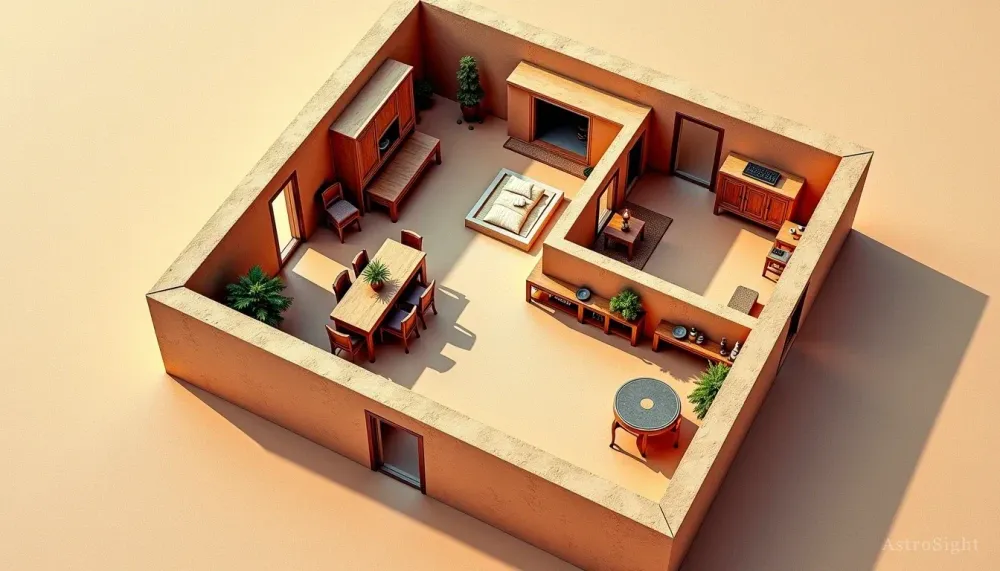
The Vastu Purusha Mandala organises a plot into a 9×9 grid of 81 squares, with 45 named energy points distributed across them. Eight of the nine zones formed by this grid (plus the center) correspond to the eight directions and their ruling elements:
| Direction | Zone Name | Element | Ruling Deity |
|---|---|---|---|
| North-East | Ishanya | Water (Jal) | Shiva / Ishana |
| East | Purva | — (transitional) | Indra |
| South-East | Agneya | Fire (Agni) | Agni |
| South | Yama | — (transitional) | Yama |
| South-West | Nairiti | Earth (Prithvi) | Nairiti |
| West | Paschima | — (transitional) | Varuna |
| North-West | Vayavya | Air (Vayu) | Vayu |
| North | Uttara | — (wealth, Kubera) | Kubera |
| Center | Brahmasthana | Space (Akasha) | Brahma |
The four cardinal directions (east, south, west, north) serve as transitional energy corridors connecting the element zones. The four corners hold the primary elemental energies; the center holds the all-pervading space element.
How Does the Earth Element Create Stability in a Home?
Earth (Prithvi) is the densest, heaviest, most stable of the five elements. In Vastu, it governs the south-west zone—the most powerful structural corner of any property. Granite has a density of approximately 2.7 g/cm³, compared to wood at around 0.5 g/cm³. This is why classical Vastu recommends granite flooring, marble countertops, or heavy stone elements in the south-west: the material weight physically reinforces the zone's earth energy.
Characteristics of a strong earth element zone:
- Master bedroom in the south-west, with the head pointing south or east during sleep
- Heavy, solid furniture (teak, rosewood, stone) in south-west rooms
- No large windows, glass walls, or openings on the south-west boundary
- No bathroom or toilet directly in the south-west corner
- Yellow, ochre, brown, or terracotta wall colours
Effects of weak earth element:
- Financial instability and difficulty retaining accumulated wealth
- Frequent transfers, job changes, or residence instability for the main earner
- Health issues for the eldest male member of the household (classical association)
- A sense of rootlessness or lack of direction
For homes with a south-west entrance—a significant earth-element challenge—see our detailed remedies guide at Vastu remedies for south-west entrance.
How Does the Water Element Attract Wealth and Clarity?
Water (Jal) governs the north-east—the zone of purification, spiritual clarity, and wealth generation. This corner combines the north's Kubera energy (material wealth) with the east's Prana Vaayu (life force) and the water element's natural quality of fluidity and flow.
Characteristics of a strong water element zone:
- North-east corner open, airy, and well-lit
- Indoor water fountain, aquarium, or bowl of clean water in the north-east
- Pooja room or prayer altar in the north-east
- Blue, white, silver, or sea-green colours on the north-east wall
- Fresh flowers or clean plants (tulsi, money plant) in this corner
Effects of weak water element:
- Blocked financial flow—money comes in but does not accumulate
- Mental fog, lack of clarity in decision-making
- Disruption to creative or spiritual practices
Vastu consultants commonly recommend a water feature in the north-east as one of the highest-impact, lowest-cost prosperity remedies. The moving water symbolises flowing abundance and keeps the zone activated even in small apartments. Fresh water in the north-east should be refreshed at least every 3 days; stagnant water reverses the activation. A fountain should ideally run for at least 20 minutes each morning during peak Prana Vaayu hours (6–9 AM). The container should be no more than 25% filled with decorative stones, leaving ample space for flowing water rather than static display.
For a full treatment of water feature placement, types, and placement rules, see our guide to Vastu water features and abundance.
How Does the Fire Element Affect Energy and Health?
Fire (Agni) governs the south-east—the zone of energy, transformation, digestion, and metabolism. Agni in Vedic tradition is the divine transformer: it converts food to energy, raw material to finished product, and inert space to inhabitable home.
Characteristics of a strong fire element zone:
- Kitchen located in the south-east, with the cook facing east
- Gas stove, oven, or electric cooking appliance in the south-east
- Red, orange, coral, or gold accent colours in the south-east zone
- Candles, diya lamps, or a salt lamp for energy activation
- Electronic equipment (servers, UPS, generators) in the south-east in commercial spaces
Effects of imbalanced fire element:
- Kitchen in the north-east creates a fire-water conflict: digestive and respiratory health issues for the household are the classical association
- Kitchen in the north creates an imbalance between Kubera's wealth zone and the heat of Agni
- Overactive fire zone (too many electronic devices, constantly lit lamps) can create irritability, arguments, and short temper
Fire element also governs willpower and discipline. Practitioners who work on creative or transformative projects often notice improved focus when their workspace aligns with the fire zone or faces east toward the rising sun.
How Does the Air Element Influence Relationships and Movement?
Air (Vayu) governs the north-west—the zone of movement, communication, guests, and social connections. The north-west is a mobile zone: energy that enters from the north-west cannot stay long before circulating further. This quality makes it ideal for rooms associated with transience and social activity.
Characteristics of a strong air element zone:
- Children's rooms, guest rooms, or a social sitting area in the north-west
- Light furniture, open shelving, good cross-ventilation
- Green, pale blue, or light grey wall colours
- Wind chimes hung in the north-west (traditionally recommended for activating Vayu)
- Garlic or fragrant herbs placed here to energise air circulation
Effects of weak air element:
- Heavy furniture or blocked ventilation in the north-west slows social connections
- Guest relationships feel strained; visitors don't return
- Children in north-west rooms show more movement, activity, and social energy (considered positive for young children)
- Business meetings, negotiations, and collaborative work benefit from north-west placement
The air element also governs vehicles: classically, garages, carports, and vehicle storage are recommended in the north-west or south-east, with north-west preferred for vehicles used for trade and travel.
How Does the Space Element Support Mental and Spiritual Wellbeing?
Space (Akasha) governs the Brahmasthana—the exact center of the plot and building. Unlike the four physical elements, space is the medium through which the other four elements interact. It is described in the Taittiriya Upanishad as the first-created element from which all others emerge.
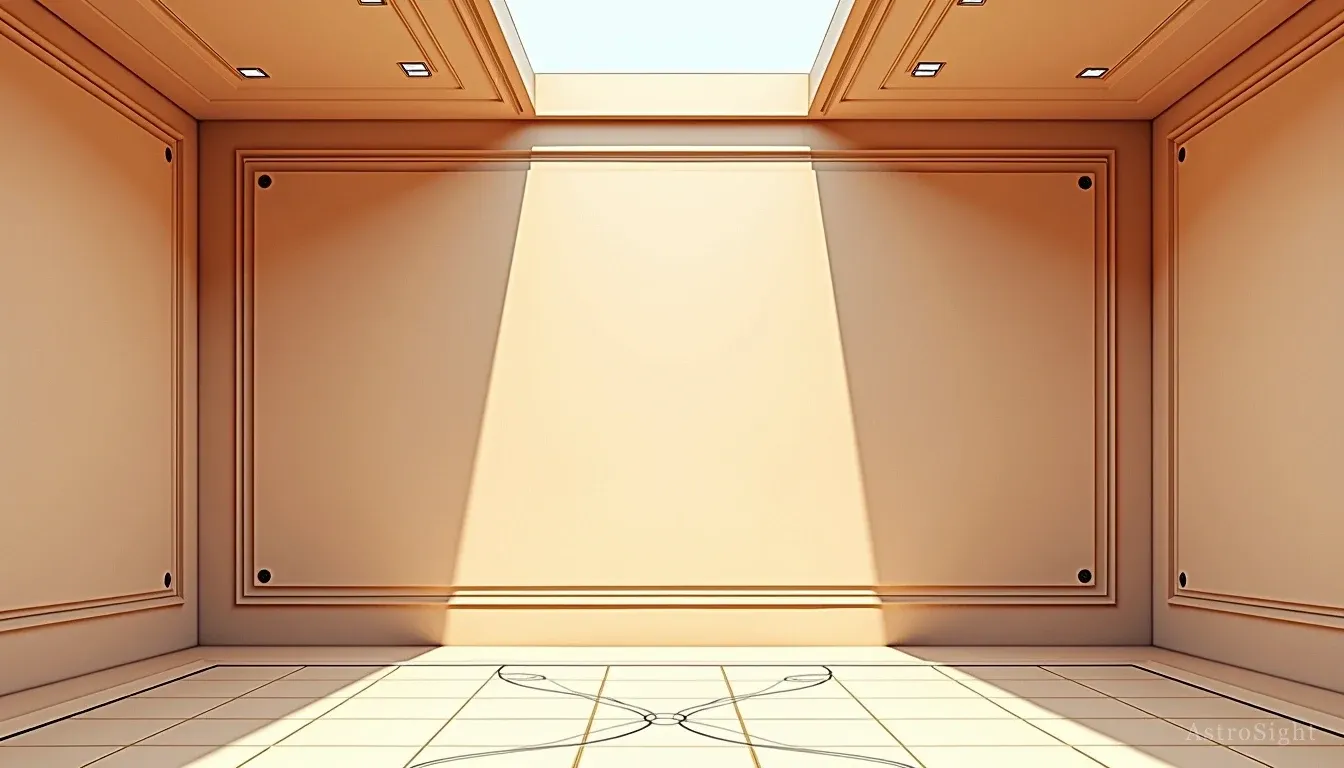
The Mayamatam specifies that the Brahmasthana must remain open and free of load-bearing pillars. In a 9×9 Vastu Purusha Mandala, the Brahmasthana covers the central 9 of the 81 squares—approximately 11% of the total floor plan. Classical Vastu architecture expressed this through central courtyards (chowk) that allowed sky, air, and light to reach the building's heart.
Modern applications for the Brahmasthana:
- Open floor plan in the center of the house—avoid placing pillars, walls, or heavy furniture in the geometric center
- A skylight or light well if the center must be covered
- No toilets, stairwells, or utility rooms in the exact center
- A Vastu Kalash, crystal, or Sri Yantra placed at the geometric center activates space element energy
- Violet, white, or sky-blue flooring or ceiling treatment in the central zone
Effects of blocked space element:
- A heavy pillar or wall in the Brahmasthana is associated with mental heaviness, restricted thinking, and suppressed creativity among the household's residents
- Central staircases are a common modern violation—circular staircases are preferred over straight-flight stairs if the center must carry a stairwell
What Colors and Materials Activate Each of the Five Vastu Elements?
Color is one of the fastest Vastu activations—it requires no structural change and can be applied to any wall, cushion, or accent piece:
| Element | Zone | Colors | Materials | Avoid |
|---|---|---|---|---|
| Earth | South-west | Yellow, ochre, brown, terracotta | Granite, marble, heavy wood | Glass walls, large windows |
| Water | North-east | Blue, white, silver, aquamarine | Crystal, flowing water, mirrors | Heavy stone, dark colours |
| Fire | South-east | Red, orange, coral, gold | Metal, glass (heat-safe), ceramics | Large water features |
| Air | North-west | Green, pale blue, light grey | Light wood, bamboo, linen | Heavy stone, blocked windows |
| Space | Center | Violet, white, lavender, sky blue | Crystal, light stone, open flooring | Load-bearing pillars, toilets |
How Do You Balance All Five Elements in One Space?
Balancing the Pancha Bhuta in a complete home involves five sequential steps:
Step 1: Map the directions. Find the true north of your plot using a compass (not a phone app, which reads magnetic north and may vary by up to 15° depending on location). Identify the eight directional zones.
Step 2: Audit each zone. Walk through each zone and note what is placed there. Mark conflicts: a water feature in the south-east (fire zone) creates a Jal-Agni conflict; a toilet in the north-east (water zone) pollutes the water element.
Step 3: Apply elemental colours. Even before moving furniture, painting each zone in its elemental colour activates the corresponding energy.
Step 4: Place materials. Move heavy objects to the south-west, water features to the north-east, fire-element appliances to the south-east, light furniture to the north-west, and remove obstructions from the center.
Step 5: Activate the Brahmasthana. Place a crystal or Yantra at the geometric center of the home and keep the space clear.
For east-facing houses, the elemental balancing begins with correctly aligning the main entrance to the Indra pada on the east wall—see our full guide to east facing house Vastu and wealth. For the impact of road-facing Vastu defects on elemental flow, see our guide to Veedhi Shoola Vastu dosh remedies.
How Is an East-Facing House Different from a North-Facing House?
The Pancha Bhuta framework also explains why each house orientation performs differently:
- East-facing: The east entrance aligns with Indra's zone (authority, Prana Vaayu) and receives maximum morning UV-B radiation, naturally energising both the fire element (east-of-center) and the water element (north-east corner near the entrance). This combination supports vitality and career growth.
- North-facing: The north entrance aligns with Kubera's zone (wealth, mercury). The north-east water element is directly behind and to the right of the entrance, making wealth energy the first thing encountered upon entering the home.
- South-facing: The south entrance aligns with Yama's zone (consequences, endings). Activating the fire element (south-east kitchen) is even more important in south-facing homes to counter the heavy earth and transitional energy at the front.
- West-facing: The west entrance aligns with Varuna's zone (water, cosmic law). The space element is accessed through the west, making west-facing homes potentially good for creative and spiritual work, but requiring careful fire-element activation.
Understanding the five elements gives you the full picture behind every Vastu recommendation—whether the suggestion is about room placement, colours, materials, or remedies, it traces back to elemental harmony in the Pancha Bhuta framework.
Align Your Space with Your Career Path
Vastu optimizes your environment. Your birth chart reveals your career potential. Get both aligned with a personalized analysis and actionable remedies.
Get Your Career ReportPersonalized Report
Wealth & Lifestyle Report
Vastu amplifies what your birth chart already shows — see your wealth yogas + home direction guide
- Personalized analysis based on YOUR exact birth chart
- Expert-prepared by Dr. Meenakshi Sharma
- Delivered as PDF within 24-48 hours
- Unlimited follow-up clarifications
By Dr. Meenakshi Sharma · Delivered in 24-48 hours

Dr. Meenakshi Sharma
PhD in Vedic Astrology, 20+ Years Experience
Dr. Meenakshi Sharma is a distinguished Vedic astrologer with a PhD in Vedic Astrology and over 20 years of professional experience in the ancient science of Jyotisha. Her extensive practice encompasses thousands of chart readings, predictive analyses, and remedial consultations, making her uniquely qualified to bridge traditional Vedic wisdom with contemporary applications. As a contributing writer for AstroSight, Dr. Sharma specializes in natal chart analysis, predictive astrology, and Vedic remedial measures, sharing her deep knowledge through insightful articles that make complex astrological concepts accessible to practitioners at all levels. Her approach combines rigorous academic training with ethical consultation standards, empowering clients through education and practical guidance while maintaining authentic adherence to classical Vedic principles.